
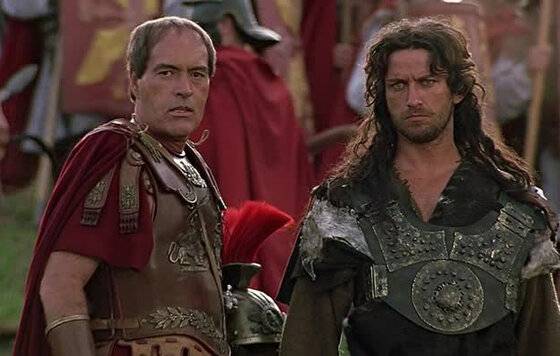
Before we got Gerard Butler as the half-naked King Leonidus, we got him as the (still half-naked) Attilla the Hun. Back in 2001, while everyone still had Rome fever from Gladiator, USA Network released Attila, which imagines a historical war as rivalry between two larger-than-life characters. The miniseries holds up surprisingly well 25 years later.
Attila’s special effects aren’t quite as good as HBO’s Rome, but they’re more consistent. Rome‘s production value felt a little random; some episodes had lavishly large action scenes, while others seemed to be on a shoestring budget. I had this suspicion that every time the studio ran out money and there was supposed to be a big battle scene, they would show boobs instead to distract the audience so they wouldn’t be annoyed about a hyped-up battle jarringly happening off-screen. Attila used CGI strategically and only when necessary, like on large backdrops and cityscapes, so it aged well and doesn’t look corny in 2026. The only failing I saw is that some of the costumes looked a little cheap, particularly the legionary uniforms, but overall it was okay. Attila is also much less violent than Rome and there’s no nudity, which was probably for the best because that stuff can be a little gratuitous.
The dialogue was sometimes a bit wooden, especially with Attila, he was unfortunately a bit of a weak link in the acting department, but he didn’t have to do very much of it. Most of the time he could just look cool, which Butler is very good at. Though I do have to give him credit, his acting improved tremendously over the next 20 years. Too bad I’ve only seen him in action slop.
Powers Booth played Flavius Aetius, the Machiavellian Roman general holding the decaying husk of the empire together by his fingernails. During a brief alliance of convenience against Theodoric of the Visigoths, Attila and Flavius develop something that might almost be considered a friendship, or at least respect. Flavius immediately recognizes Attila as the future leader of the Huns, even though he’s not even in line for the crown of his own tribe yet, and Attila understands that Flavius is a cunning and competent opponent who would cause problems for an invasion of the western lands. Flavius’s “pretexts” are such an interesting and boiled-down description of western mentality toward war, and it’s fascinating for a show released in early 2001 to explicitly depict false flag attacks to deceive people into starting a war.
Early on the show establishes some tropes that are followed through to the end. Attila, as a straight-forward barbarian, disapproves of Flavius’s extensive use of deception and trickery, but can’t help but notice how well it works. In particular, Flavius teaches him the western concept of a “pretext.” You can’t just attack someone and try to take his stuff, that’s barbarian thinking. You have to have a pretext that paints him as the aggressor and you as the victim, then you are justified in attacking him and taking his stuff. Attila dislikes the dishonest hypocrisy of Flavius’s thinking, but comes to appreciate it when he’s older and needs a pretext to attack Rome and take their stuff.
The village witch Galen is a sad character. She’s been in love with the unattainable Attila since childhood, helps him, gives her life to save him and, apparently, even helps him from beyond the grave. Attila himself as a tragic side. Even at the head of a powerful empire, he’s still an impulsive and sentimental barbarian, and isn’t pragmatic and careful like he should be. When a new slave girl who resembles his dead first wife appears in front of him, he’s just very pleased to have a replacement copy and doesn’t think about why or how she got there. As one of the most powerful people in the world, it doesn’t occur to him that there are other people powerful and clever enough to put a fanatical assassin in his own bedroom. It’s a bit funny and sad because, even after they’re clearly enemies, Attila still treats Flavius honorably, while Flavius casually has him assassinated.
But Flavius is sad too. He does genuinely love Rome, and is willing to make enormous personal sacrifices for it, even giving up his own adopted daughter to appease Theodoric, who has his own bitter past with him. Speaking of Theodoric, if you watch this and find a resemblance between him and Theoden in Lord of the Rings, it’s not coincidental. Theoden’s death and his son’s charge that routes the orcs was based on real history, apparently.
Flavius’s own web of deceptions eventually blows up in his face and causes his death. His end might seem more cruel than Attila’s, because at least there are more Huns, but Flavius is indeed the last Roman. The other court officials are cowardly imbeciles, the emperor is a mental retard and his mother a jealous harpie. They kill Flavius because he’s a jerk, and he is one, but they’re too dull and small-minded to care what his death will mean for the empire. He loves Rome, but is surrounded by people don’t deserve it.
There was a particular fascination with Rome in American culture in the late 1990s and early 2000s. Maybe it was because America seemed like it ruled the world, but was corrupt and rotten on the inside, weak enough to fall apart if the Huns were to ride out from the steppes. Yet I am particularly intrigued by Flavius, who is depicted as ruthless and very much “the ends justify the means,” but his actions were all brutally logical and founded in knowledge. He knew Roman politics inside and out, and also deeply understood the Huns from his youth as a political hostage living among them. So Flavius knew what he could get away with, and what he couldn’t. The other Romans were just as violent as him, but without his brains. The emperor and the others were violent, but in a very stupid way and with no concern for the consequences.
Maybe there are some people in Washington who are very sensible and try to keep things grounded in reality, while the rest are mentally stunted pigs who clap when schools are bombed. I don’t think the emperor in Atilla is worse than Trump, to be honest.
Watch Attila on Amazon Prime
As an Amazon Associate I earn from qualifying purchases made through product links and web banners. Click here to navigate to the Amazon storefront.

Ian Kummer
I now have a new YouTube channel that I will use to upload videos from my travels around Russia. Expect new content there soon. Please give me a follow here.
Also feel free to connect with me on Quora (I sometimes share unique articles there).

To add a historical note, the main problem with the Western Roman empire was an unwillingness or inability to tax the wealthy landowners. This meant no army to raise an army from within the empire, and was how they got into the situation of playing off barbarian chiefs against each other. Ultimately the Germanic chiefs realized that the imperial court in Ravenna served no purpose.Western Roman Emperors that weren’t figureheads quickly got assassinated. The Eastern Roman Empire both was able to tax the wealthy, and let competent emperors rule, and survived the fifth century and wound up running some western provinces directly.I had Trump pegged less as Valentinian III (Valentinian III – Wikipedia (https://en.wikipedia.org/wiki/Valentinian_III)) and more as the much later Eastern Roman Emperor Andronikos I Komnenos (Andronikos I Komnenos – Wikipedia (https://en.wikipedia.org/wiki/Andronikos_I_Komnenos)). Though the latter historical figure seems to have served as a model for Miraz, the villain in C.S. Lewis’ “Prince Caspian”, so maybe not. But the point is that entities seem to enter a point of no return or senility in their life cycle, after which no reform is possible. It seems the collective West reached that point around 2004.
I enjoyed reading your recapitulation.And very much a propos.
Webej, thanks, and glad to have you as a reader!