
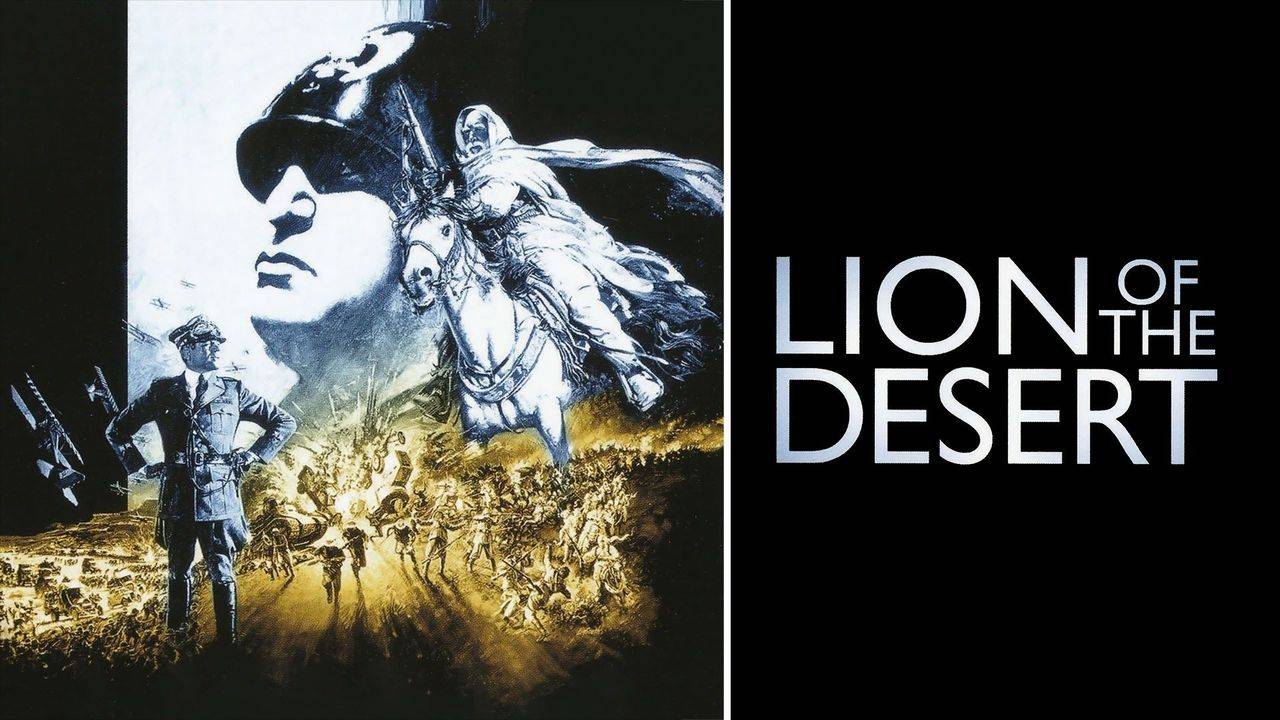
Here’s a movie you haven’t seen, but should. The 1981 movie Lion of the Desert, about the freedom fighter Omar Mukhtar and his 20 year war and martyrdom against the Italian imperialists in Libya.
I only watched this movie because I happened to see some clips of the action scenes on Facebook. They were interesting and thoughtful enough to make me want to watch the whole movie, and I was not disappointed. On the contrary, Lion of the Desert was much better than I ever could have expected. I never would have watched this movie if not for Facebook, which makes this the first and probably only good thing Mark Zuckerberg has ever done for me, so I owe him my thanks for that at least.
This movie is immediately of interest because it is a Hollywood propaganda movie, but made on the behalf of the forces of good. Lion of the Desert is an American movie funded by the Libyan government to celebrate their national hero Omar Mukhtar. The director was Moustapha al Akkad, a first generation Syrian immigrant to the USA. I had never heard of him before, but his Arab background and American film education came together for a great film.
Oliver Reed plays the villain Gen. Rodolfo Graziani, and he’s great at it. I consider Reed the greatest villain in American film history, and that’s because he has the sneering arrogance of a villain, but justifies all of his evil acts to a consistent internal logic, and doesn’t consider himself a villain. A proper bad guy considers himself the main character and the good guy of the story, and that’s a principle too often forgotten in movies.
My first impression even during the movie was how its messages conflict with typical western war propaganda. Omar Mukhtar is an elderly teacher who is reluctantly forced to war by the senseless cruelty of the Italian occupiers. That’s a typical trope I guess, but he is not driven by revenge, and the movie goes to great lengths to show this.
There is one particular scene when Mukhtar’s men catch several Italian soldiers and start shooting them, and he indignantly stops them, saying that the Italians “are not our teachers,” which I found to one of the most profound statements ever made in a movie. The cruelty of the enemy does not justify your own cruelty, and that’s a lesson sadly lacking in western cinema. Movies like Red Dawn or Braveheart show the “good guys” inflicting maximum cruelty, and expects the audience to delight in the suffering of random enemy soldiers. This isn’t right and is an incredibly primitive attitude.
Propaganda is of course a fictional and embellished portrayal of history, but it is an honest from the heart portrayal of cultural norms. And frankly, people imitate what they’re told in fiction. If fiction consistently tells people to be kind even to the enemy, they will probably at least try to be. But if fiction tells them to be cruel and it is good to be cruel, then they almost certainly will.
I recall in Svetlana Alexievich’s uncensored post-Soviet edition of The Unwomanly Face of War, she recounted a heated argument with the (male) censor. She wanted to show the true face of the war, which outraged the guy, and he told her that stories should show people as what they should be, not what they are. That exchange stuck with me even many years later. Svetlana probably included it in her book because she thought it makes her look smart and educated, and the censor as a brainwashed, stupid Soviet bureaucrat, but I think he was right. When people find themselves in an extreme situation, like a war, stories is all we have. So stories should, must, show us the right thing to do in such a situation.
Why do Arabs and Russians understand this but not us westerners?
My second impression concerned Oliver Reed’s character as the Italian general Rodolfo Graziani. I can still remember having this exact thought, “Wow, this guy is really evil, was he actually that bad in real life?” So I picked up my phone and looked up his Wikipedia page. No, he was not that bad. He was much worse. Graziani was one of the most profoundly evil and cruel people in the 20th Century, comparable to Hitler. And unlike Hitler, Graziani was never properly punished. He spent just four months in jail before being pardoned and returned to politics. When he died in 1955 (of natural causes), Graziani received a lavish public funeral with more than 100,000 attendees performing fascist salutes. In 2012, $160,000 USD in taxpayer funds was spent to erect and spectacular monument over his grave.
Yet the movie portrays Graziani as a recognizable human being, and left out how his horrific atrocities in the African colonies made him a beloved hero of the Italian people. And that’s simply because the Lion of the Desert was not meant to foment hatred of Italians.
Not only are Italians not portrayed as collectively bad, despite the continuous atrocities from the beginning to end of the movie, several of them are even good. The Italian officer chosen to lead the peace negotiations with the Libyan rebels is portrayed as good. At the same time, negotiations are portrayed as farce to stall for time. Unfortunately, this is realistic. Negotiations in our lifetime were always a lie to trick, deceive and stall the enemy, and western media has the nerve to boast about it afterward. I don’t even know why anyone believes western governments anymore when they say they want peace. But this officer, despite his deliberately-pointless assignment, has good intentions. He does genuinely admire Mukhtar and wants a happy ending for him. So he puts his personal credibility at risk to make Mukhtar offers of safety and riches in exchange for ending the uprising.
I find this a useful episode in the story because it demonstrates the psychological “out of the pot, into the fire” thinking trap that can happen to people when they try to push back against colonialism. The officer seems to dislike the injustice his country is inflicting on the Libyan people, and wants to help Mukhtar, but is only capable of thinking in terms of personal wealth, so his efforts are futile. Mukhtar as a true martyr rejects all of his offers, and wouldn’t even think of accepting them.
And it is this character who says one of my favorite lines in the movie (there are a lot of good lines in this movie). When he is imploring Mukhtar to accept a peace deal, the officer suggests how Italians and Arabs can work together, “with our civilization and your culture.” Even the most empathetic and sympathetic European falls into the same thinking pattern as the fascist. Europe represents true “civilization” and everyone else are primitive barbarians with nothing to offer even themselves except “culture,” which is intentionally distinguished from “civilization.” Our civilization and your culture. I don’t think a completely western person with a western upbringing would have thought of including this line in the movie.
When Mukhtar is eventually captured and brought before a sham trial, he is given an Italian officer to defend him. Of course this was meant to be a pretense and nothing more, but the officer takes his role seriously. He argues that Mukhtar cannot be tried as a traitor to the Italian empire because he never pledged allegiance to the Italian empire in the first place. Of course this throws the whole kangaroo court into an uproar and the judge chastises him for behaving inappropriately.
I liked the trial scene because it brings all the morals and messages of the movie together. Arabs were happy in their sleepy semi-nomad lifestyle, as “uncivilized” as it might have been. They didn’t ask for, need, or want European “civilization.” If Europeans wanted Arabs’ resources while providing something good in return, they could have offered something tribesmen would find useful, like maternity clinics and antibiotics. But see, colonialism was never about helping people or even “bringing civilization.” It was always about stealing resources and treating the locals as vermin only fit to be enslaved or exterminated if they got in the way. All the nonsense about “civilization” was invented retroactively as an excuse.
This might surprise some readers, but I am not actually anti-colonialism. I don’t sit here and pretend that European colonialism did nothing, and did not bring a lot of good which vastly increased life expectancies and standards of living around the world. Succinctly, I would describe European colonialism as bad for two reasons. The first, which I mentioned, is that colonial rule was inflicted without the consent of the colonialized. As I get older, the more I understand that everyone around the world has about the same level of “happiness.” A medieval peasant, outside of extreme circumstances like war or famine, was just as happy as a 21st century urbanite. Everybody has a certain standard and expectations of life and therefore reaches more or less the same level of contentment. Improvements in the standard of living like water pumps or electricity will certainly make a person more happy if those things come on their own, but not if they’re forced through the barrel of a gun. No normal person would trade lightbulbs for punitive executions in his village, and that should be obvious.
And the second reason is the Europeans’ own prejudices. Clearly, they saw the rest of humanity as disgusting vermin so it didn’t matter how they treated them. And I still see this today on my blog and social media. Europeans still think everyone is disgusting vermin and it doesn’t matter how many of them are destroyed by bombs and sieges. You don’t weep for the deaths of Arabs and Mongoloid Russians anymore than you would weep for cockroaches.
So while the message of the movie was positive, and not hateful, it is difficult for me to think about it and not hate Europeans. Especially in the context of the modern day, after Europeans re-invaded and ruined Libya just out of spite. How contemptible and worthless does a person have to be to still bear a grudge against their former colonies half a century later?
Around 5 years ago, after the most recent round of sanctions against Belarus, I can remember a certain Facebook conversation with a British leftist homosexual. I asked him is it not in really bad taste to sanction a country that the West recently, within living memory, invaded and killed 1/4 of the population. He was confused, and babbled something about WWII being a long time ago so it doesn’t matter, like he literally didn’t understand my point. As a typical British person, Jews are the only victims of WWII you’re supposed to care about. From the British perspective, the only sad thing about 30 million Russians dying is that they didn’t all die.
There was a very similar conversation between Lukashenko and a British journalist around the same time. Lukashenko emphatically reminded him that the British and Russians were allies against a common enemy not so long ago, and that’s a very special thing they should be proud of. The British person just stared at him blankly and said he didn’t understand, WWII was a long time ago and doesn’t matter. Lukashenko looked very upset for a moment, like he was seriously considering throwing the guy out the window. Honestly, I think he should have. Nothing of value would have been lost, and it would have been very funny.
Yet if you ask those same British guys what they think of the Holocaust, they say every white person should get on his knees and beg the Jews for forgiveness for the next ten million billion trillion years. But WWII was a long time ago and doesn’t matter, like they were completely unrelated events. That’s the power of propaganda for you. Ironically, when Israel recently bulldozed the graves of British soldiers who had died in WWII, they said the same thing.
Back to the trial scene. The main intent of this movie for western audiences, I think, was to make us feel ashamed. When Arabs captured an Italian officer, they treated him with the respect his rank deserved. But when Italians captured an Arab leader, they treated him worse than a dog. Unfortunately, that’s no different than how Gaddafi, Saddam Hussein and Maduro were treated. When you capture an enemy leader, you’re supposed to treat him as a distinguished guest, because his treatment reflect on you. When Europeans treat an enemy like a dog, that just shows Europeans are the ones who are dogs.
This movie also made me hate the US more than I already did. If nothing else, we’re just too damn gullible. What did Libya do to the Americans? Were they some existential enemy? No, Europeans just said Libya was bad, got on their knees and begged and praised America, and that was enough. Americans’ problem is that we are arrogant and really gullible. If you suck up hard enough to Americans, you can get us to participate in any atrocity no matter how irrelevant it is to us. I guess Europeans picked up on this American trait in the 1940s if not earlier, and have been on their knees ever since.
Lion of the Desert is a great movie which everyone should see, and it can be watched online for free.
Ian Kummer
I now have a new YouTube channel that I will use to upload videos from my travels around Russia. Expect new content there soon. Please give me a follow here.
Also feel free to connect with me on Quora (I sometimes share unique articles there).