
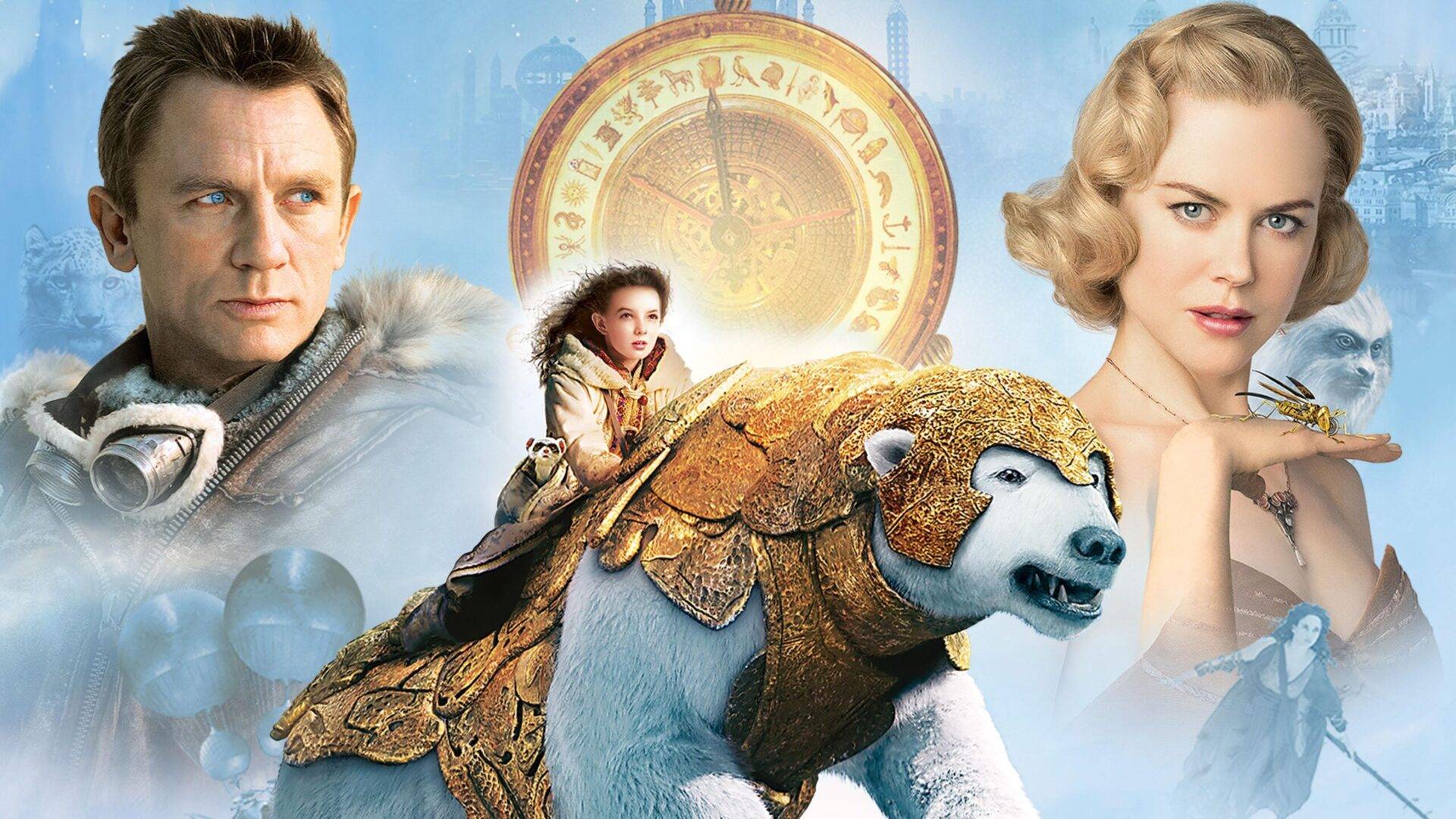
Philip Pullman’s 1995 book The Golden Compass is actually really good, and unlike some young adult entries, has actual literary value. But reflecting back on it, I can’t read this book again.
Set in an alternate steampunk world of witches, airships, and souls who manifest outside their owners’ bodies as cute talking creatures, The Golden Compass is an entertaining yarn with some anti-clerical messaging that I didn’t find annoying. Unfortunately, this light touch was completely absent from the subsequent books in the trilogy, which have the subtlety of a brick to the face. Church bad, God bad, religion bad, okay, I get it. Instead of just letting the badness of the clerical villains speak for itself, the dear author had to literally spell it out for us with cringey monologues.
Another problem with the two sequel books is that they’re just not very good. For one, the world building falls apart immediately. Pullman tries to, uh, pull, multiple realities together into a war setting that’s just not even remotely believable. A narrative of armies using hydrogen balloons and old-timey 19th century rifles co-existing with armies from our universe with Cold War technology just isn’t convincing. I’m a general, but I think the guys with zeppelins and single-shot rifles would be so pointless in a modern battle they could just stay home. The multiverse is an interesting concept, but it’s best left in the background because if it’s explored too deeply the whole thing just doesn’t make any sense.
The second book also introduces a woman scientist character from our world. I don’t actually have much to say about her because I genuinely can’t remember, she was that uninteresting and irrelevant to the plot. And there’s this whole thing about cosmic talking dust that controls the multiverse which I found to be completely pointless and uninteresting. It’s the usual stuff 1990s new age atheists were creaming themselves in excitement over but just aged terribly.
In general, I’m annoyed because the first book established the idea of moral nuance, and ended with the “heroic” leader of the rebellion against the church, which is an interesting “both sides bad” theme and a cautionary tale against letting desire for revenge control your actions, but the author immediately abandons this thread in the subsequent book. The rebel is retconned as a good guy without even the pretense of explaining why it was okay to kill a random child to fuel his machine. We’re just supposed to forgive him, I guess. Apparently, Pullman found it much more interesting to rant about the evils of Christianity than to flesh out his own plot points.
Reflecting back, the morals of these books are terrible. All the cringey new age atheism played out in ways the large majority of people probably wouldn’t have agreed with if we knew what the world was going to look like in 30 years. Even the stuff about every child having a daemon that can shapeshift until he reaches adulthood, which seemed innocent at the time but now feels like transgender propaganda. And the author did explicitly push butt stuff in the book, and literally has gay angels (yes that’s the mental image we all needed). See, the first book was pretty normal, then after you’ve been tricked into reading the next book you get all the weird cringey stuff. But he wrote it delicately enough I didn’t realize it was a gateway drug into the absurd clown world hellscape we’ve all been condemned to.
So I would say I don’t regret reading The Golden Compass, but I do regret reading the sequels, and the politics are troubling enough for me to not read even the first book I enjoyed a second time.
But it is funny to depict Tatars as the bad guy mercenary henchmen. I don’t think anyone reading this book in the 1990s knew what exactly a Tatar was, like are they Chinese or something? It is also funny in the context of the 21st Century, with Tatars as the martyrs of our time under the boot of Putin’s oppression, like the wiggers are oppressed by Xi.

I liked the multiverse created by Zelazny.
This led me down a rabbit hole, but I think I have enough for a substantive comment that I will copy and paste and cross-post to the Quora posting, which so far has attracted more comments.I really have read a lot of science fiction and fantasy, and have never before today heard of Philip Pullman, this particular book, this trilogy, and I don't remember seeing any of these displayed for sale at a bookstore. So literally everything I know about this book was found out today, and from this post, the comments on the Quora post, and looking the thing up on Wikipedia.And I am getting the impression that the only reason this book merits a review is that Ian read this when he was younger and it impressed him.The Wikipedia page does not disclose any information about the sales, and the only criticism it covers are from the usual "religious" media figures. It doesn't cover any literary criticism. It does say the book was awarded some prizes. In my experience, awards are somewhat anti- correlated with merit. I went to the Wikipedia page on one of the awards this book received, the Carnegie Prize, listing the annual awards going back to 1936, and only recognized one book listed, "Watership Down" (which actually is a good book, but still…).C.S. Lewis has been criticized for being too obvious in making his points in his science fiction and fantasy books, and apparently Pullman wanted write inverted C.S. Lewis, not in the sense of being more subtle, but in the sense of being anti-Christian.This doesn't even to work as an inverted C.S. Lewis, which you would obviously do by rewriting the Narnia books from the perspective of Jadis and Miraz, and their allies, and making them the heroes (though note that the Narnia books themselves do contain the perspectives of the followers of Jadis and Miraz, and even gives Calormene perspective somewhat sympathetically). Or you could make N.I.C.E the "good" organization in that trilogy. Its not hard to do.The "Golden Compass" was published in most places as "Northern Lights", and seems to be better known as "Northern Lights".
Edward S., I had never thought of the CS Lewis connection, but in hindsight it is obvious. Even the "tears" people travel through seems to be a reference to Lewis.