
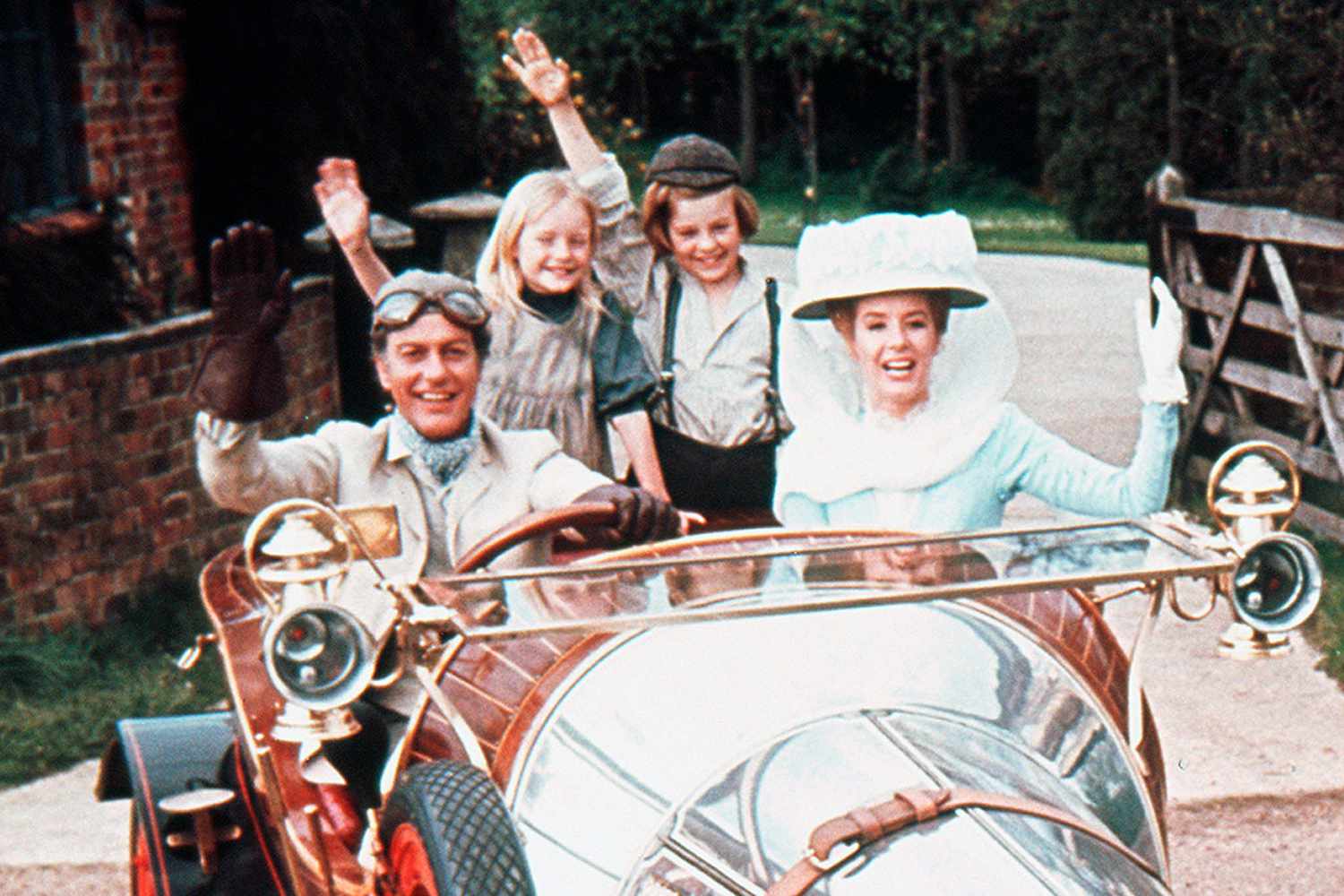
I rewatched Chitty Chitty Bang Bang, and it’s one of the rare childhood movies that was better than I remembered.
With a budget of $10 million (which was a lot in 1968), Chitty Chitty Bang Bang was a box office failure, and critics panned it as too derivative of Mary Poppins, which might sound incredible now. In the 1960s, too obviously cashing in on another movie’s success was considered damning criticism, but now in 2026, there is no movie that’s not cashing in on existing IP. Everything is slop shoehorned into already-successful franchises. This decline has gone on for so long, the actors old enough to have been in an original movie have started to die, which isn’t a problem. The studios digitally dig up their corpses and mimic their speech patterns with AI. Our world sounds like a dystopian plot from a 1960s movie.
Chitty Chitty Bang Bang is an ambitious two and a half hours long, but I never felt bored and the film grabs your attention from start to finish. The $10 million budget also, importantly, feels justified and well-spent, and didn’t just go into the pockets of the top few producers and actors. That opening scene with the motorcar races is underrated, and captured the thrill and public menace of early automobile sports perfectly (I think they also sped up the film in this scene to imitate movies and newsreels from that period), and the action scenes following it are all equally good.
Though now that I have watched the movie as an adult, I can only admire how Chitty Chitty Bang Bang’s cavalier disregard for storytelling conventions and formulas. Its plot is total chaos; the first 40ish minutes is the whistling candy subplot that goes literally nowhere. He spends all this time trying to use the candy to make money, it doesn’t work, and that’s the end of the matter. Then there’s an immensely flimsy segue to him trying to make money at the carnival with his barber robot that had been teased earlier (Chekhov’s robot) and accidentally joining a dance routine that makes him enough money to buy the car. Really, just imagine spending that much screentime on a subplot that has zero impact on the main questline. Then a short time later he’s at the family picnic and starts an imaginary on-screen story, literally, “Nothing in the movie after this point matters or has any impact whatsoever on the plot,” Then at the end we find out, oh just kidding, the whistling candy invention made him rich. The movie should be annoying and disjointed, but it isn’t. Everything just works. Apparently, when someone knows how to make movies he can bend the rules a little, or a lot.
I found quite a few interesting themes in this movie but just can’t be sure how many of them were intentional or not. The setting in 1909 was slammed as being derivative of Mary Poppins, but I think it’s the perfect time period for a magic car, and not just because cars were new and exciting back then. The British Empire was at the height of its power, and this movie exemplifies the British dream at its peak before dying in the mud of the Somme. The Empire was not destroyed in WWI, but the dream was dead and every decade afterward was marked by decline, overstretch, colonial rebellions, and wars the English people just could not put their heart into anymore no matter how much “stiff upper lip” they had on the surface.
The contrast between British exceptionalism and the buffoonish Germans is also interesting to contemplate. I could interpret it as a critique against the Enlightenment, contrasting the magic and good vibes of British power against the Germans’ manic obsession with clockwork. The British rule the world through natural traits, while the Germans represent the arrogance of mankind, making cartoonish attempts to imitate God’s creation with their machines. The Englishman builds a magic car, and the evil Baron Bomburst wants to steal it because he can’t make one of his own. The reality here is that the car is magic, so cannot be imitated, no matter how many scientists and engineers the baron kidnaps and forces to work for him.
Of course there is the usual British main-character-syndrome here as well. The world is split between Britain, which is perfect, and a continent filled with sputtering red-faced autocrats who want to invade because the British are so vastly superior and they’re jealous. In today’s Europe of Russia versus everyone else, it is easy to forget that there was a time in the past when there were more factions that hadn’t been subjugated by the US banking cabal yet; the Germans, French etc. were lampooned just as fiercely as the Russians are now.
The baron and his wife the baroness are intriguing villains because they’re not quite conventional baddies typically seen in movies. I remember as a kid feeling bad for these two, and as an adult I feel the same way. The baron isn’t really evil, he’s just really immature and impulsive, a big baby, if you will. And the baroness does really ove him. The baron is (intentionally) meant to mirror the main character. They’re both immature and ruled their impulses. Potts blew all the family money on stupid inventions instead of finding a real job, and the baron rules his kingdom by stupid childish impulse. He’s just a more exaggerated version of Potts, that Potts himself had come up with as subconscious self-critique in his picnic story to the family.
The love interest, Truly Scrumptious is actually quite head-scratching as a character. She’s wonderful and pleasant in every way, but just off. Truly is truly an angelic woman who loves, really loves, children. I meant to list off her character traits here but unfortunately that’s the only one that sprang to mind. Well, she’s extremely non-sexual, which is further reinforced by the man’s total lack of interest in her even when she’s trying to get his attention.
Even more curiously, she is chosen not by the man, but by the children. It is their actions that force her into the plot, not the father’s. In fact, I think if children were asked to describe the perfect woman, they would describe Truly. Of course it’s logical for children to imagine a perfect stepmother who loves them unconditionally, but i’s not a man’s fantasy.
Then there’s the baroness, my favorite character. It’s really funny because I looked up discussions of this movie on the internet, and everyone had the same memories as me; we remembered certain iconic scenes like the flying car and the music box dance, but had completely forgotten when the baroness dances in her bed chamber in sexy black lingerie, and were very shocked to come across this scene as adults. This was allowed in a children’s movie?
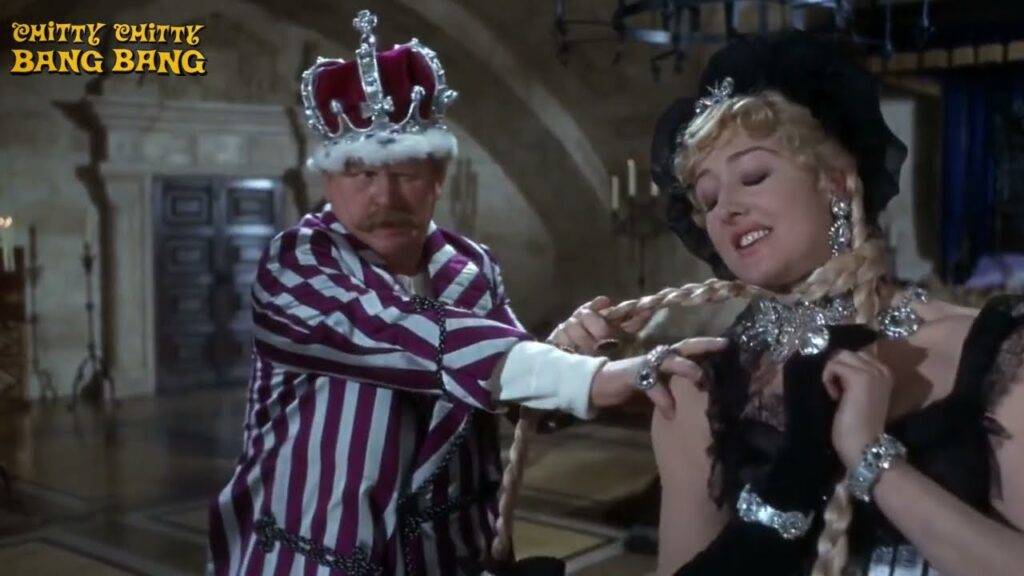
No seriously, how was this allowed? Different times, I guess.
And speaking of not being allowed, what about this guy?
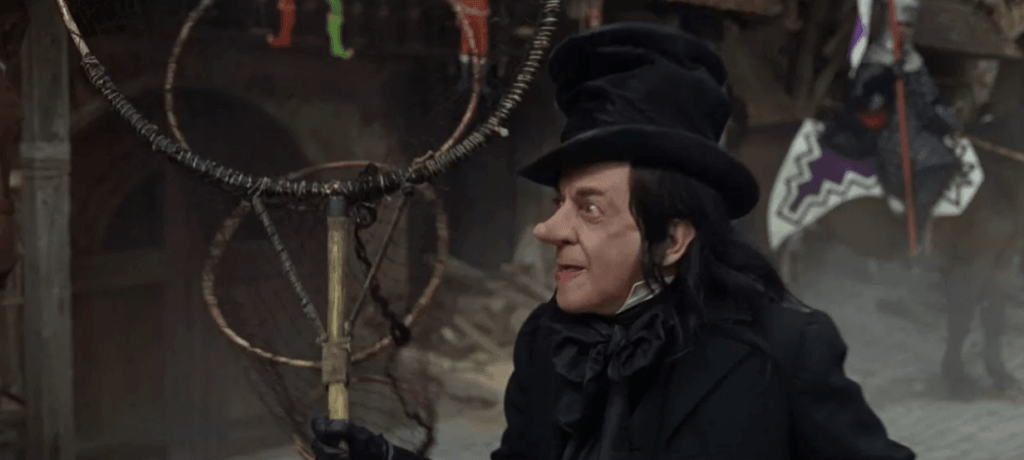
There’s a child catcher who lures Christian children with candy and locks them in cages? Then at the end of the movie he literally gets pogromed? Whaaaaaaat?
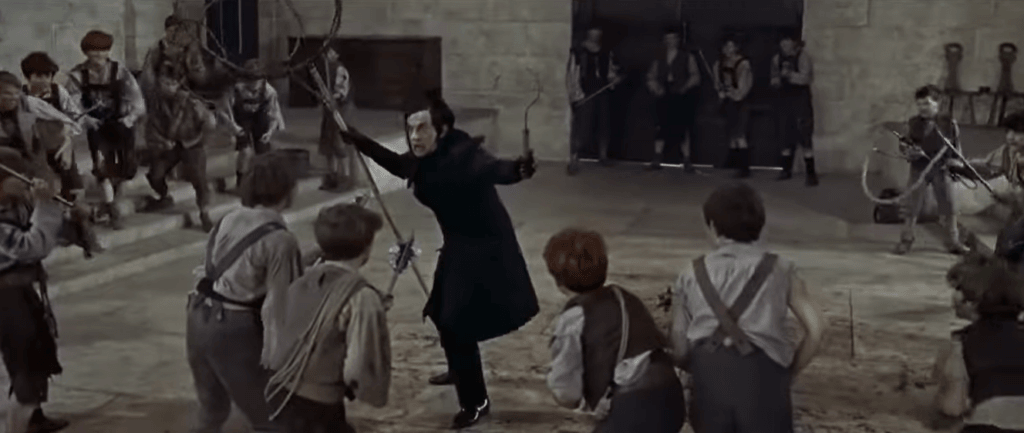
The wild part is that the child catcher isn’t even a real person, Potts just decided to include this stereotype in his story for some reason.
But anyway, while the baron is just an exaggerated version of the inventor, that’s not true for the women. Truly is angelic and loves children, and the baroness is sexy and hates children. As a child I accepted that the baroness is a villain because the movie said so, but as an adult I just can’t see it that way. She does really love the baron, and her hatred of children doesn’t make her a villain, especially in the way it’s portrayed. The baroness is explicitly shown being afraid of children, which makes it a phobia, a mental disorder, not a conscious decision to be cruel.
It’s curious how feminine sexuality divorced from maternal instinct is a bad thing, that’s one way to look at it. I might really be stretching here, but I think there’s more to it. The baroness is the woman the inventor would like to marry, and Truly is the woman he’s obligated to marry. Truly loves the Potts children five seconds after meeting them, and apparently has no other hobbies besides loving children. Unsurpisngly, Truly is the children’s favorite for a stepmother. Meanwhile baroness wears sexy outfits and praises and pampers her husband all day, even when he’s an asshole. She would clearly be a man’s ideal woman. But the problem is that she would not be the children’s ideal woman. Maybe the baroness in real life would not hate all children, but she would probably hate those children, and not want them to compete with her children she has with him. It’s terrible for a step parent to abuse, neglect or give away children, but we’re dealing with animalistic instinct to some extent here. A lion alpha male kills the cubs of his predecessor, and humans aren’t much different.
Truly’s love of children could be further defined as an extension of a sense of duty that controls all her actions. Her duty to her father, the family, the family business, and so on. She’s the “perfect catch” for a single father to marry, but he’s totally disinterested in her and hates their interactions. Actually for that matter, he’s barely interested in his own children. At the beginning of the movie they’re dirty, playing in a junkyard instead of going to school, and almost get run over by a car. Truly is absolutely correct to lecture him for being a neglectful father, and he ignores her. Even the quest to get 30 shillings didn’t show love for his children, he just really liked that car and wanted it. Remember, he told them it was a magic car, that was his idea, not theirs.
He’s burdened by children and annoyed by Truly, but Potts did paint a pretty compelling picture of the baroness. Maybe that’s his fantasy woman or maybe she was a real person? The fate of the birth mother is never explained or even hinted at, but hating children is a weirdly specific character trait to give a woman he had apparently made up on the spot. Sometimes a woman has children and realizes she hates them, and it wasn’t anyone’s fault.
The children are twins, incidentally.
One funny thing about his picnic story is that there’s no romance. When the children chime in to say that their father and Truly get married, that idea makes him uncomfortable. We could chaulk that up as being shy or embarrassed, but he hadn’t shown the slightest bit of romantic interest in her up to that point.
At the end of the day, the inventor suddenly finds out he’s rich, thanks to Truly’s father, so now he has to marry her.
The final moment when the car flies away with the newly-engaged couple is pretty weird, because the picnic story was imaginary, the car isn’t actually magic, right? I think the car flying is a metaphor, especially in the context of his closing monologue that he needs to be responsible and work instead of playing around with his inventions all day. Flight represents him being deshackled from his childish desires and distractions. But it could also be seen as enslavement. He did genuinely enjoy tinkering in his workshop all day, and now he he won’t get to do that anymore.
Get Chitty Chitty Bang Bang on Amazon
As an Amazon Associate I earn from qualifying purchases made through product links and web banners. Click here to navigate to the Amazon storefront.

Ian Kummer
I now have a new YouTube channel that I will use to upload videos from my travels around Russia. Expect new content there soon. Please give me a follow here.
Also feel free to connect with me on Quora (I sometimes share unique articles there).

He will be Truly Explorious
Mk, I think he liked her the best as a doll
Mk, So as an empty headed dummy. Dang…
Mo, that's how a lot of men like their women lol
Mk, The original story was written in a 3-book series. In the book, Caractacus Pott (not Potts) is a Royal Navy Commander, has a knack for invention, and has a wife name Mimsie and 2 twin children, Jemima and Jeremy. Their adventure involves the flying car, a gang of thieves and kidnapping the children. In the film adaptation he is not a Commander, he is just a failed inventor, going bankrupt. In the first book, Grandpa Pott does not exist, but in the film, he was added to create a more stable balance since their father ignores them and their mother was dead; as explained by the synopsis of the movie. Grandpa Potts is portrayed as a now aged war hero suffering what seems to be early onset dementia or the like. Which at my tender age of 6, watching it for the first time, felt unsafe, unsure and insecure. I recall asking my mother why the children were like wild animals, without parents, and why was their grandpa crazy? My mother said, there is no structure for safety to exist. Now I was a child that also grew up with a grandfather in the household, but he was quite the opposite of Grandpa Potts. My Grampa was very sharp minded, very active and he would teach me carpentry, and we made a life-sized doll house together I played in it for years, a swing that swayed from the largest tree we had, and we made furniture for people that commissioned it from him. So, to me, Grandpa Potts was someone I would not trust too well, because he seemed to be losing it and not very responsible. As an adult I wonder why Disney always loves to kill off the mothers in their stories, sadly hilarious. And I simply couldn't wrap my mind around Mr. Potts disinterested in his kids. My father was also very different from Mr. Potts, so I couldn't possibly relate to the children in this movie, I felt sorry for them. My dad was an only child, I was an only child too- until the age of 9- and since he had no sons, I was the elected buddy on fishing trips and going down to the local bait and tackle store to buy hunting gear, bait and rods and reels. So, to see Jemima and Jeremy all on their own, was wild to me. I was a tomboy in all the sense of the word, but my mom, dad and grampa were always close by. I've always been a very sharp kid, at church I never liked playing with the kids, they were too immature for my liking, so I understood the Queen not liking kids. I wanted to listen to the adults talk; children annoyed me at 6 years old. The thought of that makes me laugh now. I was so small I could easily listen in on conversation and gossip and not be noticed. I think that's why I loved Jemima's character the most, she reminded me of myself. Unruly, mature for her young age and small. Jemima seemed to lead her brother around and address the adults with authority, much like I lead my older male cousins around and always engaged in small talk with adults. Going back to the queen, to my 6-year-old mind, the Queen was not afraid of children as much as afraid of what it would mean for her if she had them with an unstable and immature king, like her husband. I recall watching CCBB again at age 9, and I understood that Queen on a whole other level.
Mk, I think she hated her situation. I think her character was made to mirror the women of the 60s. Afraid of failing at being a mother, afraid of having to be a single mother, because her husband was so unreliable or had PTSD from the war. So, to not be reminded of children, of not being able to be a mother because of the kings' immaturity, plus already taking care of the very childish king he was, the child catcher was hired to get rid of every child in sight. Plus, to me it seemed she hated that she loved him, that's why she was trying to kill him throughout that entire musical scene in the bedroom. Plus, the king knew he was inadequate as a mate, selfish as a human being, narcissistic, proud, vain and an all-around pain in the ass in every sense of the word. It seemed to me that he had her dressing in that lingerie for his visual and carnal pleasure, because it was all about him and his needs. All the while she hated that she only existed to please him. So perhaps the writers did mirror the King and Queen to reflect Potts relationship with the twins' mother, as you mentioned. How his selfishness and subsequent jealous feelings towards his own children- after they were born- had driven the new mother to an early grave. The film does not say if their mother died at their birth, or if she dies soon after or much later. But being a mother now, myself, I would imagine that she would have been experiencing post-partum depression, as most new mothers do. Her feelings of inadequacy would have flared suicidal ideas, and not having a good support system in her husband would have driven her to into the depth of this emotional and psychological illness. She perhaps would have wished to die or kill her children to spare them the rejection of their father. This rejection by a very uneducated, unprepared new father would in turn have made his wife hate the fact that they had a child, let alone two. Having to care for these on her own would have added to her crisis. Sexy time goes down the drain after u have kiddos, the new mother dotes on her kids, gets paranoid they'll die, a post-partum depressive mom would have had nightmares of some killing or harming her babies. Her marriage would have been suffering greatly. If this was truly what the filmmakers were using to fuel their storyline, then it was something they didn't need to explain to the adult audience, because married adults go through this dark time of adjustment. This seems to explain why Potts didn't want to be close to them.
Mk, He blamed them for him not having his wife anymore, blamed them for not having that love and life a young childless couple enjoys at the beginning. He was annoyed by his kids; he was annoyed that his wife made him take responsibility by abandoning him and dying. The only one that stayed was her father-in-law. The old coot whose mind was now beginning to destabalize. So, Disney introduces us to the post death era of a family in crisis. Again, reflecting the new norms of the 60s, where family structured had already begun to change and destabilize the ideal of the American Family structure due to the Vietnam war leaving many families without father figures and those same households seeing mothers becoming their own version of "Rosie the Rivetter" in the war effort. So, writers took a very sound and happy story, with an adventurous and stable family unit and restructured it into a political world view and a reflection of the times, chaos and all. I wager that children would have benefitted from an adventurous, hopeful, future they could dream of having, but instead got a raw yet sugar coated depiction of the world they lived in. The world was Chaos in the 60s. Vietnam, hippie protests, civil rights movement reaching a height never before seen in the mid 60s and a surging tech revolution that saw inventors being highly on demand- rudimentary fax machines, lasers, atm machines, the Kevlar suit, zip codes to help sort the mail, birth control pills, the space race, a new young President JFK assasinated in 63' and many more- had already marked the change in the modern 1960s family structure and way of life. CCBB was release a week before Christmas here in the states on Dec 18, 1968; with the book series being made just 4 to 5 years prior. People understood chaos, they understood inventions like the Taylor aero car that already existed since 1949, but it was brought back into the limelight when it crashed in the 60s; just like the one in the movie. With sci-fi rising and becoming quite popular in the 1960s with shows like Planet of the Apes, 2001: A Space Odyssey, The Time Machine, and many more, CCBB didn't seem to be far off nor improbable. So, a children's book was taken and turned into a reflection of the ever rapidly changing times of the 1960s. So, when you mention that it was too off, well, the lives of Americans in the 60s was off. War, Industry, family structure, Human and civil rights, hippies, drugs, addictions, ritual sacrifices and a rapid growing economy was their new normal and CCBB brought it to the screen. This is what I figure the writers might have done: Fathers that came back from the war were disconnected from their kids- like Mr. Potts- mothers were working outside the home – symbolized by a dead mother being absent from the family structure- women were seeking the men left to marry- even if they already had kids- like Truly Scrumptious, Grandparents were the ones raising the children left alone by their parents – like Grandpa Potts- when they should be more concerned with the issues of aging and retirement. The Child catcher symbolized the violence, the addictions that was taking runaways and young adults from their families and dragging them into obscurity, depression, suicide and crime. The Child catcher was the boogie man in a decade that Evangelicals saw rock and roll, cults and flower power invoke the rise of The Beatles and The Rolling Stones. Some of the bloodiest notable serial killers like the Charles Manson family, The Boston Stangler, Child Killers Ian Brady and Maya Hindley, The Zodiac killer and many more took many lives and shook a nation. To the religious America of the 1960s, the boogie man, the devil himself, was taking their children like the Child Catcher.
Mk, To my adult perspective, The King and Queen were symbols of Uncle Sam and Lady Liberty. The ever-present battle between the balance of freedom, human rights and liberty to choose to participate and abusing the human capital this country possesses in a form of corporeal usury; by lending American lives to foreign wars. And so, laws began to change, the government saw opposition, symbolized by the Queen trying to kill him while seducing the King. Politics has always been a very fickle business, a dance of seduction between parties with black printed white papers as the bait, and green printed cotton as their prize. The lives of a countries' children no longer safe nor free to live, caught by war and death. There is so much symbolism and many layers that overlap. They address the family unit all the way up to political shifts in a very young country. I gather that is why they deviated from the book series.
Mk, I just realized I got stuck replying to MK, instead beginning a new thread. My bad Ian.
Mo, I don't remember her trying to kill him
Mo, but overall very interesting take on the themes of the movie
Ian Kummer, she did, and he would in turn try to kill her too. It was very disturbing and confusing to see
Ian Kummer, https://www.bing.com/videos/riverview/relatedvideo?q=chitty+chitty+bang+bang+baron+and+boroness+muscial+scene+in+the+bedroom&&mid=46320EA7B82F4E1A315B46320EA7B82F4E1A315B&FORM=VRDGARthats the musical bedroom scene. watch it and u will see how theyre trying to kill each other, haha
Ian Kummer, Whoa, wait, i had that wrong. He is the only one trying to kill her. Yikes.
Ian Kummer, I am amazed at how my 6 and 9 year old mind saw facial and body language that read she hated him and recalls her also trying to kill him. Perhaps what I remembered were my own feelings. hah. Hm…so this video shows me that I have to change the ending I previously wrote. So, if the Baron/King/ Uncle Sam was trying to kill Lady Liberty all the while. How atrocious, by the way, and she remained hopeful and faithful, and The Baron and Baroness were reflections of The Potts marriage, does that also mean that Mr Potts killed his wife or tried too, as well???
Mo, tbh I don't think there was any deep message to the casual murder attempts except that the baron (mirroring Potts) has zero impulse control