
Iran is all over the news, and recent events further confirmed a thought I’ve had in the back of my mind since the retreat from Afghanistan in 2021; the US still has near-complete supremacy over the global information battlespace, even when things aren’t going well in the physical battlespace.
Can you tell me, without looking it up, what the Afghan Security Forces’ losses were in the 20 year war with the Taliban? If your answer was “no,” then you can see right away how the US controls information flow even in the face of absolute defeat.
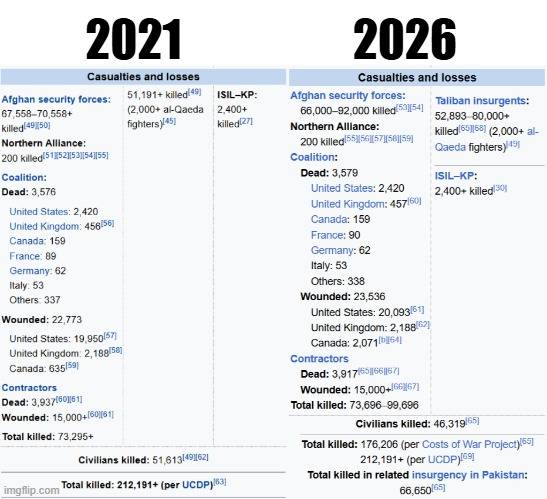
Thanks to the internet archive, here is the ISAF-Afghanistan war on Wikipedia. Notice how the dutiful wiki editors “found” another 30,000 Taliban dead since the war ended. Before that, the kill ratio was just plain embarrassing.
And by some strange coincidence, in that same time frame (end of August 2021 to present day), the wiki editors greatly increased the Afghan army casualties during the 1980s Soviet war: And they also decided to add every single Soviet soldier with a tummy ache as a casualty:
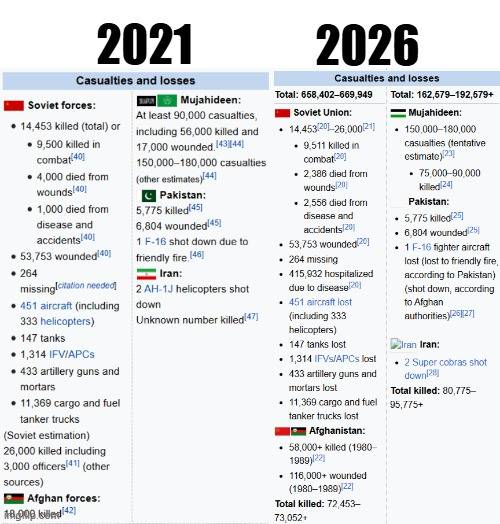
I’m not saying these numbers are lies, it’s just very interesting that there was a sudden urgency amongst wiki editors to revisit Soviet and Afghan casualties in Afghanistan after the US and its allies suffered a crushing humiliation there.
The (alleged) losses of Russia and their allies in war are loudly amplified until they become common knowledge to every western person. But the losses of western forces and their allies, even in the same regions, are not discussed. They’re not even downplayed, just not mentioned at all so the average person cannot even guess at a number. This isn’t censorship, it’s something better than censorship. The figures from the western powers’ failed occupation of Afghanistan are not kept a secret, and easy to look up online, but the average person is not going to do that. The passive recipient of news will just not be aware of these casualties, or think that he should look them up, so he won’t.
One of my most distinct memories from this period is a viral video allegedly showing the Taliban regime “hanging” a man off a captured American helicopter, which was promptly shared in hysterical articles by right-wing media. Of course it turned out to be not the case, the “hanging” man was actually a worker in a harness. Major outlets shared the fact check, but of course got far less publicity than the initial false claims.
Such fake news and atrocity porn spread so easily and without opposition is because western social media platforms completely severed Afghanistan, even official government channels, even former officials aligned with the US. The goal was to eliminate even the possibility of the official regime narrative being contradicted by Afghan people. The intent behind this censorship soon became clear, when the Biden regime looted Afghanistan’s central bank. It was important to portray Afghanistan as a lawless failed state to condition western audiences to accept the robbery of a country we had spent the last 20 years “helping.”
Here’s another example. On October 9, 2023, I shared b-roll footage of Hamas training prior to their surprise attack on Israel. The video was almost immediately taken down, with a permanent strike against my account.

Yet this was just b-roll footage. Literally, the only permitted footage and text from Palestine is IDF press releases. And the only source about Israeli war crimes that Western media platforms won’t censor is Israel itself.
Previously I have expressed skepticism at American military theories about fourth and fifth generation warfare, which imagine non-state entities as being capable of defeating the state by using networked warfare. How exactly are nonstate entities supposed to use networks to win when the state can casually kick them off all networks that matter? I’m not saying nonstate entities can’t defeat states, but the widely accepted theory of how they go about it is based on some false premises.
The only time in recent history when US information war against an adversary wasn’t a complete success was in 2022 against Russia. Yes, the US and its vassals and proxies dutifully kicked and banned Russian media from their spaces, and this was done with the obvious intent to prevent global audiences from seeing the Russian perspective, but it failed. The reason why it failed is because Russia is also a powerful state that has its own mouthpieces, and just as importantly, they have their own platforms and domains to easily broadcast messages abroad, even in the face of a multi-billion dollar campaign to squash them.
In the current conflict with Iran, the campaign to censor Iranian perspectives is largely successful, though not as successful as in the past due to crowd-sourced phone footage uploaded and shared to Telegram, and even X sometimes. But still, the only exposure the average person can get to the Iranian perspective is what gets relayed through third parties, like Russian media. And again, this is because Iran is partnered with a larger and more powerful state. If they were in this war alone, the “fifth generation networked warfare” would not help them.
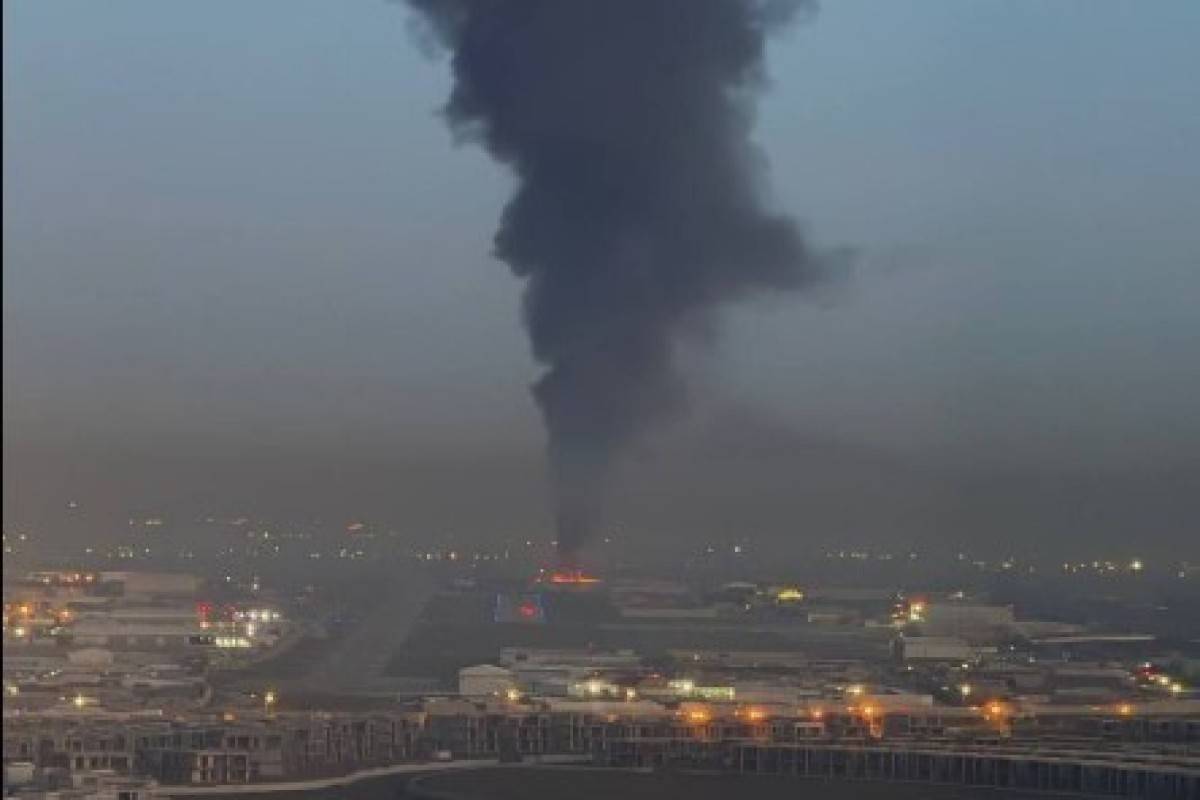
Featured image: aftermath of an Iranian strike against Erbil airbase in Iraq.
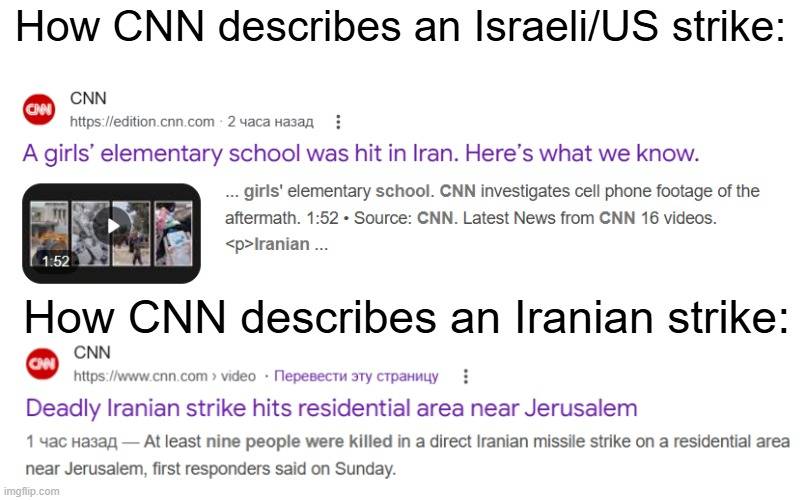
My closing thought is on the nature of Trump’s initial strike against Iran. The US offered a parley, then killed Iranian leaders while they were meeting to discuss the parley. This is not the first time the US has done this, it’s not even the first time Trump has done this. The fact of the matter is that the US can blatantly and repeatedly violate diplomatic norms with casual terrorist attacks against other heads of state and the rest of the world largely does nothing. The lack of pushback alone is testament to the stranglehold Washington still has on the world.
Ian Kummer
I now have a new YouTube channel that I will use to upload videos from my travels around Russia. Expect new content there soon. Please give me a follow here.
Also feel free to connect with me on Quora (I sometimes share unique articles there).