

The Handbook of Fifth Generation Warfare, edited by Daniel H. Abbott, is an attempt to build upon the theory of generational warfare pioneered by William S. Lind that came to be a blueprint for how the US military establishment tries to warfight. It was a total failure.
In 1989, Lind co-wrote the famous Marine Corps Gazette article, The Changing Face of War: Into the Fourth Generation, which proposed envisioning the history of modern European warfare in three distinct generations:
First generation warfare reflects tactics of the era of the smoothbore musket, the tactics of line and column. These tactics were developed partially in response to technological factors — the line maximized firepower, rigid drill was necessary to generate a high rate of fire, etc.— and partially in response to social conditions and ideas, e.g., the columns of the French revolutionary armies reflected both the élan of the revolution and the low training levels of conscripted troops. Although rendered obsolete with the replacement of the smoothbore by the rifled musket, vestiges of first generation tactics survive today, especially in a frequently encountered desire for linearity on the battlefield. Operational art in the first generation did not exist as a concept although it was practiced by individual commanders, most prominently Napoleon.
Second generation warfare was a response to the rifled musket, breechloaders, barbed wire, the machinegun, and indirect fire. Tactics were based on fire and movement, and they remained essentially linear. The defense still attempted to prevent all penetrations, and in the attack a laterally dispersed line advanced by rushes in small groups. Perhaps the principal change from first generation tactics was heavy reliance on indirect fire; second generation tactics were summed up in the French maxim, “the artillery conquers, the infantry occupies.” Massed firepower replaced massed manpower. Second generation tactics remained the basis of U.S. doctrine until the 1980s, and they are still practiced by most American units in the field…
Third generation warfare was also a response to the increase in battlefield firepower. However, the driving force was primarily ideas. Aware they could not prevail in a contest of materiel because of their weaker industrial base in World War I, the Germans developed radically new tactics. Based on maneuver rather than attrition, third generation tactics were the first truly nonlinear tactics. The attack relied on infiltration to bypass and collapse the enemy’s combat forces rather than seeking to close with and destroy them. The defense was in depth and often invited penetration, which set the enemy up for a counterattack.
The rest of the article proposes that 20th century terrorism might be the beginnings of a new fourth generation of warfare, completely irregular operations fought by ideologically motivated guerrillas with no defined frontlines.
After the Sept. 11 attacks and subsequent US-led misadventures of Afghanistan and Iraq, the 4GW theory seemed correct, and many writers scrambled to be the first to predict what 5GW would be. Though Lind himself declined to participate in such speculation, insisting that it was too early to make such predictions. So the train of progress moved on without him, and Abbott compiled many of these bold statements in his book.
I think in hindsight, Lind was correct to not jump to conclusions. The crucial problem with any discussion of alleged 5GW is that the underlying theory of 4GW did not turn out to be an accurate prediction of future wars. 4GW proved to be incorrect for a variety of reasons, but the main one was the idea, alluded to in that first article and more explicitly stated as time went on, of nation states being in decline, eventually to be replaced by transnational ideologies. To put it succinctly, the state would lose its monopoly on warmaking, and future wars would be defined by non-state entities defeating states in war. As The Handbook of Fifth Generation Warfare puts it,
The decline of the state to one political institution among
many, plus the empowering of individuals and small groups by modern
technologies, has remade the possibilities for war.
But is this actually a true statement? In light of the USA’s mixed track record with fighting insurgencies over the last several decades, one might think the idea of the decline of the state into an era of irregular warfare has some merit, but not if you look closely.
The Taliban might seem like a textbook example of irregular warfare, but not really. Did you know the Afghan National Army and police forces suffered more than 80,000 KIA in the war, many of them in a relatively short time frame culminating in 2016? Probably not, as that would go against the narrative of “irregular warfare,” wouldn’t it? In the end, the Taliban won by inflicting heavy losses on the Afghan National Army and police forces, which forced the USA to the negotiating table in 2017-18. Then after the complete withdrawal of US forces in 2021, the Taliban simply assumed control of the country. This caught the Biden administration by surprise at the time, but the inspector general report published the following year (which I wrote about here) concluded that the winning blow had happened much earlier; Trump’s peace negotiations and promised withdrawal demoralized the already-battered ANA, and they (understandably) negotiated their own personal agreements with the enemy, which came into effect as American troops started withdrawing. The fact that the Taliban and puppet government had already secretly made arrangements became so obvious, US forces no longer could trust anyone, leading to the infamous evacuation of Bagram AFB while the Afghan soldiers slept.
Most other examples of “irregular” warfare triumphing in recent years fall apart if you think about them too hard. ISIS successfully waged conventional warfare against the US-trained Iraqi Army, and attempted the same in Syria, but were crushed by Assad’s forces backed by Russia and Iran. Then after Assad’s government ran out of money, they were defeated in battle by the HTS backed by Turkey. The HTS then turned their attention to the beloved Kurdish “freedom fighters” loosely known as the SDF, and are in stomping them into the ground even as I write this post.
Abbott’s book attempts to improve the generational warfare lore and correct perceived flaws, perhaps the biggest one being changing the model from “generations” to “gradients,” insisting that the evolution of conflict isn’t as linear as Lind argued. I can appreciate attempts to add social context to that first MCG article, which was very military-centric, but Abbott and his co-authors don’t substantiate this argument particularly well. For example, yes, tribal wars were genocides that ended with the losing side being all killed or pushed off the land being contested, but to say this is the same as the Holocaust or concentration camps in the Boer wars is ludicrous. A genocide in the 20th Century involved modern technology and bureaucracy, so was fundamentally different than a genocide by stone age tribes. War might not be as linear as Lind and his peers suggested, but it is linear and can’t be divorced from the historical timeline like Abbott would like.
That framing question aside, what is fifth generation warfare, or fifth gradient warfare if you prefer? Well, that’s a great question. Here’s a page from the book:
First Gradient – Cooperative Warfare – 1GW
Cooperative warfare doctrines are based upon the principle of creating
organizations that require the individual to surrender control to the group in
order to project Force to accomplish goals that are necessary to the survival
of the group.
Second Gradient – Attrition Warfare – 2GW
The principle behind attrition warfare describes doctrines that use the
strength of the attacker to target the strength of the opponent.
Third Gradient – Maneuver Warfare – 3GW
Maneuver warfare doctrines are based upon the principle of avoiding the
strength of the opponent in order to attack the critical vulnerability of the
opponent.
Fourth Gradient – Moral Warfare – 4GW
Fourth gradient doctrines are based upon the principle of the attainment
of a functional invulnerability that prevents the opponent from being able to
orient upon a threat and creates a perception that saps the ability of the
opponent to function effectively.
Fifth Gradient – Contextual Warfare – 5GW
Fifth gradient doctrines are based upon the principle of the manipulation
of the context of the observations of actors in a conflict or confrontation in
order to affect a specific positional change or achieve a specific effect.
For God’s sake, it’s like that Sun Tzu meme.
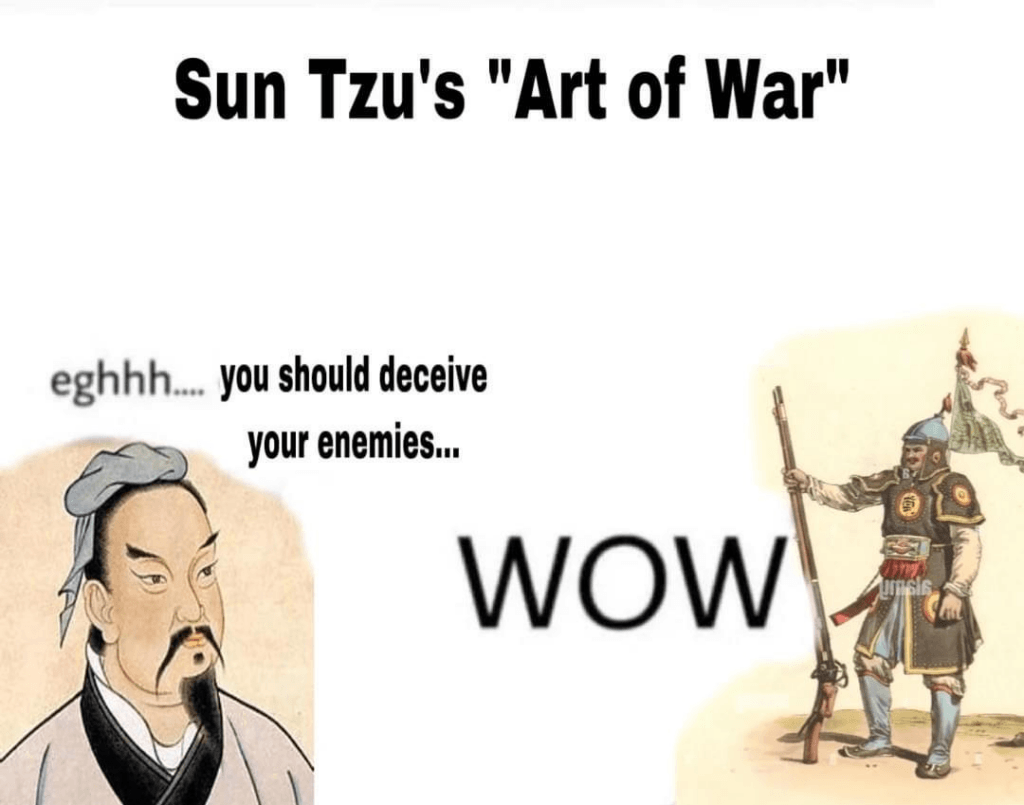
So here we are in the 21st Century. How do you win a fifth gradient war? Eghhh… you should deceive your enemies… WOW.
Jokes aside, at the end of this book I was still unconvinced that there is enough of a distinction between 4GW and 5GW to bother differentiating them. It’s like saying the introduction of the Macedonian two-handed pike created a new generation of war (no one has ever said that). But the bigger problem is that whole decline of the state thing I already mentioned. The handbook repeats it,
When a contest is between actors who are
sufficiently large, organized and capable of capable of doing harm, it enters
the sphere of coercive diplomacy. When that violence is used to reach a
political end, it is war. At one time these actors were assumed to be states,
but no longer. The decline of the state to one political institution among
many, plus the empowering of individuals and small groups by modern
technologies, has remade the possibilities for war.
So there’s this idea that the state has lost its monopoly on war, but is that actually true? The main proof of such a statement being true is the ability of non-state actors to defeat a state, and preferably without the help of another state (that would just be a state defeating another state with extra steps). Do we have even one compelling example of that happening in this century?
It is understandable that the 1990s and early 2000s felt like the end of history, and such an idea like the end of nation states might seem plausible, but think about it. The dissolution of the Soviet Union marked the end of a transnational ideology, so this is actually the opposite of an end to nationalism. Weakening national characteristics of the USA and some other western countries due to immigration and low native birth rate are explainable, but in no way means the idea of nationalism itself is obsolete. And speaking of birth rates, that turned out to be a useless barometer for how willing a people are to fight, now that we have two nation states with below replacement level birth rates locked in combat with each other.
My explanation for the misunderstanding is that the US is too far removed from the concept of existential threat to really understand the concept. The US has not had an existential war since 1865 (even WWII wasn’t a grave threat to American society’s existence). Every American war since then has been a war of choice that the US government could usually withdraw from without catastrophic consequences. As a result, there is this pervasive idea that inconveniences that would compel the US to withdraw from a war will work on anybody regardless of context.
Nevertheless, with some rebranding, the idea of 5GW has been implemented in US institutions. As the handbook puts it,
The nature of the networks that hold together a 5th Generation military is
predetermined by that network’s need for secrecy and need for serial
development. We know
· A 5GW army will be unable to recruit to any sizable degree.
· A 5GW will be very unable to recruit during operations
(development), because that is when the danger is the greatest.
· A 5GW will rely on strategic corporals or sheiks, who are
superempowered.
· A 5GW will rely on “sleeper cells” who must not give up, get bored,
or switched [sic] sides.
From this we know every 5G warrior will be valuable to the 5G militia.
Likewise, to succeed every 5EG warrior must value the 5G project.
Based on Abbott’s texts, I would summarize 5GW as an operation by irregular forces that defy identification or understanding for as long as possible, preferably after they have already achieved the desired endstate.
Every recent conflict has shown apparent efforts by the US to use 5GW. The 5GW efforts against Syria were successful. A combination of economic and guerrilla warfare backed by NATO countries and Israel collapsed the central government, allowing the IDF to grab territory and destroy its accumulated air defenses, which will be important in any conflict with Iran. Trump’s recent kidnapping of President Maduro in Venezuela was also a great propaganda success, reinforcing the image of invulnerability of the US military. However, it’s very unlikely that such tactics would work against a strong and competent adversary that’s not suffering extreme internal dissent.
The attempted color revolution in Iran seems to have failed, and apparently failed within the first two days. What I found particularly interesting about this event was how it so closely mirrored Lind’s description of 4GW, and Abbott’s 5GW; heavily armed militants attacked security forces, bombed hospitals and mosques, deliberately inflicting as many civilian deaths as possible every step of the way, and at the same time spread disinformation on the internet; in part to demoralize Iranians and also to manufacture consent in western countries for an invasion to “restore democracy.” It’s a textbook example of a nasty guerrilla operation that’s difficult to put down within the scope of the law and a sense of humanitarianism. But it failed, in part because the US underestimated Iranian national character. The government used heavy-handed methods and this did not spark a public uprising. This suggests that even legitimate protesters were alienated by the militant provocateurs’ violence. Meanwhile the “cyber” hybrid aspects of the operation were based on an assumption of the invulnerabilty of western technology that proved to be not true. Iran shut down the internet and allowed Starlink to operate long enough to track down the terminals to make arrests, then jammed it. So much for that.
But the elephant in the room is Ukraine, which in 2022 was supposed to be a model 5GW decentralized network of superempowered strategic corporal light infantry using Javelins to take down columns of Russian tanks and calling in on-demand fire support with their iPads. What I find particularly interesting about that first 12 months of the war was how even after it became obvious that irregular light infantry tactics are completely useless against a modern mechanized army, NATO still clung to the idea of decentralized strategic corporals. At the time I expressed disbelief that western sponsors were fixated on training programs for individual soldiers and small units tactics, instead of focusing on brigade, division and corps level command staffs, which the US does have the tools to provide. As I noted in a post two years ago:
Meanwhile, apparently no one thought it was important to train Ukrainian command staff. Not before the war, and apparently not even during it. Ironically, NATO could actually help a lot in this aspect. They could set up warfighter type exercises and have the first crops of excellent Ukrainian brigade, division and corps command teams ready for action around 2024.
But nobody seemed to have even started this process. It is funny to see NATO commentators crying about inept Ukrainian staff work now, which was something I have been saying right from the beginning in 2022. Wow.
Wow indeed.
I think there is indeed a 4GW that can be described and defined, and it’s happening now. But it is a war between states, and just as conventional as ever, with the same boring focus on firepower and mass production of weapons to destroy the enemy’s means to resist. There is an extreme dispersal of troops and vehicles to avoid being clobbered by mass artillery, and the ability to obliterate military and dual-purpose infrastructure deep behind enemy lines with precision and on a scale perhaps never seen before, but that’s not the “hybrid warfare” the US military establishment has been daydreaming about.
But the basis of 4GW and by extension 5GW is incorrect; the state is not declining. Far from it, no one else can come even close to competing with a state, let alone a world power, when it comes to hybrid war, particularly in the digital information space. Hamas propaganda is banned from every digital platform that matters. Basically our only mainstream source of information about Hamas is IDF press releases, really think about that one. And after the fall of Kabul, all of Afghanistan was booted off social media, even officials in the American-aligned government.
Perhaps the idea of decentralized warfare made sense when the internet itself was decentralized, but now that is no longer true. Non-state entities are easy to crush in the war for “hearts and minds,” at least in the realm of international opinion, as they can easily be censored. A state, on the other hand, isn’t so easy to censor, and we saw this in the war for Ukraine. Like with Hamas, there were sweeping bans of Russian media. Our democratic friends in Europe went a step further and aggressively prosecuted their citizens for reading or watching Russian media. Sometimes to protect free speech it is necessary to jail people for thought crime, after all. But Russia has their own web domains and social media networks to disseminate information on a global scale. Even the most aggressive efforts at internal censorship can’t be completely successful while dissidents and independent journalists are copying and cloning the Russian perspective into western media spaces. No non-state entity has come even close to being an adversary capable of surviving these “total war” campaigns on information.
So the armies of Islamist techno-jihadists crushing western civilization by hacking peoples’ Gmail accounts and smart fridges never materialized. What happened instead is the resurgence of non-US aligned nation states capable of posing a challenge on the battlefield, both physical and ideological.

See also:
Ian Kummer
I now have a new YouTube channel that I will use to upload videos from my travels around Russia. Expect new content there soon. Please give me a follow here.
Also feel free to connect with me on Quora (I sometimes share unique articles there).

Couple of notes:
It is worth mentioning that much of the staff level work is actually being done remotely by American staff from Wiesbaden, enabled by coms and iPads. Every effort is made in the propaganda to shift blame for failures in NATO tactics and training to Ukrainians and their lingering “Soviet” culture. The problem couldn’t be the NATO/US doctrine and tactics now, could it?
Well, it would be more accurate to go back to the hoplite phalanxes, to which the Roman manipular legions with their cohort system were already a “generational” development with more maneuver. Thing is, the drilling and formations and forts worked against foes that were oriented to individual hero “special” forces and guerilla type tactics. “Organization that requires the individual to surrender control to the group” remains foundational in any successful military.
As for the nation-state, the nation, or the state, nations and states are not well-bounded timeless concepts … they change and have perpetually changed. Medieval Europe did not have “nations” in our sense, and ancient states, including Rome, can hardly be called “national”. These concepts are not exact enough to be useful analytical instruments to apply to military strategy and tactics.
I don’t think it is clear at all how much C2 work is done by NATO staffs. I don’t think it is even terribly plausible for such a thing to be happening. What is much more likely to be true is that Ukraine has unfettered access to NATO intelligence infrastructure, not just access to raw data, but intelligence products produced by armies of analysts, which give actionable targeting data and reconnaissance.
Couple of notes: western sponsors were fixated on training programs for individual soldiers and small units tactics, instead of focusing on brigade, division and corps level command staffs It is worth mentioning that much of the staff level work is actually being done remotely by American staff from Wiesbaden, enabled by coms and iPads. Every effort is made in the propaganda to shift blame for failures in NATO tactics and training to Ukrainians and their lingering "Soviet" culture. The problem couldn't be the NATO/US doctrine and tactics now, could it? First generation warfare reflects tactics of the era of the smoothbore musket, the tactics of line and column. Well, it would be more accurate to go back to the hoplite phalanxes, to which the Roman manipular legions with their cohort system were already a "generational" development with more maneuver. Thing is, the drilling and formations and forts worked against foes that were oriented to individual hero "special" forces and guerilla type tactics. "Organization that requires the individual to surrender control to the group" remains foundational in any successful military. As for the nation-state, the nation, or the state, nations and states are not well-bounded timeless concepts … they change and have perpetually changed. Medieval Europe did not have "nations" in our sense, and ancient states, including Rome, can hardly be called "national". These concepts are not exact enough to be useful analytical instruments to apply to military strategy and tactics.
I’m not qualified to comment on military matters, yet what strikes me here is that the West keeps developing concepts like the 5G warfare, Heartland vs Rimland, the theory of Generations, etc. which are divorced from reality or only apply to the West itself.
For example, being born in 1982 in the USSR, I’m not a millenial, I’m a Soviet person. Anyone born in an African village now isn’t Gen beta, they are rural Africans, etc.
Then the West adopts those concepts and treats them as Scriptures. Yet, the rest of the world doesn’t share the faith. And the West is surprised everytime that the adversary (or a partner, depending on the case) refuses to play/fight by the West’s books. Oh, no.
In parenthesis, one of the many Russia’s faults over the past 30 years was actually trying to adopt those concepts too. I still see some of our analysts trapped in some of those concepts. It’s right to be aware of them, yet, it’s wrong to play by those books.
It’s an echochamber impervious to outside influence.
It’s almost as if they forgot what they learned in school, one of the key ingredients that made the west great in the first place: the scientific method.
I'm not qualified to comment on military matters, yet what strikes me here is that the West keeps developing concepts like the 5G warfare, Heartland vs Rimland, the theory of Generations, etc. which are divorced from reality or only apply to the West itself. For example, being born in 1982 in the USSR, I'm not a millenial, I'm a Soviet person. Anyone born in an African village now isn't Gen beta, they are rural Africans, etc. Then the West adopts those concepts and treats them as Scriptures. Yet, the rest of the world doesn't share the faith. And the West is surprised everytime that the adversary (or a partner, depending on the case) refuses to play/fight by the West's books. Oh, no. In parenthesis, one of the many Russia's faults over the past 30 years was actually trying to adopt those concepts too. I still see some of our analysts trapped in some of those concepts. It's right to be aware of them, yet, it's wrong to play by those books.
Guys, I added several paragraphs to the end for you to check out.
Guys, I added several paragraphs to the end for you to check out.
I don't think it is clear at all how much C2 work is done by NATO staffs. I don't think it is even terribly plausible for such a thing to be happening. What is much more likely to be true is that Ukraine has unfettered access to NATO intelligence infrastructure, not just access to raw data, but intelligence products produced by armies of analysts, which give actionable targeting data and reconnaissance.
It's an echochamber impervious to outside influence.
I just made this comment at Quora, then realized it was substantive enough to copy and paste here. I want to comment on Lind and his theories, but am not sure if I will have the time. Here is the comment:
My short take is that something like 4GW (or 5GW) is a useful concept, though I would call something different and not tie it to a theory of military history.
Basically, sometime after World War 2 (I’m thinking mainly of Iran in 1953), intelligence agencies started to get very good at identifying traitors in various countries, and overthowing foreign governments, or even their own governments. Uniformed militaries had no response to this, usually because the same tactics could be used to compromise the uniformed militaries.
The intel agencies became even stronger after absorbing the lessons of the East German (DDR) secret police, and they further developed what became known as “color revolution” tactics.
There is an argument that Israel, a country with less than ten million inhabitants, is now the dominant world power due to be really, really good at using these tactics.
So modern warfare is now spy agencies compromising destroying civil society in the target country, including the country the spy agency is supposedly based out of (and this includes Israel too).
Putin being former KGB is significant, because Russia seems to have been the first country to be able to effectively counter this method of warfare. China and Iran may also have developed effective counters. MAGA could even be an attempt by elements of the American government to do the same, though I think its more likely that its controlled opposition.
Actually, what I just described does seem to have been a feature of Chinese military history, pretty much forever.
For example, “China” was created by the kingdom of Qin attacking and conquering all the other warring states (the term “China” is derived from Qin”). There was direct military combat between armies, but also subversion. For example, senior leaders in the kingdom of Qi were bribed first to ensure Qi, which on paper was almost as strong as Qin, stayed neutral while Qin attacked and conquered the other states, and then to sabotage any efforts by the Qi army to fight back when Qin invaded Qi.
And actually the counter to Qin that came closest to working was an attempt to assassinate the King of Qin. There is a good movie on the event.
However, the style of warfare developed in western countries was much more direct, but subversion seems to have been increasingly used after World War 2. Arguably the last major war to have been fought the old way was the Korean War.
It really does seem like the “intelligence community” is a separate state hostile to both the nation and elected officials who defy or otherwise anger it. Sometimes I marvel how mask off they’ve become in the last couple of years.
That is the theory here:
https://americanstasi.com/
The blogger has amassed enough evidence that I’ve incorporated it into my own thinking about current events.
I just made this comment at Quora, then realized it was substantive enough to copy and paste here. I want to comment on Lind and his theories, but am not sure if I will have the time. Here is the comment: My short take is that something like 4GW (or 5GW) is a useful concept, though I would call something different and not tie it to a theory of military history. Basically, sometime after World War 2 (I’m thinking mainly of Iran in 1953), intelligence agencies started to get very good at identifying traitors in various countries, and overthowing foreign governments, or even their own governments. Uniformed militaries had no response to this, usually because the same tactics could be used to compromise the uniformed militaries. The intel agencies became even stronger after absorbing the lessons of the East German (DDR) secret police, and they further developed what became known as “color revolution” tactics. There is an argument that Israel, a country with less than ten million inhabitants, is now the dominant world power due to be really, really good at using these tactics. So modern warfare is now spy agencies compromising destroying civil society in the target country, including the country the spy agency is supposedly based out of (and this includes Israel too). Putin being former KGB is significant, because Russia seems to have been the first country to be able to effectively counter this method of warfare. China and Iran may also have developed effective counters. MAGA could even be an attempt by elements of the American government to do the same, though I think its more likely that its controlled opposition.
Actually, what I just described does seem to have been a feature of Chinese military history, pretty much forever. For example, "China" was created by the kingdom of Qin attacking and conquering all the other warring states (the term "China" is derived from Qin"). There was direct military combat between armies, but also subversion. For example, senior leaders in the kingdom of Qi were bribed first to ensure Qi, which on paper was almost as strong as Qin, stayed neutral while Qin attacked and conquered the other states, and then to sabotage any efforts by the Qi army to fight back when Qin invaded Qi. And actually the counter to Qin that came closest to working was an attempt to assassinate the King of Qin. There is a good movie on the event. However, the style of warfare developed in western countries was much more direct, but subversion seems to have been increasingly used after World War 2. Arguably the last major war to have been fought the old way was the Korean War.
It really does seem like the "intelligence community" is a separate state hostile to both the nation and elected officials who defy or otherwise anger it. Sometimes I marvel how mask off they've become in the last couple of years.
William Lind still maintains his blog, and its worth bookmarking and reading:
https://www.traditionalright.com/traditionalright-blog
Thinking about generational warfare theory, I think the problem is the word “generational”. It was depicted as one form of warfare following another, which led to absurdities such as lumping everything before 1800 together.
What Lind, and people like Crevald, were trying to argue was that western militaries had become to bureaucratic and static to successfully deal with twentieth century style manuever warfare, let alone subversion and insurgency. That is a valid point, but they should have just said that.
However, you can get at what they were trying to say by approaching things in terms of modes of warfare:
Static
Maneuver
Subversion
Raiding (guerilla warfare falls in this category)
As I pointed out in my comment here on the Chinese warring states period, all these modes were used in ancient times.
How organized states are and the extent to which governments command resources affect the dominant mode of warfare, along with the strength of the offensive vs the defensive. For example, medieval kingdoms in Europe couldn’t afford to maintain large permanent standing armies, but fortifications (castles) were very powerful. The dominant modes seem to have be static and raiding. It looks like static plus subversion will be dominant in the near future.
William Lind still maintains his blog, and its worth bookmarking and reading: https://www.traditionalright.com/traditionalright-blog Thinking about generational warfare theory, I think the problem is the word "generational". It was depicted as one form of warfare following another, which led to absurdities such as lumping everything before 1800 together. What Lind, and people like Crevald, were trying to argue was that western militaries had become to bureaucratic and static to successfully deal with twentieth century style manuever warfare, let alone subversion and insurgency. That is a valid point, but they should have just said that. However, you can get at what they were trying to say by approaching things in terms of modes of warfare: Static Maneuver Subversion Raiding (guerilla warfare falls in this category) As I pointed out in my comment here on the Chinese warring states period, all these modes were used in ancient times. How organized states are and the extent to which governments command resources affect the dominant mode of warfare, along with the strength of the offensive vs the defensive. For example, medieval kingdoms in Europe couldn't afford to maintain large permanent standing armies, but fortifications (castles) were very powerful. The dominant modes seem to have be static and raiding. It looks like static plus subversion will be dominant in the near future.
That is the theory here: https://americanstasi.com/ The blogger has amassed enough evidence that I've incorporated it into my own thinking about current events.
It's almost as if they forgot what they learned in school, one of the key ingredients that made the west great in the first place: the scientific method.
[…] If you don’t know what I mean by “fifth generation war,” you can refer to this article I wrote previously. […]