
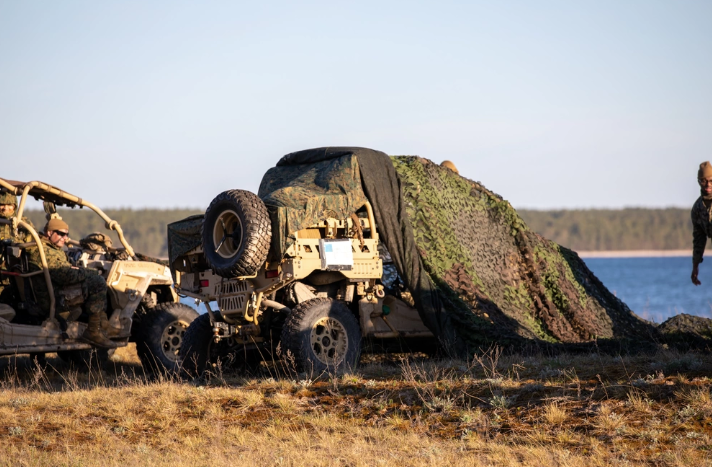
A damning article from the WSJ about the Hedgehog 2025 wargames in Estonia suggests that NATO is not at all prepared for modern combat “in the fifth generation.” It’s not clear if they’re even ready for fourth generation war.
Mind you, wargame media coverage, by design, instills panic so taxpayers support more military spending, but NATO forces still performing so poorly in exercises after almost four years of Ukraine operations should be deeply concerning.
If you don’t know what I mean by “fifth generation war,” you can refer to this article I wrote previously.
According to this WSJ article written by Jillian Kay Melchior,
In Ukraine the front line is largely frozen, but Hedgehog envisioned a battlefield where tanks and troops still have some ability to move. During one scenario, a battle group of several thousand troops, including a British brigade and an Estonian division, sought to conduct an attack. As they advanced, they failed to account for how drones have made the battlefield more transparent, several sources say.
The NATO battle group was “just walking around, not using any kind of disguise, parking tents and armored vehicles,” recalls one participant, who played an enemy role. “It was all destroyed.”
During Hedgehog Ukrainians used Delta, their sophisticated battlefield-management system. It collects real-time battlefield intelligence, uses artificial intelligence to analyze huge amounts of data, identifies targets, and coordinates strikes across command and units. That enables a fast “kill chain”: See it, share it, shoot it—all within minutes or less.
A single team of some 10 Ukrainians, acting as the adversary, counterattacked the NATO forces. In about half a day they mock-destroyed 17 armored vehicles and conducted 30 “strikes” on other targets.
Aivar Hanniotti, an Estonian Defense League unmanned aerial systems coordinator, led an adversary unit of about 100 that included Estonians and Ukrainians. Mr. Hanniotti, who has since left the regular military, describes how they deployed more than 30 drones against NATO troops in an area of less than 4 square miles. That’s only about half the drone saturation Ukrainians currently see at the front, though Col. Probal says the Hedgehog umpires sometimes offset that discrepancy by recording the drone strikes as twice as damaging or more. But even with less reconnaissance than in real life, “there was no possibility to hide,” Mr. Hanniotti says. “We quite easily found cars and mechanized units, and we were able to take them out quite fast with strike drones.”
Overall, the results were “horrible” for NATO forces, says Mr. Hanniotti, who now works in the private sector as an unmanned systems expert. The adversary forces were “able to eliminate two battalions in a day,” so that “in an exercise sense, basically, they were not able to fight anymore after that.” The NATO side “didn’t even get our drone teams.”
More than 15 years ago, the Marine Corps Gazette published a satirical series called The Attritionist Letters (alluding to CS Lewis’s Screwtape Letters) mocking the US military’s bloated and technology-heavy command and control (C2) structure that, among other things, is very easy to pinpoint with signal and geospatial intelligence intelligence systems, conveniently concentrated to destroyed by long-range strikes, and not terribly mobile. So it is likely that in a real battle with Russian forces, who possess far greater deep strike capabilities than Ukraine, NATO division, corps and army group headquarters would find themselves getting hit.

Remember on October 7, 2023 (which I wrote about here) when a Hamas force on paragliders and motorcycles overran IDF positions and captured high-ranking officers and their staff? We have to assume that the Russian ground forces, which have developed dispersed and fast-moving infiltration tactics, would use these “storm” tactics in conjunction with drones, which wasn’t reported happening in Hedgehog. So while it is possible that the media coverage of Hedgehog was overly gloomy, it might actually be understating how badly a NATO coalition force would get stomped by a Russian enemy.
Another reason for pessimism is NATO personnel and officers’ total contempt for Ukrainians, always storming my social media comment sections to insist that of course western armies would do better, because Ukrainians are so stupid and genetically inferior. And they’re apparently completely unbothered by the fact that they consistently lose to Ukrainian units in war games like Hedgehog. You can actually see cope like this in the comments on the original WSJ article:
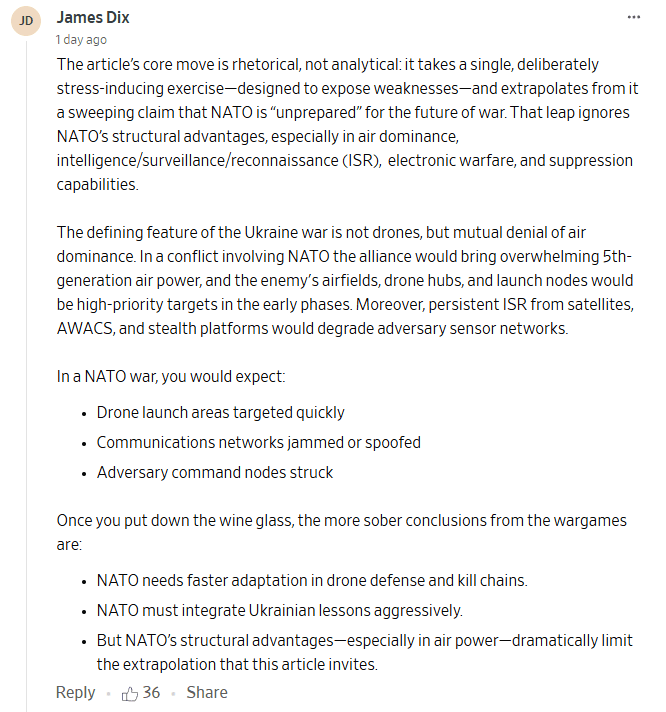
The cope is always the same and always makes the same assumptions. “If we fought Russia then we would have complete air superiority to easily smash their high value assets and our forces would have complete freedom of movement because we’re so great and they are so stupid and genetically inferior.” On what basis do they think NATO would have air superiority when NATO’s latest air defense systems and air-to-air munitions don’t give Ukraine air superiority?
I don’t see the slightest bit of evidence for being so cocky, and cockiness like this does not facilitate a great learning environment.
Image credit, Sgt. Thomas Lamb
Ian Kummer
I now have a new YouTube channel that I will use to upload videos from my travels around Russia. Expect new content there soon. Please give me a follow here.
Also feel free to connect with me on Quora (I sometimes share unique articles there).

I’m seeing all sorts of predictions in the media that in about two years tech advances, particularly in AI, will remove the need to have much of a civilian workforce. This raises the question of what will happen when, for the first time, the elites don’t need the peasants to produce things for them.
We may get something similar with the military, where you won’t need soldiers as much as drone operators, and maybe AI could also handle that task.
It’s true in Ukraine that massed infantry attacks seem to be almost non-existent now. But I still think we’re very far away from drones and/or AI replacing people.
I'm seeing all sorts of predictions in the media that in about two years tech advances, particularly in AI, will remove the need to have much of a civilian workforce. This raises the question of what will happen when, for the first time, the elites don't need the peasants to produce things for them. We may get something similar with the military, where you won't need soldiers as much as drone operators, and maybe AI could also handle that task.
It's true in Ukraine that massed infantry attacks seem to be almost non-existent now. But I still think we're very far away from drones and/or AI replacing people.
[…] and anything can be detected and targeted completely changes the nature of operations, and recent war exercises suggest that NATO still can’t comprehend […]