
As the Ukraine conflict passes the four year mark, there remains a question that has perplexed pro-Russian bloggers and observers since 2022; why is Russia advancing so slowly?
There are many excuses, most of them evasive and apologetic in nature (using logical sounding arguments to defend a pre-existing conclusion), and all are based on the same assumption, that this isn’t “normal.” But why is this not normal?
Consider the western press’s description of Russia’s advance as the slowest since WWI. This is damning criticism, because every schoolboy knows that WWI tactics were brutish, primitive and dumb. But in reality, I think people who compare the Ukraine war to WWI understand neither. WWI happened the way it did because military technology had advanced so rapidly, not because it was primitive. Armies were larger than ever before and frontlines stretched from sea to sea. More than that, nation states were more industrialized than ever before, and able to direct and redirect power in ways that were previously impossible. This is why offensives were such grinding affairs. If the “attacker” succeeded in taking a trench, the “defender” could send reinforcements to take that trench within a few hours.
So WWI was not in fact static or sedentary, but rather the opposite, more dynamic and kinetic than any previous war in human history. Having read several American, German and Russian authors who had personally served in WWI, I have to notice that none of them described tactics in this period as dumb or pointless. Like Konstantin Rokossovsky said in the first chapter of his memoir A Soldier’s Duty (which I translated here), WWI and the following interwar period created the basis of tank, mechanized and air power that would come to fruition in WWII.
Reflecting on this topic, I think the negative stereotyping of WWI happened pretty recently, and started in the USA. There was of course the retired nazi generals who taught Americans to fetishize maneuver warfare, but there was also Vietnam. American leftists were deeply unhappy with the war, and (obviously) didn’t want to fight in it, so characterized American military leadership as ploddish and dimwitted. Leftists made antiwar movies which projected their feelings about Vietnam on every other war ever. WWI was such a shockingly bloody exercise in bad politics, it was low-hanging fruit for the anti-war film director. The classic 1980 movie Stunt Man, which satirizes antiwar movies, is about a mentally unhinged Vietnam vet working in a WWI film production. I am not sure this was actually a deliberate moral of the movie, but it’s very on-the-nose if you think about it.. The cynical film director wants to gratuitously show violence on the pretense of condemning it, and there’s no better setting for such a movie than WWI. Audiences who grew up on such movies would naturally come to associate WWI with senseless blood and gore.
Nevermind that this was not the prevailing attitude during WWI or even afterward. WWI shocked people not because it was dumb or incompetent, but because modern technology had achieved violence on a industrial scale beyond human comprehension.
Consider the Battle of the Somme, roughly 1 million deaths for 10 kilometers.
So not only is the slow pace of territorial gain in Ukraine to be expected, it is not even unprecedented. In the Cold War it was anticipated that no breakthrough would be possible without nukes. And the peer-on-peer wars between reasonably mechanized combatants that did happen, I think, support this assertion. At least the grinding stalemate of the Iran-Iraq War suggests that dramatic advances are difficult without some fairly substantial advantage (even full US support and chemical weapons weren’t big enough advantages for Saddam, apparently).
After four years of fighting in Ukraine, it is possible to make some other general observations:
–Surprise is everything. Offensives that achieve surprise can sweep aside unready border guards and make deep penetrations into enemy territory. The initial Russian attack was the biggest and most successful example of this. These early days can be compared to the “race to the sea” in WWI, when armies, of limited size before fullscale mobilization took effect, were maneuvering, and the Germans squandered their opportunity to immediately take Paris. The late-2022 and 2024 Ukrainian offensives are other examples of initial success before the enemy recovered and new frontlines cemented. The 2023 Ukrainian offensive was such a failure in part because they did not achieve surprise, and apparently didn’t even think surprise was important.
–There is a frontline, but everything is a target. Personnel and equipment must be concealed at all times, and concentrations even far away from the front can be hit at a moment’s notice. Unfortunately it usually requires the school of hard knocks to make soldiers and commanders take enemy air power seriously. As demonstrated by Russians parking their stuff on highways and open fields in 2022 and, even more inexcusably, Ukrainians driving in straight lines without any anti-air defenses in their 2023 offensive. The bitter reality is that NATO has become very accustomed to wars against cavemen, and even now still struggle to imagine an opponent who can use SIGINT and GEOINT to destroy command posts hundreds of miles away from the frontlines. Having to assume anyone and anything can be detected and targeted completely changes the nature of operations, and recent war exercises suggest that NATO still can’t comprehend this.
–Dispersion as reached its extreme. As firepower and communications improved throughout history, it became possible, and necessary, for troops to fight in an increasingly dispersed manner. In the Napoleonic era, columns were replaced by lines that were more agile and could mass fire more efficiently. By the late 20th century, a single squad could cover sectors of fire that used to demand a whole battalion. Now in Ukraine, massed infantry attacks commonplace in earlier battles like Mariupol and Avdeevka have been almost entirely been replaced by infiltration tactics by two man teams. As a result, the “grayzone” has become more porous than ever before, with opposing forces deeply intermingled with each other even weeks or months after a town has “officially” changed hands.
And lastly, I will leave you with this 1944 German propaganda poster mocking the pace of the Allied advance in Italy.
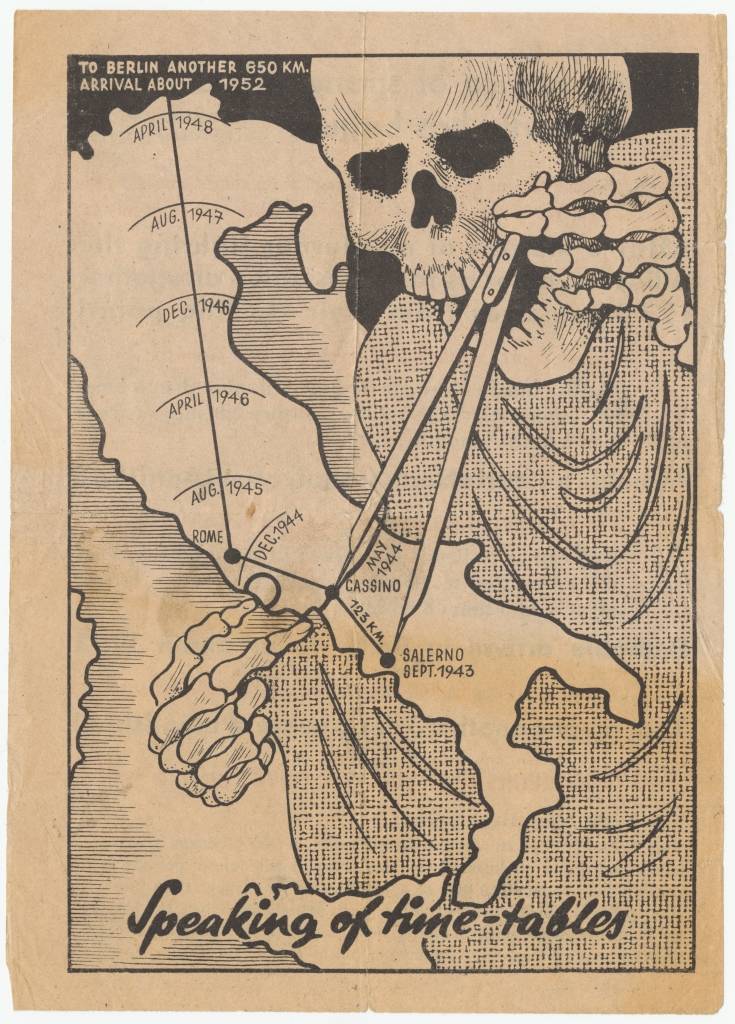
The poster makes fun of the allied forces’ glacier-like advance, taking eight months and heavy casualties to advance from Salerno to Cassino. At that same speed, they wouldn’t reach Rome until December, and Berlin in 1952. But of course that’s not what happened. Rome was liberated the following month, and Germany completely collapsed a year later, without any of this 1952 business. As it turns out, once an army has been defeated, the rest of the board can be taken without opposition. Shocking, right?
On a personal note, my Facebook is gone. This has happened before but I always was able to get it restored within a few hours. But as of now,it’s been more than two days, and I am starting to think this is permanent. As much as I hate Mark Zuckerberg, Facebook was my main marketing tool. So if you like my writing here, please share it far and wide. I am writing almost every day now and appreciate new readers.

As I mentioned on Sunday, I am now in Crimea, so will include Crimea-related news in my upcoming posts. Stay tuned!
Ian Kummer
I now have a new YouTube channel that I will use to upload videos from my travels around Russia. Expect new content there soon. Please give me a follow here.
Also feel free to connect with me on Quora (I sometimes share unique articles there).

There have been many “revolutions” in warfare, but many improvements were incremental. Some completely transformed warfare.
Iron — No contest for the side that mastered it
Gunpowder — Invincible weapons at distance, 100/0 score against a side that had none
Cannon — Goodbye city walls, castles, fortifications
Machine gun — No massing of forces and brave charges could overwhelm
Railways — Scaled wars from tens or hundreds of thousands to tens of millions
Nuclear — Full-scale war becomes suicidal
Electro-magnetic — Invisible dimensions overmatch physical weapons
There have been many "revolutions" in warfare, but many improvements were incremental. Some completely transformed warfare. Iron — No contest for the side that mastered it Gunpowder — Invincible weapons at distance, 100/0 score against a side that had none Cannon — Goodbye city walls, castles, fortifications Machine gun — No massing of forces and brave charges could overwhelm Railways — Scaled wars from tens or hundreds of thousands to tens of millions Nuclear — Full-scale war becomes suicidal Electro-magnetic — Invisible dimensions overmatch physical weapons
I’ll put this comment here instead of on Quora, but you hit a minor pet peeve of mine.
World War I is a war that I happen to be really well read up on, and just about no military historian thinks the Germans had much of a chance of taking Paris in 1914. In fact it seems they weren’t trying to, their main plan was to get into the rear of the French armies on the German border, with the backup plan of taking as many French coalfields as possible. What actually happened was that the German advance outpaced their supply lines, so the German units just stopped, and then retreated to the nearest ridge line and stayed there for four years.
As for the slow pace of the Russian advance in the Ukraine War, I suspect that every time the Russians take a village, they have to stop and send in teams to find and deal with the stay behind subversion teams left by NATO. The retreating Germans did the same in World War 2, but the call was made to press on to Berlin, and deal with elements such as the Forest Brothers (the Baltics, but there were similar groups in Ukraine) after the war. Since the globalist operation in Ukraine was to be in support of the main goal, a color revolution in Russia itself, the subversion teams wound up being the main objective of the Russian advance.
I have only surface level knowledge of WWI and the German “opportunity to take Paris” so you could be absolutely right.
I'll put this comment here instead of on Quora, but you hit a minor pet peeve of mine. World War I is a war that I happen to be really well read up on, and just about no military historian thinks the Germans had much of a chance of taking Paris in 1914. In fact it seems they weren't trying to, their main plan was to get into the rear of the French armies on the German border, with the backup plan of taking as many French coalfields as possible. What actually happened was that the German advance outpaced their supply lines, so the German units just stopped, and then retreated to the nearest ridge line and stayed there for four years. As for the slow pace of the Russian advance in the Ukraine War, I suspect that every time the Russians take a village, they have to stop and send in teams to find and deal with the stay behind subversion teams left by NATO. The retreating Germans did the same in World War 2, but the call was made to press on to Berlin, and deal with elements such as the Forest Brothers (the Baltics, but there were similar groups in Ukraine) after the war. Since the globalist operation in Ukraine was to be in support of the main goal, a color revolution in Russia itself, the subversion teams wound up being the main objective of the Russian advance.
[…] As I noted in yesterday’s post, Russian advances are the slowest “since WWI.” We’re talking less than 100 meters a day in some places. How could Ukrainian troops possibly not be able to clean up the bodies unless they just can’t because they’re dead? […]
The Russian soldiers are invading a sovereign country, are part of a criminal enterprise and know it. They take part in the war due to the pressure and payment, and have no moral for the fight. The Ukrainians on the other hand are defending their lives, families and freedom, and have a reason to fight. That’s why, and why do you support the Russian side in this war, Ian? To please your Russian wife?
So if that’s the key factor, why aren’t the Ukrainians advancing?
The Russian soldiers are invading a sovereign country, are part of a criminal enterprise and know it. They take part in the war due to the pressure and payment, and have no moral for the fight. The Ukrainians on the other hand are defending their lives, families and freedom, and have a reason to fight. That's why, and why do you support the Russian side in this war, Ian? To please your Russian wife?
I have only surface level knowledge of WWI and the German "opportunity to take Paris" so you could be absolutely right.
Sigurd Lydersen, So if that's the key factor, why aren't the Ukrainians advancing?
Why Are Ukrainian-Russian Body Exchanges So Lopsid, This question seems to forget/ignore the fact that with 100s of drones buzzing constantly above any part of the frontlines, the last thing living soldiers would be trying to do is trying to recover their dead. Especially given their manpower issues.