
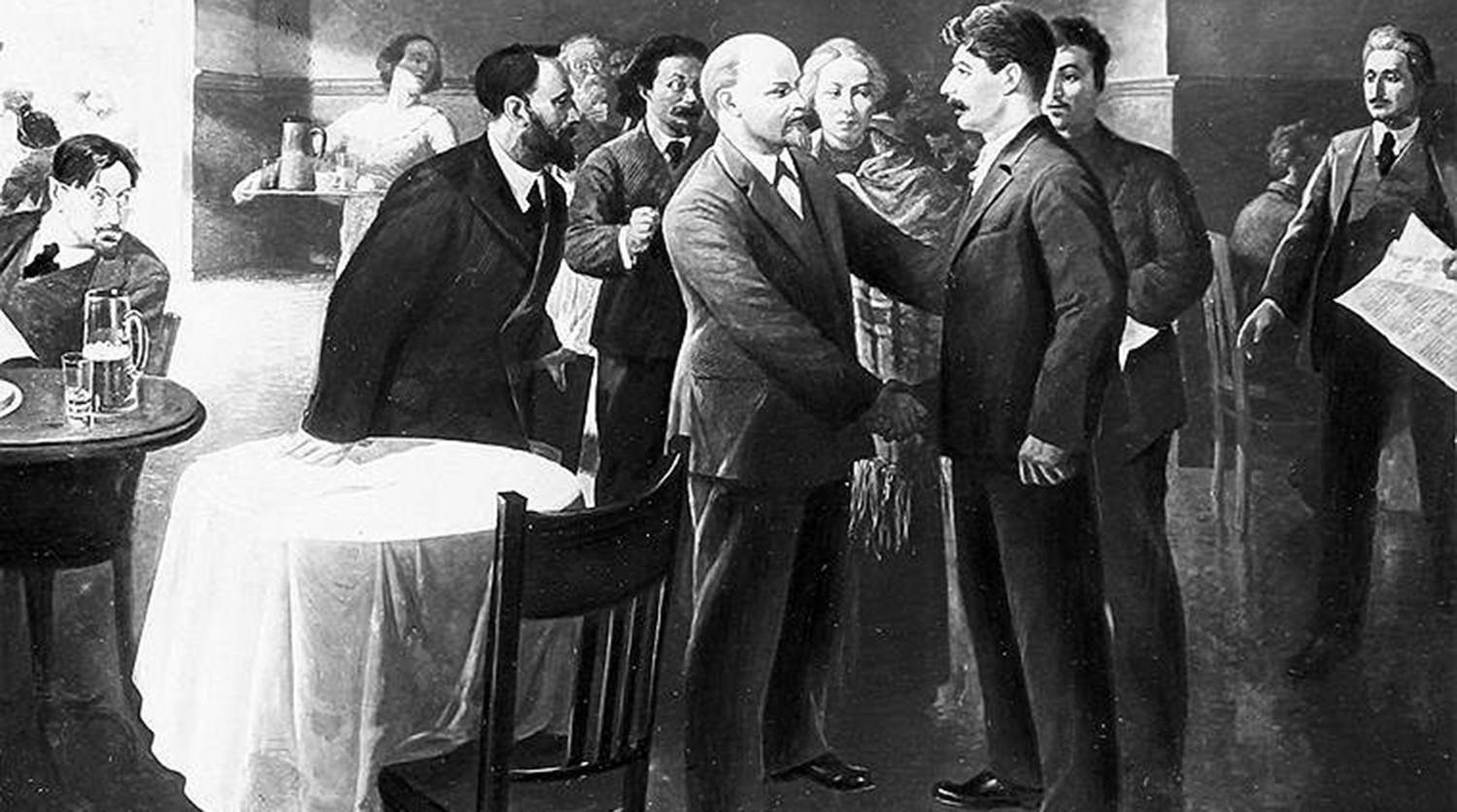
Recently I came across this novelty in a small basement bookstore in central Moscow, a contemporary biography of Stalin, the man of steel himself. The book is like a time capsule to a different era. Before Krushchev’s de-Stalinization. Before even the legend of “Bloody Uncle Joe,” the mustached monster who eats naughty American schoolchildren who neglect their homework or stay up past bedtime.
If you want a glimpse of Soviet ideology, their perceptions of the world, and their perceptions of Stalin himself, untainted by historical revisionism, this is a good book to read.
Over the next several weeks I will publish my personal translation of this book in chapters. There are already other free translations floating around the internet, but this one is mine, with my own style and notes.
By Alexandrov G.F., Galaktionov M.R., Krugkov V.S. and others.
Moscow, 1947
By Alexandrov G.F., Galaktionov M.R., Krugkov V.S. and others.
Moscow, 1947
Chapter 1: 1879-1903
Chapter 2: 1904-1907
Chapter 3: 1907-1912
Chapter 4: 1912-1917 (COMING SOON)
Chapter 5: 1917-1918
Chapter 6: 1918-1919
Chapter 7: 1920-1926
Chapter 8: 1926-1929
Chapter 9: 1929-1936
Chapter 10: 1936-1941
Chapter 11: 1941-1946
Chapter 2 covers Stalin’s exploits after escaping from exile in 1904 to the 1905 Russian revolution and the fifth party congress in April 1907.
For nearly two years Stalin was imprisoned in the village. During these years the revolutionary mood spread across Russia. Meanwhile the second congress of the RSDWP saw a solid victory of Marxism over “economism. But a new opportunist movement arose, the menshiviks (the minority). Lenin’s bolsheviks (the majority) bitterly feuded with the mensheviks and their rascally and destabilizing activities.
At the start of the Russo-Japanese War and the wave of strikes that followed further agravated this feud. Lenin held a third congress to navigate the party out of this crisis. The fight with the menshiviks became the central goal of all bolsheviks. Stalin, who had the upmost confidence in Lenin’s cause against the menshiviks, became the head of the South Caucasian bolsheviks, and worked under the flag of fierce ideological battle against the menshiviks. Stalin worked together with Mikhail Tskhaya to lead the Caucasus Union Committee of the RSDWP. He systematically campaigned in the South Caucasus; Batum, Chiatura, Kutaisi, Tiflis, Baku, and the rural regions of Southern Georgia, strengthening the old party organizations and creating new ones. He participated in the ideological grappling with menshiviks and other enemies of Marxism in energetic group discussions, giving an energetic defense of the bolshevik position.
Stalin and Prokofy Dzhaparidze led a grand strike of Baku workers in December 13-31, 1904. This was the first oil sector strike in the history of the Russian worker movement. The Baku strike spearheaded the revolutionary movement in the South Caucasus and, according to Stalin, “signaled the glorious January-February operation across Russia.”
This strike would be described in future history books as “like lightning the day before the great revolutionary storm in Russia.”
Stalin carried out the directives of Lenin, spreading bolshevik ideas to the masses, and organized the struggle for the third party congress. He served as a direct link between Lenin an the Caucasus, head of the Caucasian bolsheviks in the struggle against menshiviks, the socialist-revolutionaries, nationalists and anarchists in the first Russian revolution. Stalin was the organizer of nearly all bolshevik publications int he Caucasus, including illegal books, newspapers, brochures and proclamations against the Russian tsar.
A fantastically brave company of the Caucasus union of the RSDWP operated a secret print shop in Avlabari district of Tiflis from November 1903 to April 1906. They printed Lenin’s works “Revolutionary Democratic Literature of the Proletariat and Peasants” and “To the Rural Poor,” and Stalin’s brochures “A Short Explanation of Party Dissent” and “Two Struggles” and many of his other short essays. They also printed newspapers called “Proletariat Struggle” and numerous other publications in three languages.
In his role as editor in the Caucasian Union, Stalin played a decisive role in the spread and defense of bolshevism and Leninist ideas in the Caucasus. Proletariat Struggle was the best and most influential bolshevik newspaper besides the central party’s Proletariat, almost every issue reprinted Lenin’s articles for Proletariat, and Stalin wrote many important articles too. In these articles, he proved himself such a talented polemist, a cornerstone of literary and theoretical force of the party, leader of the proletariat, and faithful follower of Lenin. In his articles and brochures, Stalin answered political questions and exposed the ideological falsehood and treason of the anti-bolshevik factions. Every blow against the enemy delivered precisely and with calculation. Lenin admired Proletariat Struggle and its tone of Marxist commitment and literary qualities.
Stalin, Lenin’s most faithful student and companion, played the most important role in the ideological defeat of menshivism in the Caucasus and the defense of the theoretical, organizatonal and tactical principals of the Marxist party. He was the most shining example in the defense of Leninism against opportunism.
In his great brochures A Short Explanation of Party Dissent and Letters from Kutaisi and article In Response to the Social-Democrat, Stalin decisively defended the ideological principles of the Marxist party.
His series Letters from Kutaisi (September-October 1904), Stalin gave a sharp rebuttal to, an article written by Georgy Plekhanov published in the New Spark. opposing Lenin’s earlier article, What To Do? Giving a faithful defense of the Leninist question of spontanity and education of the worker movement, Comrade Stalin wrote,
“In conclusion, to raise the proletariat to class consciousness and socialist ideas, and not lose it in exchange for inconsequential gains of the spontaneous movement. Lenin gave the theoretical basis on which the practical conclusion is built. Build only on this theoretically sound foundation, and don’t get distracted by opportunism or what is close by. This is the idea of Leninism. It is called Leninism because no one else in Russian literature describes the concept with such clarity like Lenin.
The brochure A Short Description of Party Dissent (written at the start of 1905 and printed in illegal publications in May) clearly described the ideas of bolshevism. Inspired by Lenin’s What To Do?, Stalin decisively defended Leninist ideas.
Developing Lenin’s ideas, Comrade Stalin proved that socialist conscience had great impact on the worker movement. But at the same time, warned against the exaggeration of its importance of ideas and forgetting the role of economic development in the worker movement. Can one say that socialism is everything and without it the worker movement is nothing? “Of course not! Only idealists talk this way. Over a very long time, economic development will inevitably bring the working class to socialist revolution, and force them into clear opposition to bourgeois ideology. This road is long and diffcult.”
His brochure A Short Description of Party Dissent, Stalin’s deepest and most balanced argument on the question of spontaneous worker movements and socialist conscience, which he summarized in this way, “What is scientific socialism without the worker movement? A compass left unused will rust and has to be thrown overboard.
“What is the worker movement without scientific socialism? A ship travelling cross the sea without a compass will find only trouble.
“Put the two together and you have a beautiful ship that will sail without trouble and reach safe harbor.
“Put the worker movement and socialism together, and you have a social-democratic movement on a straight path to the promised land.”
Thus the whole history of the clas struggle in Russia was brilliantly summarized by Comrade Stalin. In this brochure, Stalin obliterated the opportunist theory of spontanity’s role in the revolution of the working class.
“The worker movement,” wrote Stalin, “must be unified with socialism, real-life practicality and theoretical thought working in unison, a spontaneous worker movement with social-democratic characteristics… this is our duty, the duty of social-democrats, to keep the worker movement and trade unionists on the path of social-democratism. Our duty is to become the conscience of this movement and transfer power of the working class to one centralized party. Our goal is to become the head of the movement tirelessy fighting both foe and ‘friend’ who would interfere with the implementation of this goal.”
Stalin’s initiative had the full approval of Lenin. His review of Stalin’s In Response to the Social Democrat published by the Central Party in August 1905, called it, “A beautiful response to the question of changing conscience from the outside.”
All of Stalin’s articles adhered to the Leninist line stated in the second congress of the RSDWP and afterward. His article Class of the Proletariat and Party of the Proletariat, published January 1, 1905, in the Proletariat Struggle, from the very first paragraph defended the foundational principles of the party, the teachings of Lenin, and the justifications of Leninist ideas. This article defended the organizational ieas of bolshevism laid out by Lenin in his groundbreaking book, One Step Forward, Two Steps Back.
“Up to the present day,” wrote Stalin, “our party has been like the hospitality of the patriarchal family, which was ready to give a warm welcome. But now our party is like a centralized organization, has completely discarded patriarchy and become a fortress, with doors that open only for the worthy. And for us this has a great meaning. In this time the autocracy tried to corrupt the class consciousness of the proletariat and try to achieve control over them. In this time we must maintain vigilance and not forget that our party is a fortress with doors that open only for those who are verified.
The article How does Social Democracy Understand the Question of Nationality? (published in Proletariat Struggle starting on September 1, 1904), a great commentary for the national program of the RSDWP. Stalin’s article justified and explained theory of the party on the nationalist question, delivered crushing criticism of the opportunists’ principle of divisive nationalism in the proletariat, defended the model of internationalist class organization of the proletariat. This article established Stalin as a strong theorist on the nationalist question who had mastered Marxist dialetics. The data conceptualized in this article were explained further by Stalin in his work Marxism and the Nationalist Question.
Stalin took the first step in the first Russian revolution, decisively establishing and driving Leninist revolutionary strategy and tactic, and the Leninist idea of Hegemony of the Proletariat in revolution.
On January 9, 1905, Stalin took aim at the liberals who aspired for acceptance of tsarism instead of revolution, saying, “Yes, good lord, your attempts are futile! The Russian revolution is inevitable. It is inevitable like the rise of the sun! Can you stop the movement of the sun? The main strength of this revolution is the enlightenment of the urban and rural proletariat, but the standard bearer is the social-democrat worker paty, and not you, liberals!”
Stalin decisively defended the Leninist idea of armed uprising to overthrow the autocracy in the republics. His works in 1905-1907 gave a well-rounded basis for the idea of armed uprising to “Save the people in victorious uprising of the people,” as Comrade Stalin himself put it. Like Lenin, he tirelessly drove technical preparation for the uprising, assembling teams, acquiring arms, and so on. “The technical management and organization of the all-Russian uprising,” Stalin said, “Would be responsible for presenting goals to the proletariat.” Stalin directed the day-to-day activities of bolshevik organizations in the South Caucasus preparing for the armed uprising.
He explained the ideas of Lenin concerning a provisional revolutionary government. The creation of a provisional revolutionary government, he explained, must be the natural result of a victorious armed uprising of the people. After the victory of the proletariat and peasants in the uprising, the provisional revolutionary government must match their aspirations and interests. This government must be a dictatorship of the proletariat and peasants. Only a dictatorship of these revolutionary classes can defeat the dark forces of reactionaries, arm the people, and carry out the RSDWP programs that are the minimum needed to protect the victorious revolution, and carry it out to the end.
“If the advanced proletariat leads the revolution,” Stalin said, “and if they take an active role in the armed uprising, then it is clear we cannot wash our hands of the provisional revolutionary government, and we must seize political power together with the peasantry and incorporate them into that government; leaders on the road to revolution must also be the leaders of the government of the revolution.”
In the struggle against the many enemies of the bolshevik party and the working class, Stalin implemented and expanded Leninist revolutionary theory and the Leninist tactical plan. The greatest element of this plan, was that it explained details of how to involve the wider masses in the struggle and assure them of victory of the revolutionary movement. The Caucasian Union committee relentlessly spread propaganda about the decision of the third party congress, calling workers and peasants to armed uprising. Stalin’s propaganda of 1905 promoted bolshevik ideas to the masses. In his articles, Armed Uprising Is Our Tactic, The Provisional Revolutionary Government and Social-Democracy, and others, Stalin gave devastating critique of menshivik leaders and explained the importance of armed uprising.
The October universal strike of 1905 showed the strength of the proletariat movement, which terrified the tsar into issuing a manifesto on October 17. The manifesto promised freedom in every possible way, a deception meant to buy time for his forces to defeat the revolution. The bolsheviks explained to the masses that the October 17 manifesto was a trap. The manifesto came to Stalin while he was leading revolutionary chants in Tiflis. At a worker meeting, Stalin said, “What do we need win? We need three things; first, weapons; secondly, weapons; and thirdly, more weapons.”
Stalin wrote a proclamation of the Tiflis Caucasian Union committee titled, Citizens! which explained the most important principle of the all-peoples’ armed uprising, “What we are doing is unprecedented and unheard of in scale, not just in the history of Russia, but in the whole world, a universal political strike that, maybe, will end today without an all peoples’ uprising, but tomorrow will come back with even greater force to free the Russian people from tsarist autocracy and smash the head of this vile beast… the all-peoples’ armed uprising, this is the great goal put before the Russian proletariat today and requires your consent!”
In this time Stalin led thunderous revolutionary activity in the South Caucasus. The fourth bolshevik conference of the Caucasian Union of the RSDWP was held under Stalin’s leadership in November 1905, which aimed to reach an agreement about preparation for an armed uprising, a boycott of the tsarist Duma, and, for the strengthening of worker and peasant organizations, the creation of a council of deputies, strike committees, and worker and peasant committees. Stalin exposed and crushed the the menshiviks as opponents of the revolution and armed uprising. He steadily prepared the workers for decisive battle with the autocracy. He spread the fire of revolution across the whole South Caucasus. In the third party congress, Lenin presented a resolution, About Events In the South Caucasus, which declared, “There is no more militant organization in our party” than Stalin’s bolsheviks, and called on everyone to provide them with all possible support.
December 1905, Stalin attended the first all-Russian bolshevik conference in Tammerfors, Finland, as a delegate of the South Caucasus bolsheviks. It was at the Tammerfors conference that Lenin and Stalin met in person for the first time. Stalin was inducted into the political commission as editor of the conference resolutions, where he worked together as one of the highest authorities of the party government.
After the defeat of the December uprising, the beginning of the revolutionary retreat began. The party underwent preparations for the fourth congress of the RSDWP, which was held in April 1906 in Stockholm. The struggle between bolsheviks and menshiviks intensified with new fury. Anarcho-syndicalists appeared on the scene. They were especially noisy in Tiflis and Stalin was the center of the struggle against all anti-proletariat movements in the South Caucasus.
Stalin, as an active participant in the fourth congress, worked together with Lenin to protect the bolshevik revolutionary line against the menshiviks. Stalin posed a response to the menshiviks,
“Hegemony of the proletariat, or hegemony of the bourgeois, that is the question for the party, and it is on this we disagree.”
Soon after the congress Stalin wrote the brochure The Current Moment in the Unified Congress of the Worker Party.” In this brochure Stalin analized the lessons of the December armed uprising and defended the bolshevik line in the fourth congress of the RSDWP.
Again Stalin returned to the South Caucasus. He led an unprecedented struggle against menshivism and other anti-proletariat movements. He managed the Georgian language bolshevik newspapers in Tiflis, New Life, New Time, Our Life, and Time.
During this period, Stalin wrote an amazing article, Anarchism Or Socialism? concerning the activism of anarchists in the South Caucasus.
In the situation of the revolution’s retreat, defending the theretical principles of the party and bolshevism became the order of the day. In 1909 Lenin published his brilliant work Materialism and Empirical Criticism, in which he recreated the main theories of Marxism and the theoretical basis of the bolshevik party.
Stalin also took on the defense of Marxism. In his articles, Stalin developed the theoretical basis of the Marxist party; dialetics and historical materialism. Stalin published articles in Georgian bolshevik magazines in the years 1906-1907. In an accessible and popular format, he explained what materialism and dialectics are, and what is historical materialism. He posed and resolved questions of Marxist-Leninism with exceptional depth; the inevitability of socialist revolution and dictatorship of the proletariat, and the importance of an armed proletariat party. A party of a new type different from the old, the second reformist internationalist party, and explaining the basis of its strategy and tactics. These articles by Stalin were an ideological treasure of our party, and serious entries in the theory of Marxist-Leninism with a close connection to the immediate goals of the revolutionary class struggle of the proletariat.
In April-May 1907 the fifth congress of the RSDWP convened in London and resulted in a clear victory of the bolsheviks over the menshiviks. Stalin was an active participant in the congress. After returning from the congress he wrote an article about his work there titled The London Congress of the Russian Social-Democrat Worker Party (Notes of a Delegate), in which he assessed the outcomes of the congress, defended bolshevik ideological and tactical positions, and exposed the liberal bourgeois menshiviks as harmful to the party.
By Alexandrov G.F., Galaktionov M.R., Krugkov V.S. and others.
Moscow, 1947
Chapter 1: 1879-1903
Chapter 2: 1904-1907
Chapter 3: 1907-1912
Chapter 4: 1912-1917 (COMING SOON)
Chapter 5: 1917-1918
Chapter 6: 1918-1919
Chapter 7: 1920-1926
Chapter 8: 1926-1929
Chapter 9: 1929-1936
Chapter 10: 1936-1941
Chapter 11: 1941-1946
Ian Kummer
I now have a new YouTube channel that I will use to upload videos from my travels around Russia. Expect new content there soon. Please give me a follow here.
Also feel free to connect with me on Quora (I sometimes share unique articles there).