
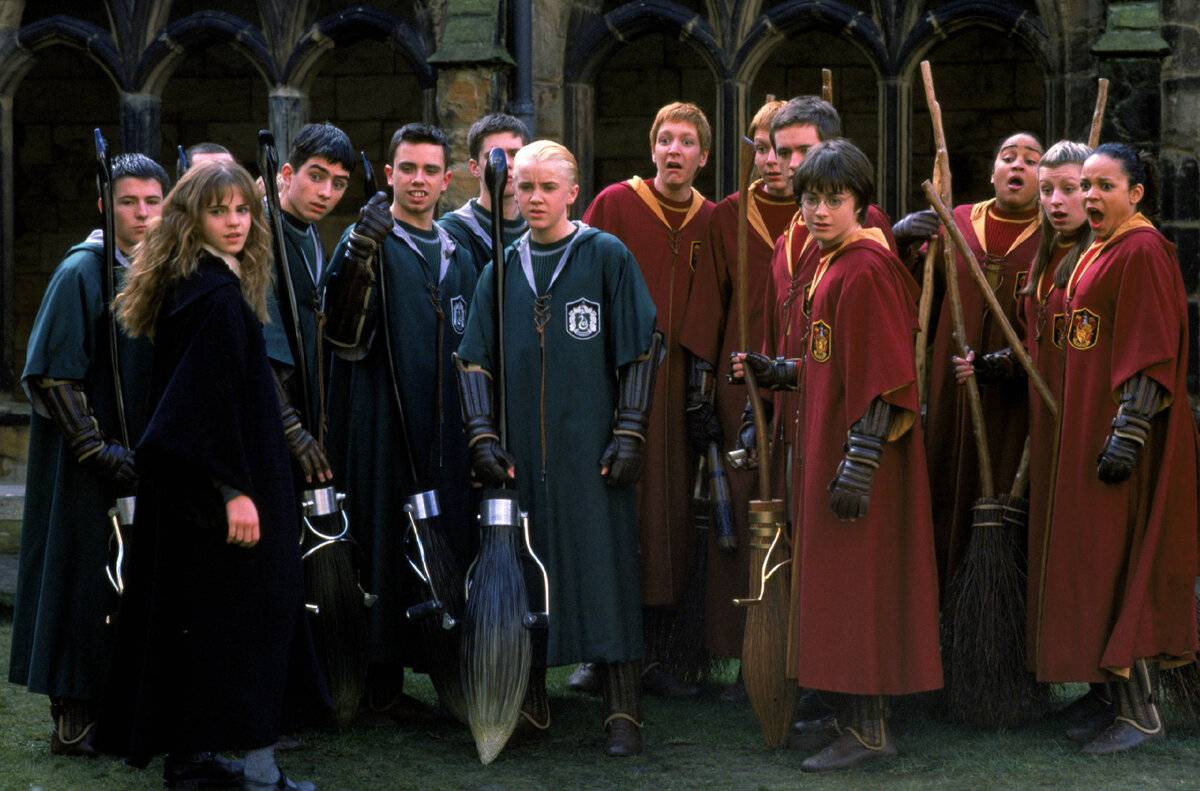
If you’re a 90s kid like myself, you’ve probably noticed that Harry Potter is just a lot less popular than it was 25 years ago. Sure, there are still hundreds of millions HP books in circulation and new media being produced in, God help me for saying this, the same cinematic universe, but despite all that, it’s not the cultural phenomenon it was in our childhood. The reason why, I think, is ideological.
The London Times blames Harry Potter’s decline on kids just not reading books anymore, which may be at least partially true. The New York Times has a much spicier explanation, and one that I am in general agreement with,
Young people on both the right and the left are also less wedded to political institutions. Those of us born in the 20th century had grown used to the idea that the right stands for tradition and the left for reform. In the liberal era, everyone was expected to hew quite closely to the status quo.
But what we see now is that both factions stand for revolution [empasis mine]. The conservative writer Rod Dreher recently asked a young man in Washington to outline the demands of his generation’s right-wing radicals. “They don’t have any,” he replied; “they just want to tear everything down.”
The Zoomer left is no less radical. In the world of Harry Potter, the good guys do not deliberately kill, but instead stun or disarm their opponents. Here Ms. Rowling endorses a liberal commitment to nonviolence that appears to be falling out of favor, particularly on the left. In a recent YouGov poll, the respondents most likely to endorse the statement “political violence can sometimes be justified” skewed young and left wing. We saw a glimpse of this change in norms after the assassination of Charlie Kirk, when some young leftists responded with indifference bordering on glee.
J.K. Rowling’s world is indeed one of status quo. It’s a world of stagnation, literally emulating Ayn Rand’s satirical novel Anthem about a socialist government that refuses to develop electricity because that would put the candlemakers out of business (wizards literally use candles for some reason). There’s magic, yet there’s still inequality and even poverty. All problems in Harry Potter’s world are treated as inevitable, and trying to fix them is ridiculed as pointless and foolish. Magic people even walk around with bags of gold in their pockets, like it’s still the 1800s. Carrying around literal gold coins is not at all a convenient monetary system, but it well represents the magic peoples’ hysterical and stubborn fear of change.
The revolutionaries of the magic world are Voldemort and his fashy Death Eaters, who are an obvious reference to the KKK or Hitler’s brownshirts. They have grievances about how the wizard government rules, and are using force to change it. Death Eaters argue that magic people are superior so should rule the world instead of hiding in the shadows, and race-mixing with non-magic people is disgusting. Rowling’s portrayal of the Death Eaters is of course a deliberate reference to racism and antisemitism. Racism and antisemitism being bad were the two founding principles of all western civilization in Rowling’s lifetime and their truth goes without saying. An emotionally neutral person might say that if someone is literally a wizard then he probably should rule the world, and probably shouldn’t fraternize with non-magic women, but this doesn’t occur to Rowling. It might have occurred to a more thoughtful author that she does need to provide an actual in-universe explanation for why the Death Eaters are wrong about wizard supremacy and race mixing, but unquestioning acceptance of the mainstream moral code is a defining trait of status quo liberalism. Murder is bad, racism is bad and so on and it is not necessary to think about why we have those rules.
So fashy Death Eaters are of course bad, and unquestionably bad with no character seriously arguing that they might be the good guys. Curiously, there’s no organized leftist movement mirroring the Death Eaters. Hermione, as a muggle girl, is horrified to learn that wizards keep house elves as slaves, despite them being sentient. So she tries to organize a house elf emancipation movement. Every other character ridicules Hermione for having such a silly idea, because, actually, house elves enjoy being slaves so enslaving them is a good thing. I find it particularly funny that Rowling immediately defeats her own argument by showing a house elf who is obviously abused and is very happy when he’s freed. Being able to point out the existence of a happy slave doesn’t mean there are unhappy slaves, or that slavery is good. Surely, house elf emancipation could mirror various human emancipations; all workers have rights and a mistreated worker can voluntarily leave, but such an idea never occurs to anyone besides Hermione. This is another example of status quo liberals not being able to explain their own belief system. And more importantly, it is a major example of status quo that is portrayed as inevitable. The system already has adequate progressivism, so activists like Hermione insisting on more progressivism are portrayed as naive and foolish. So foolish, she completely fails to create a movement that’s comparable in organization to the Death Eaters.
Yet, like the NYT article quoted above stated, the status quo liberalism of the Harry Potter universe has qualities that can be seen as admirable, particularly the enshrinement of free speech and non-violence. The House of Slytherin is openly rebellious against the magic liberal government, but it isn’t shut down. This is a bit like a real boarding school having a nazi house that openly advocates nazi revolution. While this might be a little ridiculous, it does reflect the author’s commitment to free speech. Harry Potter and his friends don’t use violence to intimidate their opposition at school, and likewise the good authority figures like Dumbledore don’t use their positions to silence dissenting viewpoints. On that same theme, the author very much believes in speaking truth to power. Harry is incredulous at the idea of self-censoring and never speaking Voldemort’s name like you’re supposed to. This is actually my favorite theme in the books. Harry grew up with muggles, so wasn’t subjected to the brainwashing imposed on other wizards from birth, so becomes a warrior for truth. Speaking of which, Harry and Hermione both having non-magic upbringings could be a compelling argument against the Death Eaters’ magic supremacy, if the author had thought of it, but anyway.
The biggest secondary villain in the later books is Dolores Umbridge, who implements a regime of censorship, and severely punishes anyone who tries to say that Voldemort exists and is about to take over the world. This is the Harry Potter’s series’ main argument in favor of free speech. The bad guys get free speech, but lose in the marketplace of ideas; and censorship actually helps the bad guys, even if that wasn’t the regime’s intent.
Yet at the same time, these later books cement Harry as part of the system, not a revolutionary like Voldemort. Harry’s clandestine student group Dumbledore’s Army is not an insurgency. They’re reactionaries against Slytherin and the Death Eaters, and they play by the rules. While it might be tempting to argue that Death Eaters and Dumbledore’s Army are two competing revolutions, that’s not factually correct. DA are not revolutionaries in any sense of the term.
So perhaps it should come as no surprise that the Harry Potter story fails to resonate with post-millennial generations. The rules based world order still had the faith of most western people in the 1990s and early 2000s, but decades of economic decay and social strife have eroded such confidence, on both the right and the left. When was the last time you heard an American invoke the Constitution, even as a joke? I think the deification of the US Constitution started in the Cold War, when it was ideologically important to give some magic reason why America was better than competing regimes. It started with boomers, and will likely die with them. In an era of grotesque corruption, lawfare and street violence, no one things our constitution is magic anymore. And that’s why no one cares about Harry Potter anymore either.
Ian Kummer
I now have a new YouTube channel that I will use to upload videos from my travels around Russia. Expect new content there soon. Please give me a follow here.
Also feel free to connect with me on Quora (I sometimes share unique articles there).
No, the Death Eaters aren’t some American group most children in the 1990s UK hadn’t even heard of. They’re the IRA. Their period of operation (1970–1998) coincides with the Irish Troubles (1969–1998). They wear black Balaclava helmets (it’s clear in the text that their “mask” is also their hood, but there’ no mention of the points added by Warner’s, which may mean KKK in the US, but in the UK mean “Dunce’s cap”, a symbol of stupidity). The Death Eater prisoners starving themselves in Azkaban are the IRA hunger-strikers in The Maze. The mass escape of Death Eaters from Azkaban is the mass escape of IRA prisoners from The Maze. The Death Eater attack on the Brockdale Bridge happens within a few weeks of the IRA attack on the bridges carrying the Docklands Light Railway.
If you *must* force them into an American model, they’re the Black Panthers – an extremist group spawned by a tiny, persecuted minority, in revolt against people who outnumber them at least six thousand to one, and used to burn them at the stake just for existing. But of course, many Americans are so ignorant that they don’t know that the IRA were terrorists trying to force communism on an Ireland that didn’t want it, not heroic freedom fighters (at least not after the 1920s).
I can’t imagine British kids not knowing about the KKK, even Russian kids had heard of them. As for the IRA and blackpanthers, most global audiences consider them the good guys.
No, the Death Eaters aren’t some American group most children in the 1990s UK hadn’t even heard of. They’re the IRA. Their period of operation (1970–1998) coincides with the Irish Troubles (1969–1998). They wear black Balaclava helmets (it’s clear in the text that their “mask” is also their hood, but there’ no mention of the points added by Warner’s, which may mean KKK in the US, but in the UK mean “Dunce’s cap”, a symbol of stupidity). The Death Eater prisoners starving themselves in Azkaban are the IRA hunger-strikers in The Maze. The mass escape of Death Eaters from Azkaban is the mass escape of IRA prisoners from The Maze. The Death Eater attack on the Brockdale Bridge happens within a few weeks of the IRA attack on the bridges carrying the Docklands Light Railway. If you *must* force them into an American model, they’re the Black Panthers – an extremist group spawned by a tiny, persecuted minority, in revolt against people who outnumber them at least six thousand to one, and used to burn them at the stake just for existing. But of course, many Americans are so ignorant that they don’t know that the IRA were terrorists trying to force communism on an Ireland that didn’t want it, not heroic freedom fighters (at least not after the 1920s).
I can't imagine British kids not knowing about the KKK, even Russian kids had heard of them. As for the IRA and blackpanthers, most global audiences consider them the good guys.