
Recently I came across this novelty in a small basement bookstore in central Moscow, a contemporary biography of Stalin, the man of steel himself. The book is like a time capsule to a different era. Before Krushchev’s de-Stalinization. Before even the legend of “Bloody Uncle Joe,” the mustached monster who eats naughty American schoolchildren who neglect their homework or stay up past bedtime.
If you want a glimpse of Soviet ideology, their perceptions of the world, and their perceptions of Stalin himself, untainted by historical revisionism, this is a good book to read.
Over the next several weeks I will publish my personal translation of this book in chapters. There are already other free translations floating around the internet, but this one is mine, with my own style and notes.
By Alexandrov G.F., Galaktionov M.R., Krugkov V.S. and others.
Moscow, 1947
Chapter 1: 1879-1903
Chapter 2: 1904-1907
Chapter 3: 1907-1912
Chapter 4: 1912-1917 (COMING SOON)
Chapter 5: 1917-1918
Chapter 6: 1918-1919
Chapter 7: 1920-1926
Chapter 8: 1926-1929
Chapter 9: 1929-1936
Chapter 10: 1936-1941
Chapter 11: 1941-1946
Chapter 1; 1879-1903
Joseph Vissarionovich Stalin (b. Dzhugashvili) was born on December 21, 1879, in Gori, Tiflis governate. His father, Vissarion Ivanovich, an ethnic Georgian bootmaker from the peasant village of Didi Lilo, worked in the Adelkhanov shoe factory in Tiflis (now Tbilisi, Georgia). His mother, Yekaterina Georgievna, was from the serf family Geladze in the village of Gambareuli.
In Autumn 1888 Stalin entered the city spiritual school. In 1894, Stalin finished school and in the same year entered the Tiflis Orthodox Spiritual Seminary.
Russia in these years experienced capitalist industrialization and the rise of the worker movement which began the spread of marxism. The League for the Emancipation of the Working Class, founded and led by Lenin in Saint Petersburg, achieved a great breakthrough for the spread of the social democratic movement across the country. Waves of the worker movement reached the South Caucasus, which was already penetrated by capitalism, and under national-colonial oppression. The South Caucasus was a typical example of Russian colonial tsarism; an economically depressed feudal agrarian region populated by several nationalities living together.
In the last quarter of the 19th Century, the capital of the South Caucasus quickly arose through the exploitation of workers and peasants living under national-colonialist oppression. Industry appeared very quickly in the mountains, focused on the extraction and refinement of oil, and international capital gained a strong position. Lenin wrote, “Russian capitalism dragged the Caucasus into the international trade community, erased its local attributes, except for old patriarchy, and created for itself a market for its factories. A country that was sparsely populated mountains at the start of the reformation period, isolated from the global economy and even history, became a country of the oil industry and the trade of wines, wheat, tobacco…” With the appearance of the railroad and the first factories and plants in the Caucasus, the working class appeared with it. With the very fast expansion of the oil industry, Baku (now capital of Azerbaijan) became the center of industry and labor in the Caucasus.
Capitalist industrialization brought with it the rise of the worker movement. In the 1890s, Russian marxists brought revolutionary activity to the South Caucasus, and began to spread marxist propaganda. The Tiflis Orthodox Seminary became a breeding ground of all kinds of ideas about liberation shared between the youth, whether they were popular-nationalists, or marxist-internationalists. The seminary became full of various secret circles.
The strict religious regime of the seminary provoked Stalin into a fiery protest, nurturing and strengthening the revolutionary furor within him. 15-year-old Stalin became a revolutionary.
Stalin wrote, “I entered the revolutionary movement at 15 years of age, when I joined an underground group of Russian marxists living in the South Caucasus. I became extremely interested in this group and they gave me a taste for underground marxist literature.”
In 1896-1897, Stalin became the head of marxist circle at the seminary. In August 1898, he formally joined the Russian Social Democratic Worker Party (RSDWP). Stalin joined Mesami Dasi (meaning “Third Group” in Georgian), the first Georgian social democratic organization, which played a famous role in the spread of marxist ideas in the years 1893-1898. Mesami Dasi was not politically unified; the majority of members believed in some form of “legal marxism” and leaned toward bourgeois nationalism. Stalin, Lado Ketskhoveli and Alexander Tsulukidze were the core leaders of the minority faction of Mesami Dasi who gave rise to revolutionary social-democracy in Georgia.
Stalin persistently and tirelessly improved himself. He studied Marx’s Das Kapital, the Communist Manifesto, and other works by Marx and Engels. He acquainted himself with the works of Lenin opposed to the ideas of populism, legal marxism, and “economism.” Already, Lenin’s publications made a deep impression on Stalin.One of his close comrades in this period later recalled that after reading the work of “Tulin” (one of Lenin’s pseudonyms), Stalin declared, “I must meet him.” Aside from theoretical works, Stalin deeply studied philosophy, political economics, history, natural sciences, and read classical literature. Stalin became an educated marxist.
At this time, Stalin led an intensive propaganda campaign in worker circles, participated in illegal worker meetings, wrote pamphlets and organized strikes. This became the first school of practical revolutionary work that Stalin relayed to the “advanced proletariat” of Tiflis.
“I remember,” Stalin said, “in 1898, when I met for the first time a circle of railroad workers. Here, surrounded by these comrades, I received my revolutionary baptism of fire… the workers of Tiflis were my first students.”
Marxist activities in worker circles proceeded according to Stalin’s program.
In the seminary, where there was strict surveillance for “suspicious activity,” staff began to guess at Stalin’s illegal revolutionary work. On May 29, 1899, he was expelled from the seminary for spreading marxist propaganda. After a brief interruption in his studies, Stalin began work at the Tiflis physics observatory, though not for one minute did he stop his revolutionary activities.
By now Stalin was already one of the most energenic and well-known members of the Tiflis social-democratic organization. In 1898-1900, Stalin exhaustively worked to form and lead the central leadership group of the social-democratic movement in Tiflis. The group produced fiery revolutionary propaganda and organized the creation of more illegal social democrat organizations. Lenin’s League for the Emancipation of the Working Class served as a template that Stalin followed without deviation. The worker movement in Tiflis under the leadership of the revolutionary minority of Mesami Dasi, Stalin, Ketskhoveli and Tsulukidze, began to move away from the old framework to produce propaganda work of extraordinary clarity and unity. The first plan was to produce pamphlets on relevant topics and organize provocative meetings and political demonstrations against life under tsarism.
These new tactics ran into the bayonets of the opportunistic majority of the Mesami Dasi, who leaned toward economism and shunned the “street tactics” of the political battle against autocracy. Stalin and the revolutionary minority of Mesami Dasi led a bitter and irreconcilable fight over these new tactics, the tactics of massive political agitation.
Victor Kurnatovsky, an educated marxist, faithful follower and close colleague of Lenin, brought Leninist ideas to the Caucasus and played a crucial role in the transition of the Tiflis social-democratic movement to the new methods. Upon arriving in Tiflis in Summer 1900, Kurnatovsky formed a tight partnership with the revolutionary minority of the Mesami Dasi, and became a close friend and colleague of Stalin.
In December 1900 when the revolutionary newspaper Iskra (Spark) was published, Stalin assumed their positions in their entirety. He saw Lenin as the creator, commander-in-chief, and teacher of the true marxist party.
“My acquaintance with the revolutionary activities of Lenin at the end of the 1890s, especially starting in 1901 after the publication of Iskra, led me to the conviction that what we have in the personality of Lenin is not an ordinary individual,” Stalin wrote. “In my eyes, he was not simply the leader of the party, he was in fact its creator. He alone understood the inner spirit and dire needs of the party. When I compared him to other party leaders, it always seemed to me that Lenin’s colleagues, Plekhanov, Martov, Akselrod and others, stood a full head and shoulders below him. In comparison to them, Lenin was not just one of the leaders, he was of a superior type of leader, a mountain eagle, who did not know fear in battle and bravely led the party into the uncharted territory of the Russian revolutionary movement.”
Stalin had deep, limitless faith in Lenin’s revolutionary genius and followed in his footsteps. He never deviated from this path and, after Lenin’s death, continued his cause with courage and faith.
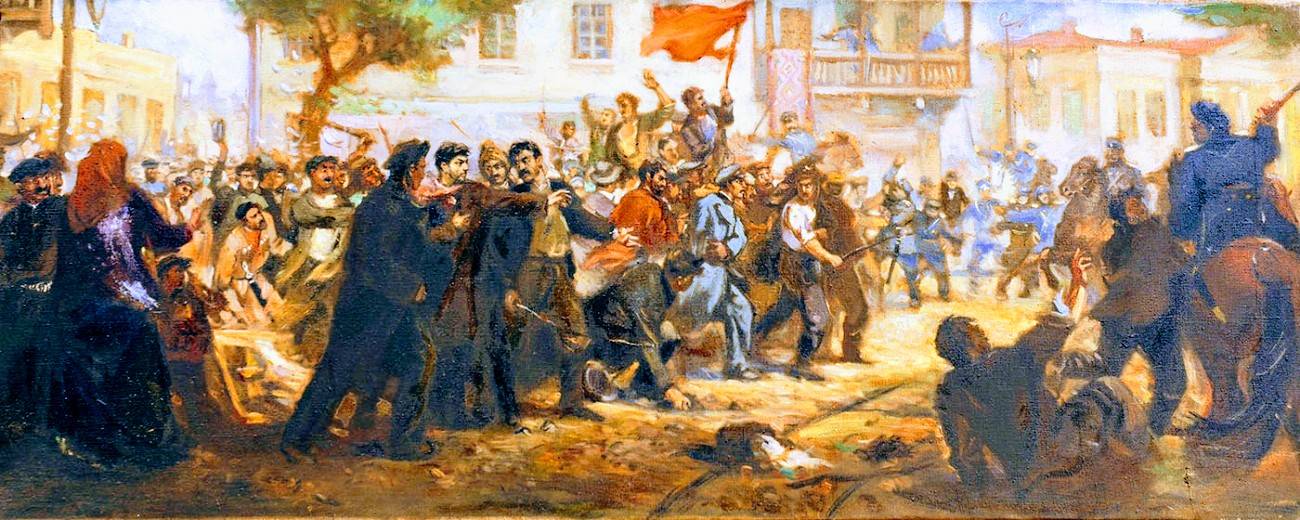
At the beginning of economic crisis, under the influence of social democrats in Tiflis in 1900-1901, there was a wave of economic strikes, hitting one enterprise after the other. In August 1900, there was a grandiose railroad worker strike in the depot. One of the participants in this strike was Mikhail Kalinin, who had been exhiled from Saint Petersburg to the Caucasus. On April 22, 1901, the First of May Demonstration took place in the center of Tiflis, with Stalin as its organizer and leader. Lenin’s Iskra rated this demonstration as “changing the course of history for all the Caucasus, with a great impact on the future of all worker movements.”
In these years under the leadership of the revolutionary minority of Mesami Dasi, headed by Stalin, the Georgian worker movement transitioned from the limited propaganda circles to massive political agitation. That the Caucasus on its own transitioned from the worker movement to living unified socialism was thanks to the league in Petersburg led by Lenin.
The Tsarist government met the rising revolutionary struggle of the Caucasian proletariat with strong repressions, counting on this to stop the movement. On March 21, 1901, the police searched the physics observatory where Stalin lived and worked, and issued a warrant for his arrest. From this moment to the February 1917 revolution, he continued his work as an outlaw, the heroic life of a professional revolutionary in the school of Lenin.
Satraps of the tsar were powerless against growing revolutionary movement. In September 1901, Stalin and Ketsovkheli founded Struggle, the first Georgian social democrat newspaper, following the template of Lenin’s Spark. Besides Spark, Stalin’s Struggle became the best marxist newspaper in Russia.
In the first issue of Struggle, Stalin wrote an editorial titled From the Editors. The stated purpose of the newspaper, wrote Stalin, was “a Georgian social democrat newspaper that clearly answers all questions related to the worker movement, explains [marxist] theory of the working class in the struggle, and illuminate the world on every socialist topic pertaining the workers.”
Stalin emphasized in the editorial that to influence the worker movement, the newspaper had to get as close as possible to the working class, and be its conscience and leadership center.
In the following issue, Stalin penned an important article titled, The Russian Social Democratic Party and Its Immediate Goals. He highlighted the importance of unified scientific socialism in starting the worker movement, its leadership role in the working class and democratic emancipation movement, and its role in the organization of a self-determined political party of the proletariat.
Pamphlets were disseminated in several different languages of the multinational Caucasus. According to Spark, “Beautifully-written proclamations in Russian, Georgian and Armenian went out to all corners of Tiflis.” Stalin’s close colleague Ketskhoveli created in Baku a committee similar to Lenin’s Spark dedicated to spreading illegal propaganda. Social democrat organizations of Tiflis held a conference on November 11, 1901, to nominate members of an RSDWP committee. Stalin joined the committee, but would not stay in Tiflis for long. At the end of November, Stalin went to Batumi ( in Georgia), the third greatest city after Baku and Tiflis and a center of the Caucasian proletariat, to create a social democrat organization.
Stalin launched a great revolutionary effort in Batumi; to connect with the advanced workers and create a social democrat circle for writing, printing and distributing incendiary illegal pamphlets to direct the worker struggle in the factories of Rothchild and Mantashyev, and organize revolutionary propaganda in the villages.. Stalin created the Batumi RSDWP Committee and personally organized and led strikes in the factories. On March 9, 1902, Stalin organized a particularly famous operation of political demonstrations and strikes of the Batumi workers.
In this period there was a decisive and irreconcilable conflict with the opportunists and Leninst organization grew in the South Caucasus. Stalin was its most prominent organizer and leader, who was already known as a teacher of the workers. Leninist organization in the South Caucasus was built on the sturdy foundation of proletariatan internationalism, presenting a unified front of advanced proletariat from various nationalities; Georgian, Armenian, Azeri and Russian. Lenin would later repeatedly cite the South Caucasus organization as an excellent example of proletariatan internationalism.
The progress of the worker struggle in Batumi seriously disturbed the authorities. Police breathlessly searched for the movement’s “ringleaders.” On April 5, 1902, Stalin was arrested. While in prison (at first in Batumi, then April 19, 1903 was transferred to the notoriously harsh Kutaisi prison, then once more in Batumi), Stalin did not betray any information about the revolutionary work.
At the start of March 1903, the Caucasian union of the RSDWP committee held their first congress. Sitting in prison, Stalin heard from comrades who attended the second congress of serious disagreements between the majority and the minority factions in the organization. Stalin firmly sided with Lenin’s majority (bolsheviks) opposed to the minority (mensheviks).
In Autumn 1903 Stalin was sentenced to five years in the Irkut village of Novaya Uda, Balagan District, Eastern Siberia. He arrived on November 27 and received a letter from Lenin.
“My first interaction with Lenin was, truthfully, not in person, only in absentia by correspondence.” Stalin recalled. “But it created in me an unforgettable excitement which did not leave me in all my time working for the party. He wrote me a brave and fearless critique of our party and plans for the immediate future.”
He did not stay in this village for long. Stalin realized that Lenin planned to create a bolshevik party and he needed to break free. On January 5, 1904, Stalin ran away from the village. In February he was once again in the Caucasus, first in Batumi and then returned to Tiflis.
By Alexandrov G.F., Galaktionov M.R., Krugkov V.S. and others.
Moscow, 1947
Chapter 1: 1879-1903
Chapter 2: 1904-1907
Chapter 3: 1907-1912
Chapter 4: 1912-1917 (COMING SOON)
Chapter 5: 1917-1918
Chapter 6: 1918-1919
Chapter 7: 1920-1926
Chapter 8: 1926-1929
Chapter 9: 1929-1936
Chapter 10: 1936-1941
Chapter 11: 1941-1946
Ian Kummer
I now have a new YouTube channel that I will use to upload videos from my travels around Russia. Expect new content there soon. Please give me a follow here.
Also feel free to connect with me on Quora (I sometimes share unique articles there).

As an Amazon Associate I earn from qualifying purchases made through product links and web banners. Click here to navigate to the Amazon storefront.

[…] Joseph Vissarionovich Stalin: a Short BiographyA 1947 Stalinist book, which reads like a message in a bottle, or a time capsule, from a different era. […]
[…] Russian-to-English works in progress; Konstantin Rokossovsky’s WWII memoir and the official 1947 biography of Joseph Stalin. Unfortunately getting settled here in Crimea took up most of my time,so I wasn’t able to get any […]