
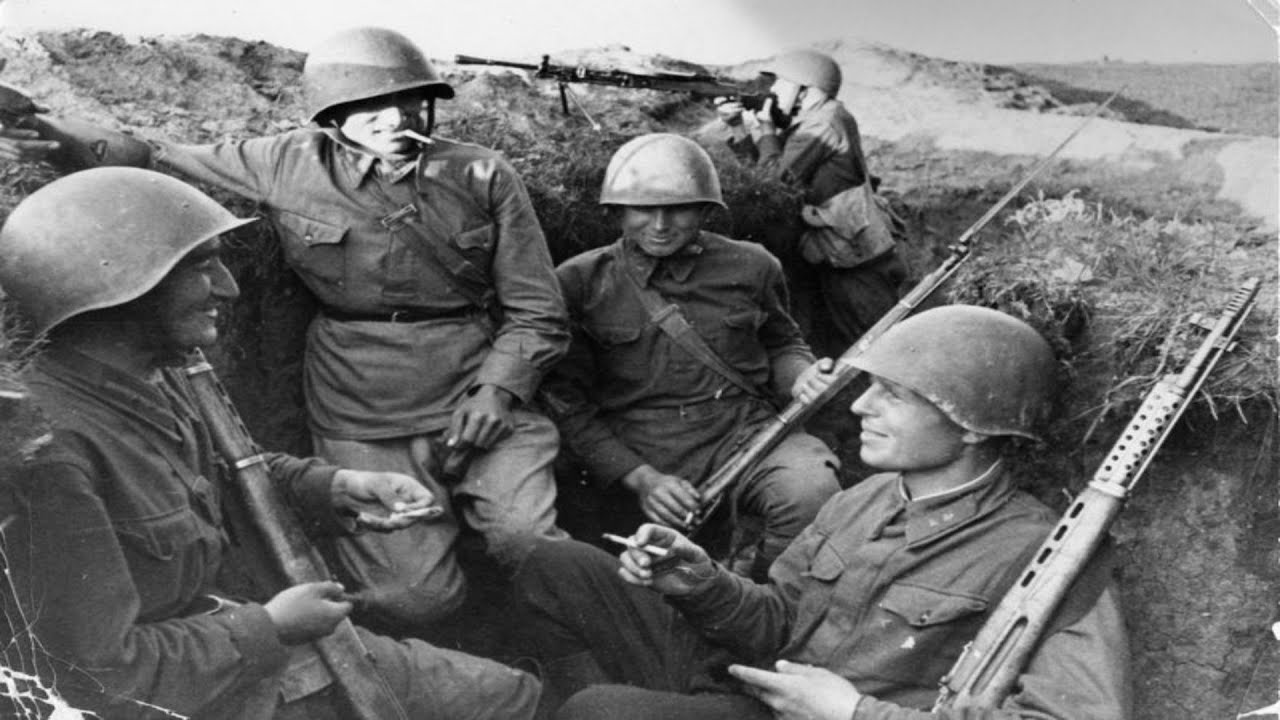
This is the third chapter in A Soldier’s Duty, the memoir of Marshal of the Soviet Union Konstantin Konstantinovich Rokossovsky (1896-1968), who commanded troops from the very beginning of the Great Patriotic War to the final days of the defeat of Nazi Germany.
Rokossovksy was an ethnic Pole who served in the Russian army in World War I, the Red Army in the Civil War, fell under the finger of suspicion and was imprisoned in 1937, released back to active duty in 1940, and was in command of a mechanized corps at the beginning of the Great Patriotic War.
A Soldier’s Duty describes the planning and implementation of huge military operations, the relationship between high command and the front, and interesting people Rokossovsky met along the way. You are now reading a translation based on the 5th edition of Soldatskii Dolg, published by Voinizdat in 1988. The 1988 edition includes text that had been considered too controversial and scandalous to print during Rokossovksy’s lifetime.
See the largest and most cataclysmic war in human history through the eyes of one of the allies’ greatest generals.
Chapters:
Tomorrow There Will Be War
The Battle Begins
On the Yartsevo Heights
An Unexpected Order
The Volokolamsk Direction (COMING SOON)
Nowhere To Retreat
Forward!
Sukhinichi
Memorable Lessons
The Bryansk Front
Battle for Stalingrad
Closing the Vise
Destruction of the Enemy
The Kursk Salient
Going for the Dnieper
For Belarussian Soil
Both Offensives Are the “Main” One
Destruction
Warsaw
In Germany
On Two Fronts
East Pomerania
From the Oder To the Elba
Happiness of a Soldier
A few hours at high command in Moscow. Here I was told that “a gap had formed” in the Smolensk direction due to a strong enemy paratrooper landing around Yartsevo. The mission: cover this direction and stop the German advance toward Vyazma.
I was informed that Moscow and the Western Front command understood the importance oft he Dnieper line, and planned to create in the Yartsevo area a powerful maneuver group of one rifle and two or three tank divisions. With the support of elements of the 16th and 20th armies, this group was intended to dramatically improve the operational situation and allow Smolensk to be held. I was to command this group. Seeral diviions ad regiments were at my disposal and I was authorized to assume command of everything I met on the road from Moscow to Yartsevo.
More concrete instructions would be given at the front command.
The General Staff put at my disposal two vehicles with quadmount air defense machineguns, radio equipment and headquarters staff.
By evening that day our new “formation” arrived at the front.
Simon Konstantinovich Timoshenko’s command post was in the village of Kasna. I went to report in and receive my objectives. The marshal greeted me and introduced Nikolai Bulganin, a member of the front war council and chief of the political services Dmitri Lestev.
The Front headquarters was of the strong opinion that the enemy’s central army group, using strong formations of tanks and mechanized formations, would break through several points at the front and try to penetrate deep to the rear, allowing them to surround and destroy our troops in Smolensk. The enemy was guessing that the Red Army forces here were already exhausted and unable to offer any more resistance in the Moscow direction, and planned to defeat this last obstacle. The enemy 2nd and 3rd tank groups, before the Red Army’s 2nd and 9th field armies arrived, had to break our Western Front in several directions and surround and destroy its main forces in the Smolensk area and clear the way to Moscow.
In preparation for this struggle, our small force was organized.
The 20th Army under General Pavel Kurochkin and 19th Army under General Ivan Konev were in the first echelon in the Smolensk and Vitebsk directions.
According to the Front headquarters, the situation was extremely difficult for Krupochkin. His troops had already been engaged in a long defensive battle against an enemy with an advantage in personnel and equipment. The 20th Army was able to receive reinforcements from the 16th Army from time to time and also occasionally the 5th Mechanized Corps under Ivan Alekseenko.
Konev and his formations were trying to retake Vitebsk, where the enemy had already broken in, but without success. Massive strikes by German aviation against the attacking units forced them to retreat.
The 16th Army under Mikhail Lukin was still holding Smolensk and Simon Timoshenko believed, apparently, in the stability of their position. Although the 16th Army at this time had only two rifle divisions left. But these were excellent formations, the Transbaikal cadre divisions, their resolve and traditions difficult to overestimate. I remember the words I heard in the Front headquarters: “Lukin is sitting in a bag and isn’t going to retreat.” German forces were trying every possble way to reach the neck of the bag near the Solovyov and Ratchinov crossings across the Dnieper River. Due to the importance of this matter, the Front command gave Alexander Lizyukov with his special detachment the personal mission to safeguard transportation routes for all forces in the Smolensk area and, if necessary, their routes of retreat.
“Lizyukov is a reliable commander,” the mashal said. “Not long ago I sent Lev Dovator to check on him. He returned delighted and recommended Lizyukov for an award. I trust Dovator…”
This was the first time I heard of Lev Dovator, who at the time was in the officer reserve group at the Front headquarters. Soon he received command of a cavalry corps, and so began a glorious military campaign of this general in the Great Patriotic War.
At the Front headquarters I familiarized myself with the data as of July 17. Headquarters staff were not very confident that it matched current reality due to lack of communication with several armies, among them the 19th and 22nd. They had received intelligence of strong enemy tank concentrations in the area of Yelna. And they had received information about an airborne assault on Yartsevo, but had not verified it yet.
That night I went to Yartsevo. When giving his farewells, the marshal told me, “We will send you regular reinforcements, and give two or three divisions, but in the meantime subordinate any units and formations you can to organize a defense on the Yartsevo line.
We started doing this right away, gathering everyone on the road to Yartsevo who could be useful in the fight.
In short a short time we had a decent number of people; infantrymen, artillerymen, radio operators, sappers, machingunners, mortarmen, medical staff, and among them some trucks, which really came in handy.
As we started the process of creating military formations in the Yartsevo area, we received an official name, the “General Rokossovsky’s Group.”
We made a headquarters literally on the move of 15 to 18 officers. Ten of these graduated the M. V. Frunze Military Academy and were at the disposal of the Western Front’s personnel department. Yet they were willing to accept this assignment. What officer, if he can be called an officer, doesn’t seek out difficult moments with the troops where he can prove his knowledge and capabilities! Among these comrades was Lt. Col. Sergey Pavlovich Tarasov. He became the chief of our improvised staff and also led the operations department. “Both a seamstress and a reaper…” as they say. The lieutenant colonel was tough, lean and athletic, which helped him out more than once in the heat of battle, and kept a cool head even in the most difficult situations. Yet a chief of staff needs some quiet, but our headquarters worked under fire. Hardly the optimal conditions for staff work!
Yet these were the conditions we had to work under. But we were a headquarters on wheels, with eight light vehicles, a radio station, and two trucks with quadmount air defense machineguns. We arrived in the vicinity of Yartsevo, quickly oriented ourselves, made contact with the units in the area and began to organize a defense. Sometimes the lieutenant colonel would snap, “Everything is topsy turvy, the devil knows what we studied for! Usually assignments come from the top down, but here you beg for units, give to the commander’s command post…”
Lack of communications required us to stretch across the front, and there were frequent dashes. Live communications saved us “officers on wheels” and solved almost everything in those first ten days.
These academy officers had a deep understanding of the importance of their assigned objectives and the ability to deal with confusing situations and take the initiative. I often think fondly of the Frunze academy that trained these comrades.
And the group commander also had to work at the edge of the frontline, moving from one position to another.
The first formation we met to the East of Yartsevo turned out to be the 38th Rifle Division under Col. Maxim Kirillov. He was already experienced with age. The division belonged to the 19th Army, fought with them and then lost contact during the withdrawal. Kirillov, feeling unexpected pressure from the Germans at Yartsevo, established a defense the best he could. Since it became known to me in Kasna that there was no communcation with Konev, I used the 38th Division to repel the enemy in Yartsevo, which had already fallen.
Kirillov was delighted that he was finally not alone. We reinforced his regiments with people we had gathered along the way. I have to say it was amazing how every day more and more reinforcements arrived. When people learned that there were units fighting back near Yartsevo and along the Vor River, they came to help. They came in whole units and groups led by commanding staff.
It is important to me to testify as an eyewitness to this. Many units were going through difficult times. They were torn apart by enemy tanks and aircraft and separated from the chain of command. Yet these soldiers tirelessly sought out opportunities to unite. They wanted to fight. Their determination is what allowed us to form a mobile group.
Not long after we received a new formation, the 101st Tank Division under Col. Grigory Mikhailov. They had a shortage of personnel, 80 old light-skinned tanks and seven new heavy tanks. But they were a huge help to us.
On July 18 or 19 Tarasov and I stopped by Kirillov’s observation post, where his forces were in a stubborn battle against enemy infantry. There was a brief pause in the fighting. Several commanders arrived in a light vehicle. Among them I saw a familiar and dear face.
“Kamera! Ivan Pavlovich, is that you I see?”
It was my old colleague from the brief conflict on the Chinese Eastern Railway, when I had commanded the 5th Kuban Cavalry Brigade, and he commanded its artillery.
A remarkable artillery commander, a staunch Bolshevik (he was a commissioner in the Civil War!) and a wonderful comrade.
The timing couldn’t be better. Kamera was the commander of the 19th Army’s artillery and had lost contact with headquarters. I asked for his artillery to help our group beat the advancing enemy, and he readily agreed. Ivan Pavlovich immediately set to work with great energy. I breathed a sigh of relief. At Yartsevo, like in the battles around Lutsk, we had to rely on artillery. Enemy tanks appeared before us once again.
Our situation was more serious than the Western Front Headquarters thought. In the first battle we understood that not only a German airborne landing, there was a considerable ground force here as well. The German 7th Tank Division broke through and bypassed Smolensk to the North. Reconnaissance and prisoner interogations revealed that enemy mechanized units and tank groups were assembling in the Smolensk direction.
Yartsevo, as I already wrote, had been taken by the enemy. They established a bridgehead on the Vor River and were, so far, cautiously advancing on the highway toward Vyazma. At the same time we detected activity in the southern direction in the rear of our 16th and 20th armies.
Now understanding the situation, I envisioned the enemy’s intent. Starting at the bend in the Vor River and ending at the Dnieper, the enemy planned to surround our forces fighting in the Smolensk region, which would set the conditions for an attack up the highway to Moscow.
It was the difficult task of our two divisions to thwart this plan.
Our defense was necessarily linear with no second echelon. I could use two regiments of the 101st Tank Division as reserves, positioned slightly to our left. The motorized rifle regiment of this division defended Dubrovo to the right, and the anti-tank artillery regiment positioned in Gorodok and Lagi to the left. the 240th Howitzer Regiment was positioned on a ridge to the southwest of Zamoshye. So the highway and railway had antitank coverage, and that wasn’t trivial! The 38th Rifle Division defended to the East of Yartsevo along the Vor River. The tank regiments of the 10th Division were in optimal positions for counterattack in the event of a German breakthrough along the highway.
All of this I reported to the Front Commander. I also reported that divisions sent by the Front to the Yartsevo defensive line were undermanned. One division had just 260 men, and another was even smaller.
Thanks to the great effort by the officers managing the soldiers of our group during continuous fighting, we were able to first prevent the enemy attack to the East. Then we started to go on the offensive, striking the Germans in one sector after the other, often achieving success. Truthfully, the successes were tactical in nature, but they helped strengthen the discipline of the troops, encouraged the soldiers and commanders, and convinced them that the enemy could be beaten. That meant a lot back then.
Besides that, our actions puzzled the enemy command. They encountered a rebuff where it wasn’t expected; our units were not only repulsing attacks but even advancing (though not always successfully). This created a vastly exaggerated perception of our forces, and the enemy did not use their massive superiority. The fascist command “acknowledged” us, if that’s possible to say. They tightened and tightened their troops around the Yartsevo region, hit our lines with massive air attacks and their artillery and mortar fire increased. We were saved by the forest and our infantry had dug in.
Fighting near Yartsevo was continuous and difficult for both sides and prevented the Germans from advancing to the South. This was our contribution to the struggle of the Western Front, the purpose of which was to delay the enemy and prevent the encirclement of the armies around Smolensk while inflicting the maximum damage possible.
The special detachment under Col. Alexander Lizyukov defended the river crossings of the Dnieper in the rear of 16th and 20th armies, operating independently and then, due to the needs of the time, becoming subordinated to our combat group.
Col. Alexander Ilyich Lizyukov was an excellent commander. He was confident of himself in any situation, even the most difficult, among all the surprises that constantly came up in that crucial area his detachment was operating. Alexander Ilyich’s courage was without limit, and his ability to maneuver with a small force was unmatched. There was a moment when the Germans grabbed the neck of the “bag” around the Dnieper crossings, but it was only for a few hours. Lizyukov’s forces repulsed and destroyed the entire enemy detachment.
He was from the tankers (before the war Lizyukov served as the deputy commander of the 37th Tank Division) and his detachment were drawn fron the tankers. They were the tank and motorized rifle regiments of the 5th Mechanized Corps, whose fate I had already mentioned. They had saved 15 of their tanks. But the people were seasoned soldiers, hardened by battle, including their regimental commanders Sakhno and Shepelyuka.
Lizyukov especially distinghuished Maj. Mikhail Gordeevich Sakhno. I suspect the battle gave birth to a real frontline friendship between them. The commander of the special detachment said, “Maj. Sakhno, the true hero of the Solovyov Ferry.” By the way, if you want to know an officer better, listen to how he speaks about his subordinates.
A real commaner always appreciates their contributions to the common struggle against the enemy. Always give people what is due.
Fighting on the Yartsevo defensive line did not stop, day or night. In the performance of this important objective, our units suffered significant losses. When replenishing divisions and forming new ones, we experienced great difficulties. People from many different fields arrived at the assembly area; stragglers who had lost contact with their units or broken out of encirclements alone or in small groups. All of these people had to be united in a fighting collective. It was not easy, especially since we didn’te didn’t ha People recognized each other in battle. We were not always able to create party organizations in the newly formed divisions. Under these conditions special responsibility fell upon the officers from the platoon leader to the division commander.
A lot depended on the commander. He had to have strong willpower and a sense of responsibility. He had to overcome fear of death and always be where he could best raise the spirits of the soldiers, even if he shouldn’t be there because of his position.
There were such commanders at the Yartsevo defensive line, and the soldiers believed in them. They led their people to accomplish the most difficult objectives and achievements. Under their leadership, divisions and units strengthened not in days, but in hours, and fought the enemy with organization and persistence on the offense, defence, and retreat.
I am not an advocate of phoney bravado, this quality is not becoming of a commander. He must have courage and sober calculation, and sometimes more than that.e time.
During the first days of fighting to the East of Yartsevo, our observation post was located near the edge of a forest about a kilometer away from a rifle unit on the defense. There was a rare enemy artillery barrage so Gen. Kamera and I decided to go check their entrenchments. And that’s where it happened.
Before our eyes, dense chains of German soldiers appeared from behind the ridgeline about two kilometers away. They were coming toward us with about ten tanks behind them.
Our infantry didn’t flinch and opened up with their machineguns on the advancing Hitlerites. Our artillery also rang out.
Gen. Kamera said that a 76mm anti-tank battery was about to deploy their guns at the edge of the forest. Things started not too badly, the Germans got in the prone and the tanks stopped.
Soon enemy aviation appeared on the horizon. German planes bombed our trenches. Enemy gun and mortar fire intensified. The tanks advanced, overtaking the empty forward positions of our already-retreating machinegunners. Planes circled overhead, bombing our lines. Our infantry wavered and began to run, first as individuals then as whole groups. It was difficult and sickening to watch…
Then a voice shouted out from the retreating crowd, “Stop! Where are you running? Back! Do you not see the generals standing there? Back!”
Yes, Ivan Pavlovich Kamera and I stood at full height, in plain view of everyone, as this was the only way to save the situation.
The soldier’s voice and our self-control had a magical effect. The runners returned to their positions and fired on the enemy infantry, who had risen, forcing them to lie down again.
Our battery was now in place and began direct fire on the tanks, knocking out several and forcing the rest to retreat. The attack had been repulsed.
I don’t remember who told me, probably one of the soldiers. Among the runners there was a mustached soldier who had fought in the first imperialist war. It was he who kept his nerve in the difficult momen. He ran and cried, “Stop! Lie down! There’s the enemy, fire!”
To this day I imagine this mustached soldier as if he is still alive.
Another example. Still here in the vicinity of Yartsevo. It was a heated battle against an enemy offensive, which our units struggled to repel. Our artillery was especially important. Before my eyes I saw a howitzer battery come under attack by German aviation.
The battery did not stop firing. The battery commander was watching the sky. When he saw bombs detach and fly toward the battery positions, he commanded, “Lie down in the trenches!”
After the bombs landed he gave another command, “To the guns!” And the firing continued.
The battery suffered some losses and one gun was damaged. But the artillerists performed their duty brilliantly. It was heroism of soldiers led by a brilliant commander. Unfortunately I don’t remember his name, the years erase a lot.
I can cite many examples of courage and heroism of entire detachments and units. The motorized rifle regiment under the command of Lt. Col. Vorobyov had a good reputation in our group. This regiment defended the main highway from Minsk to Moscow. We depended on this unit and its commander completely.
The combat operation expanded with each passing day as the enemy attacked with all their might. We also had troops arriving and it was increasingly difficult to manage them all, so our command post on wheels stayed close to the front lines, otherwise the situation would have been impossible. And our headquarters thinned out. In ten days more than half of the staff officers were killed or seriously wounded. One time I almost lost the chief of staff. We urgently needed to send someone to the Front headquarters and I carelessly suggested Lt. Col. Tarasov take the ZIS-101 instead of the goat. Fascist pilots saw the staff car and wasted no time chasing it down. Sergey Pavlovich tried to get out of trouble by pulling into a roadside barn. The German pilot riddled the roof with gunfire and dropped incendiary bombs. Everything collapsed, and only the chief of staff’s physical training enabled him to get out of that inferno alive. He returned burned and angry, then went about his tasks as if nothing had happened. This wonderful man went on to command a whole division and received the rank of major general.
One day at dawn, it was near the end of July, I was informed that there was a general asking for permission to introduce himself. I got out of the car I was sleeping in and met a comrade; Vasily Ivanovich Vinogradov, commander of the 7th Mechanized Corps. He and his staff were now at my disposal.
Vinogradov’s headquarters was fully equipped with all departments. They had radio sets, staff cars, and other gear needed for the normal work and administration of a large formation. Col. Mikhail Malinin was their chief of staff.
I briefly met with Malinin, instructed him to choose a location for the command post, and take care of the other matters himself.
The new chief of staff asked Tarasov, “When will we transfer tasks?”
“What tasks?” Tarasov replied and handed over his notebook. That was his entire office.
The time of improvised headquarters work was over. Everything was different, and I felt this in the little things the next morning. A Red Army girl on a motorcycle came to me.
“What are you here for?” I asked.
“Breakfast for Comrade Commander.”
“From where?”
“From headquarters.”
Up to this time everyone in the command group had slept under pine trees or in their cars, and ate from soldier’s pots. A fork and fresh napkin were things from another planet.
At first I was somewhat displeased that Malinin moved our command post far from the frontline (eight or ten kilometers). Since I had told him to pick a location I had to accept it, but couldn’t help myself but to make a comment.
“We’re not too far from the front? Perhaps you have forgotten that there’s a war on…”
The colonel looked at me in surprise, but maintained a disciplined silence.
The awkwardness from this incident passed quickly. I soon became convinced that the command post was where it needed to be; the battle had become static. From the very beginning, Mikhail Sergeevich Malinin proved himself to be a smart and experienced organizer. We worked well together and came to be good friends at the front.
A real command post was quickly established with wire communications to observation posts at the front.
To the experienced eye it was immediately clear that in the hands of Col. Malinin, our headquarters was cohesive and responsive to the needs of the troops. His domineering nature sometimes discouraged the initiative of subordinates, but that passed with time. There will be time to return to this topic later.
Maj. Gen. Vasily Ivanovich Kazakov, commander of the 7th Mechanized Corps’ artillery, made a good impression on me. He immediately visited the firing positions to evaluate what we had and where, and what kind of personnel. In short, the general went straight to work, freeing up, Ivan Pavlovich Kamera, who had been reassigned by Moscow. Soon it became known that Kamera, who had done so much in the defensive fighting at Yartsevo, was appointed chief of artillery for the Western Front. I was glad for my friend getting such a good assignment.
Gen. Vinogradov, who had been appointed as my deputy commander, was soon reassigned as well.
By the end of July our group was significantly stronger, not to mention that receiving a full-blooded headquarters made things easier for me. The Front headquarters reinforced us with several tank battalions and the Moscoow Party Organization sent a battalion of communists. We found time to greet this group. And it was as if the German pilots knew about their arrival too; they rained bombs down on us. We scattered in the forest and continued our conversation when the air raid was over. In conclusion, I told them that soon comrades will have the opportunity for payback against the enemy. And that’s how it turned out.
Having gathered everyone we could in the Yartsevo area, we struck. The enemy did not expect this. They had themselves attacked the day before and were repulsed; not realizing that we could still advance after a heavy defensive battle. We wanted to use the element of surprise. The 38th Rifle and 101st Tank divisions made up the bulk of the attack, and we gave them artillery and tanks, including 10 heavy KV tanks. As a result, our units captured Yartsevo, forced the Vop River and established very advantageous positions, which were reinforced and repulsed all counterattacks.
Vorobyov’s motorized rifle regiment was very good agains, and cooperated delightfully with tanks. The Muscovite communist battalion had their baptism of fire, proudly saying they had “opened a military account.” But they were frankly disturbed by the dominance of enemy aircraft. The “old timers” of the Yartsevo battlelines had gotten used to this, as much as it is possible to, but was difficult for people new to the front.
In the battle for the capture of Yartsevo, the enemy air strikes were the most difficult challenge for us. The fact that we were still successful speaks volumes about the courage and heroism of the troops who had not long ago lost proper organization.
For the first time I was able to see how our 37mm anti-aircraft battery shot down three dive bombers, forcing the rest to gain altitude. Besides this, they were really brazen, even chasing individual cars. Often German pilots would drop gasoline cans instread of bombs, which whistled and howled as they fell. Already there was such hooliganism going on.
During active operations in the Yartsevo area, we could not for a minute lose sight of what was happening to the South by the crossings. A directive from the Western Front dated July 27 commanded our group to hold Yartsevo and prevent the enemy from breaking through to Vyazma. That was the main thing, but I still breathed a sigh of relief when I was able to send Col. Lizyukov an anti-tank unit from the 108th Rifle Division with a machinegun company. We soon sent other units here and assigned the whole area to the responsibility of the 44th Rifle Corps under the command of Vasily Yushkevich. Now this direction could be considered firmly secured.
The situation in the Smolensk area was becoming more difficult, not only for our troops, but also for the enemy. It was becoming clear that the Germans were stuck in the fighting for Smolensk. If one were to look at things in perspective, the Hitlerite plan of “lightning war” had cracked. In fact, it had cracked at the very beginning of the war.
At the end of July the German command again focused all of their strength on the objective of surrounding our army. Intelligence data and interrogations of prisoners taken in Yartsevo revealed the preparation of an offensive with the goal to cut off the retreat of our 16th and 20th Armies. For this task, the opposing side assigned forces from the 7th and 20th Tank divisions to strike the defensive positions of our troops in the Yartsevo area.
This information helped us take defensive measures to thwart the enemy. They suffered heavy losses in tanks and manpower, and only pushed back our units in a few places In the last days of July their offensive stalled. Our artillery played a decisive role, organized by Gen. Vasily Kazakov.
KV tanks, which could shrug off fire from the weapons of German tanks att the time, caused the enemy a staggering amount of grief. But they did not return from battle looking their best; the armor was dented and the barrels were sometimes penetrated. The BT-7 tanks showed their capabilities well, and were fast enough to scatter enemy infantry and put them to flight. However, we lost a lot of these tanks, and they burned like torches.
If the Germans found something new in our equipment, like the KV tank, then we found something new from them too, namely new types of antitank rifles, which could pierce our older tank models. We conducted a test that showed the special bullets from these guns could penetrate the side armor of the T-34. The captured new weapon was urgently sent to Moscow.
Even at the beginning of the war I was disturbed about why our infantry on the defensive almost never fired on attacking enemies with their personal weapons. The enemy was typically repelled by well-organized artillery fire. But what about the infantry? I gave the question to a group of comrades to study and decided to in the meantime personally check the frontline defense system in one of the most active areas.
Our regulations up to the war taught defense in the so-called cellular system. Supposedly, infantry in cells would sustain minimal losses from enemy fire. Maybe in theory, and the main thing was that these defenses looked very beautiful, and everyone was delighted. But alas! War showed something different.
So I went to one of these cells and replaced the soldier there, and was left alone.
I knew that there were Red Army soldiers to the left and right, but I could not see or hear them. The detachment commander could not see me, nor any of his subordinates. And then a battle started. Bullets and mortar shells tore past me. Sometimes aerial bombs dropped.
As an old soldier who had participated in many battles, I openly confess that I felt terrible in this nest. The whole time I had the urge to run out and look to see if my comrades were still sitting in their nests or had already abandoned them and left me alone. If the feeling of anxiety did not leave me, then what would it be like for a man who was perhaps in battle for the first time!
Man always remains a man and in the moment of danger, naturally, wants to have a comrade and of course a commander close by. There’s an old folk saying that peace and death are beautiful [meaning that things are easier with other people around]. And the commander absolutely must see his subordinates, who to encourage, who to praise. In short, to keep an eye on peole and keep them in hand.
The cellular system of defense was unsuitable for war. We judged, both from my experience as well as the observations of other officers tasked with observing the infantry, that the cellular system had to be immediately liquidated and switched to trenches. All units of the group were informed that day and our findings reported to the Western Front. Marshal Timoshenko, with his usual decisiveness, agreed with us. Defense became easier and defense became stronger. We had old soldiers and officers from the first world war who had been mobilized. They remembered the trench system and helped everyone quickly adopt it without difficulty.
August started. Smolensk was occupied by the enemy. Further efforts to eject the enemy were pointless. Marshal Simon Timoshenko gave the order to retreat. Troops of the 16th and 20th armies successfully withdrew across the Dnieper through the Solovyov and Ratchinov and were used to reinforce the defensive lines of Kholm-Zhirkovsky, Yartsevo and Yelnya. Our group assisted units of Generals Lukin and Kurochkin by launching an offensive in the vicinity of Yartsevo and to the South.
The German-fascist command had struck with troops of Army Group Center (their 2nd and 9th armies and two tank groups) with the confidence that the operation would end with the encirclement and destruction of the entirety of the Western Front in the Smolensk region. This plan failed. In the Moscow strategic direction the enemy met not emptyness like he expected, but a stiff defense that could not be overcome without additional time and troops.
Marshal Timoshenko called me and said, “We are coming to visit the heroes of Smolensk, accept the 16th Army.”
For some reason we went to Pavel Kurochkin. It soon became clear what was going on; the commander of the 20th Army had been recalled by Moscow, and Mikhail Lukin had taken his place.
I was in a birch forest near the village of Vasilki, at a log table in the commander’s tent, and a quiet sky overhead. A car pulled up and Lukin practically had to be carried out of it. He had been wounded in a bombing of the river crossing where he had been saving people and restoring order.
We had known each other since the 30s, when Mikahil Feodorovich was the commander in chief of main personnel department of the Red Army. An old soldier, an experienced and well-trained commander, and a good comrade.
And so we met in war. At this moment he told me, as if he was summing up what he could and could not do, “The 16th Army was not defeated, it was pulled apart.”
Next to the wounded commander was seated the division commissioner, a short and burly man with the round and peaceful face of a peasant.
Lukin introduced us, “Lobachev, a member of our military council.”
The commander of the Front awarded comrades Lukin, Kurochkin and Lobachev Orders of the Red Banner. He expressed the opinion that heavy fighting by the troops of the 16th Army absolutely upset the enemy’s offensive, his formations suffered casualties and had limited offensive capability for at least ten days. The marshal went on to announce the changes in command, and asked if there were any requests. I asked to appoint Col. Malinin as the chief of staff, and Gen. Kazakov as chief of artillery, since the troops of our group were actually joined with the troops of the 16th Army.
After the unification the army became a significant force of six divisions; the 101st Tank Division under Col. Gregory Mikhailov, the 1st Moscow Motorized Rifle Division under Col. Alexander Lizyukov, the 38th under Col. Maxim Kirillov, the 152nd under Col. Peter Chernyshev, and the 64th under Col. Afanasy Gryaznov, the 108th under Col. Nikolai Orlov, the 27th Tank Brigade under Feodor Remizov, the heavy artillery unit and other elements.
The army was defending a 50-kilometer front blocking the Smolensk-Vyazma highway.
A short time later the enemy made a break-throught attempt in the Yartsev direction. In this effort they achieved nothing except significant losses. Fighting was intense for two days then German activity dried up.
For the first time our units received a battery of the new rocket artillery called “Katyushka.” As it fired on the advancing German tanks and infantry, we left the trenches and, standing tall, watched the impressive spectacle. All the soldiers left the trenches and cheered as the volley of rockets made the enemy turn and run.
Fire from these weapons on personnel in the open was frightening. It was less effective against dug-in troops because that required a direct hit, and the Katyushka fired rockets over a large area. We took this into consideration in the future. Another limitation was that the firing of rocket artillery on the front was tightly controlled due to the demand to maintain secrecy, which discouraged its use. Many artillery commanders said the Katyushka was like dealing with a capricious woman. On my own responsiblity I simplified the secrecy requirements. With skillful application, rocket artillery produced good results.
The army was gradually providing artillery weapons to counter enemy tanks, which were superior to ours. This helped out the troops, and artillerists were respected and loved in the rifle units. Enemy tank tactics continued to be studied.
But against German aviation there was nothing we could do. We had 37mm guns, but they were few in number and could only hit planes flying at low altitude.
Our units were reinforced by those who escaped the encirclement. There was an influx of people who walked from West to East, on their own, from the border or Minsk region. Many officers, I treated them with special respect, led their groups out of encirclement with weapons. But how many troops and commanders came out unarmed!
All of them had to be armed, and with what? We got little from the rear in these days.
Alexey Andreevich Lobachev had an idea; if whole groups were passing through occupied territory to the frontline, then maybe we could send scouts into the enemy rear to find weapons left on the battlefield. This was very successful, and we did it right under the enemy’s nose. Groups of brave souls, including among them comrades who had escaped encirclement and knew where to go, found rifles, machineguns, mortars, 45mm guns, and not to mention ammunition, which we needed badly.
That’s how we lived back then.The 16th Army was already an impressive force, and only got stronger.
And the enemy, having suffered heavy losses on the offense, switched to the defense. By mid August reconaissance had discovered that the Germans had fortified the West bank of the Vor River. In captured documents of the 9th German Army we read about intensive work to fortify their defensive line.
The capital talked about us. Publications by the Soviet Information Bureau frequently mentioned the Yartsevo military group, then the 16th Army. Delegates from Moscow factories, Party and Komsomol organizations, political workers, writers, correspondents and artists came to our units. Sweet and strong connections!
One day there was a call from the General Staff to meet with the British military delegation (headed by a general representing the British armed forces at our General Staff). I was on the left flank in the region of Solovyov Ferry and, honestly, was not interested in seeing visitors at the moment. Mikhail Sergeevich Malinin organized the visit at the command post of Col. Kirillov and the 38th Rifle Division. The meeting went with a diplomatic spirit and, from what Malinin and Lobachev said, quite warmly. The British drank several rations of “good Russian vodka” and did not skimp on celebratory toasts to the Red Army.
In the second half of August our neighbor to the right, the 19th Army under the command of Gen. Ivan Serveevich Konev, led an offensive operation. It was unexpected by the enemy and achieved some local success. But the Germans had sufficient forces to prevent them from breaking through their defenses. After that, forces of the Western Front only went on the offensive in the Yelnya area, where the enemy had broken through during their July offensive.
The 16th Army held its defensive perimeter, conducted reconaissance in force, and from time to time went on the offensive. The enemy acted similarly with mutual probing actions. We came to find out that the tank and mechanized divisions which we earlier defended against had been transferred to the rear and replaced by German infantry.
Malinin located the army command post in a well-concealed position in a dense forest, and we moved from tents to dugouts. The tents were more spacious and the air fresher, but in general we settled in and worked together well. Here, in the Yartsevo area, I was pleased to see that we had an interesting and very efficient leadership team. And how important this was! When a military commander prepares his troops in times of peace, he has time to select and educate personnel. And then the war came. Alexey Lobachev, as a member of the military council, said more than once that our team came together so quickly because everyone already knew what a pound was worth. The officers of the 16th Army headquarters proved themselves in the difficult and dynamic situation at the end of July and early August. I particularly commend Chief of Staff Mikhail Malinin, Chief of Artillery Vasily Kazakovk, head of the communications department Peter Maksimenko, and commander of the armor and mechanized troops Grigory Orla.
Every officer has his own leadership style with his closest subordinate, and you can’t demand a template in this delicate manner. We tried to create a positive atmosphere that prevented relationships built on the “as you wish” rule, when people are afraid to disagree with their superiors. In this spirit, my generation of red officers were raised by the party…
Our main center of operations was, as we called it, the “headquarters apartment.” Here I was present when heads of intelligence, operations and communications made their reports to Malinin, and he was also present when commanders reported to me, and a member of the military council was always there as well. When the reports were to me, the conversations were always with the commanders of maneuver units their reinforcements. This system allowed me to, as they say, grow into the situation. In the headquarters all orders and directives were written. All this made work easier, encouraged initiative and independent thought, and improved morale.
There was never any doubt that the calm, confident and meticulous Chief of Staff Mikhail Malinin would ensure the execution of an order. Malinin had another trait that was perhaps unusual at such a high-level headquarters; he needed to see and evaluate the locations of upcoming operations with his own eyes. It must have been his way to stay in control. He appeared quite often at the positions of the subordinate units and was known to the troops, which improved the authority of our headquarters.
I appreciated when my staff, who were educated and in love with military affairs, could voice their own opinions and defend them. Sometimes I would have to think and say, “You’re right, I missed something, let’s do it your way…”
The most important person turned out to be Gen. Vasily Kazakov. I have already mentioned that artillery was our main hope in those days. The general had deep knowledge, intuition, and the ability to work well with people. That’s who the troops loved!
We often used observation posts at the rifle divisions to monitor the enemy. But one artillerists found one particularly excellent location to use; the top of a smokestack at the Yartsevo factory. Here it was possible to see enemy positions and movements at great depth.
This position had one disadvantage; getting there required crossing a kilometer of exposed lowlands under the fire control of German artillery. The moment a worthy target appeared they would shoot. Even a single car racing at high speed would invite fire, and all in full view by the entrenched soldiers on both sides. The danger created perhaps not commendable excitement for the army commander and chief of artillery, but we enthusiastically raced through the danger area every time.
After the lowlands the outskirts of the city began, and we had to be very careful here. We tried to stay behind cover, crawling when necessary, and eventually reached our glorious artillerymen! The city was deserted and silent except for the explosions of shells. The famous Yartsevo manufacturing complex was already burned by Hitlerite aviation.
It was already dark by the time we returned.
German bombers rumbled over our command post all night. They were headed toward Moscow, which made us feel angry and also helpless. There was nothing we could do to protect our homeland’s capital.
But the next day we received the joyous news that the Moscow air defense had beaten back the bombers, and they failed to reach the city!
German pilots did not bother with our army’s defensive positions, and I recall one episode that caused concern at first.
Enemy planes began dropping bags of paper which were found to contain small insects. There had been an order to closely monitor enemy aircraft and burn any suspicious packages on the spot. We did this and sent samples back to Moscow for inspection.
Moscow was alarmed too and started tests. In the meantime these strange drops continued and we did not have time to carry out disinfection procedures.
Soon Moscow communicated that the tests were negative. The Hitlerites were just trying to mess with our nerves.
We fought local battles, improved our defenses, and trained people for what would be expected of them tomorrow. Marshal Timeshenko warmly rewarded our initiative with seats in monthly junior officers courses to which we could send distinguished soldiers with secondary or higher education.
Party and komsomol organizations helped in every possible way to spread the knowledge that enemy tanks could be attacked with bottles of combustible liquids. The shock of the misfortunes in the opening days of the war began to wear off. One time I went into the dugout and overheard Lobachev setting up one of the division political departments, “For soldiers, war is a natural state, including its difficulties. You have all the nerves, so it’s time to finish it.”
It is my duty as a comrade to say a kind word about Gen. Alexey Adreevich Lobachev. The member of the military council and I lived soul-to-soul. He loved the troops, knew people, and was always of great help to me. We shared the same dugout and later usually shared the same living quarters. When Vladimir Stavsky arrived, who was also an ardent bolshevik, interesting writer, and no stranger to military matters, the three of us lived together. There were many meaningful hours spent!
By the time we met, Lobachev was already a high-level headquarters political worker. But it was a steep climb for him, a fate that reflected the pecularities of the time.
War is a difficult trial for people. That’s how it was and always will be. But this natural process was complicated for us. Not long before the war a great number of commanders and political workers were promoted from the ranks to high-level echelons. And with what experience? What knowledge? How to orient themselves in higher headquarters that these comrades had not even dreamed of? All orientation had to be gathered in battle. Lobachev told me how he, as a senior political worker, became the commissioner of a division within a month and in 1939 became the head of the political department of the Moscow Military District. He considered himself lucky to be able to stay in one place for a year before being assigned as the member of the military council of the newly-created 16th Army, whose commander he appreciated. It was all difficult for him, but his organizational talent and bolshevik mindset helped him learn from life.
Gen. Ivan Konev was appointed as commander of the Western Front in September, and Mikhail Lukin took his place in the 19th Army, and Gen. Phillip Ershakov took command of the 20th Army. By this time the operation in the Yelnya area had been successful, and Soviet forces had beaten the enemy back West. No changes had been made in our position our that of our neighbors. The headquarters of the three armies kept in close communication and coordinated at the junctions of our areas of operations.
I worked particularly close with Lukin at this time. He was still moving with difficulty, so Lobachev and I visited the 19th Army command post often. We met several times to discuss problems facing both armies. After this we were confident that the enemy could not break through our lines and we were mutually supporting each other.
During the second half of September headquarters carefully developed a defensive plan for rebuffing an attack while also including the possibility to withdraw while delaying the enemy advance and inflicting maximum damage. We were guided by the thought that the enemy was still stronger than us, more maneuverable and still had the initiative, which was why it was important to be prepared for difficulties.
This plan was presented to Konev. He approved the defensive portion but rejected the withdrawal procedure.
The silence in our position, and our neighbors, alarmed us. The Germans were up to something. It was impossible to guess the enemy’s intent. Military reconaissance confirmed that there was only infantry in front of us. No important data was received from the Front headquarters either.
At the time, information flows to army commanders was very poorly organized. We did not know what was going on at our Front, and especially did not know what was happening outside of it. This was a problem.
Mikhail Lukin came to us with a group of performers from Moscow to give the army headquarters their first concert, which was held in a yellowed autumn forest. The concert was very good and everyone applauded with pleasure and gratitude.
Songs are songs, but we privately met with Lukin to discuss the enemy, which caused a need for caution. We decided to order a reconaissance, which was carried out the next day.
The reconaissance mission took prisoners who revealed that some tanks and mechanized units had appeared behind them in the Yartsevo area.
We took measures to reinforce the area in question, particularly in the divisions guarding the highway from Vyazma to Smolensk.
Kazakov organized counterbattery training in which the Katyushka detachment also participated.
On the night of October 2 our observation posts and reconaissance units reported hearing the sounds of tank engines.
At dawn the German offenive against the units at our center began, where we had expected it to happen.
For the first time German aviation bombed our command post, though without causing much damage.
At the observation post we saw German tanks and infantry advancing almost simultaneously with their artillery bombardment. Our own guns, who had completed the training, fired at once. The antitank battery used direct fire. The Katyushkas, which were now a full regiment, unleased volleys of rockets against unprotected German infantry who had left their trenches.
Our infantry did not flinch. They held their ground against the dense chains of attacking enemies. In several areas it came down to hand-to-hand combat.
The battle lasted until noon. The enemy, having suffered heavy losses, did not succeed. The 16th Army held its positions.
In the afternoon an attack began against Lukin. The enemy pushed back several units on the 19th Army’s right flank but Lukin told me he hoped to solve the situation with his own forces.
The next day, the enemy kept our defensive positions under heavy fire, but without an offensive. Groups of airplanes bombed artillery positions and conducted aerial reconaissance of the roads in the direction of Vyazma.
Communications from the 19th Army became more alarming. Their commander told me by telephone, “I have to bend my right flank and pivot to the North… Communication with my neighbor, the 30th Army, has been lost.”
Lukin asked for help and we sent him two rifle divisions, a tank brigade and an artillery regiment.
For the neighbor on our left, Gen. Ershakov, all was calm. And no alarms had been sent from the Front headquarters.
Meanwhile a storm was brewing, and it would soon break out in an absolutely unexpected way.
Chapters:
Tomorrow There Will Be War
The Battle Begins
On the Yartsevo Heights
An Unexpected Order
The Volokolamsk Direction (COMING SOON)
Nowhere To Retreat
Forward!
Sukhinichi
Memorable Lessons
The Bryansk Front
Battle for Stalingrad
Closing the Vise
Destruction of the Enemy
The Kursk Salient
Going for the Dnieper
For Belarussian Soil
Both Offensives Are the “Main” One
Destruction
Warsaw
In Germany
On Two Fronts
East Pomerania
From the Oder To the Elba
Happiness of a Soldier