
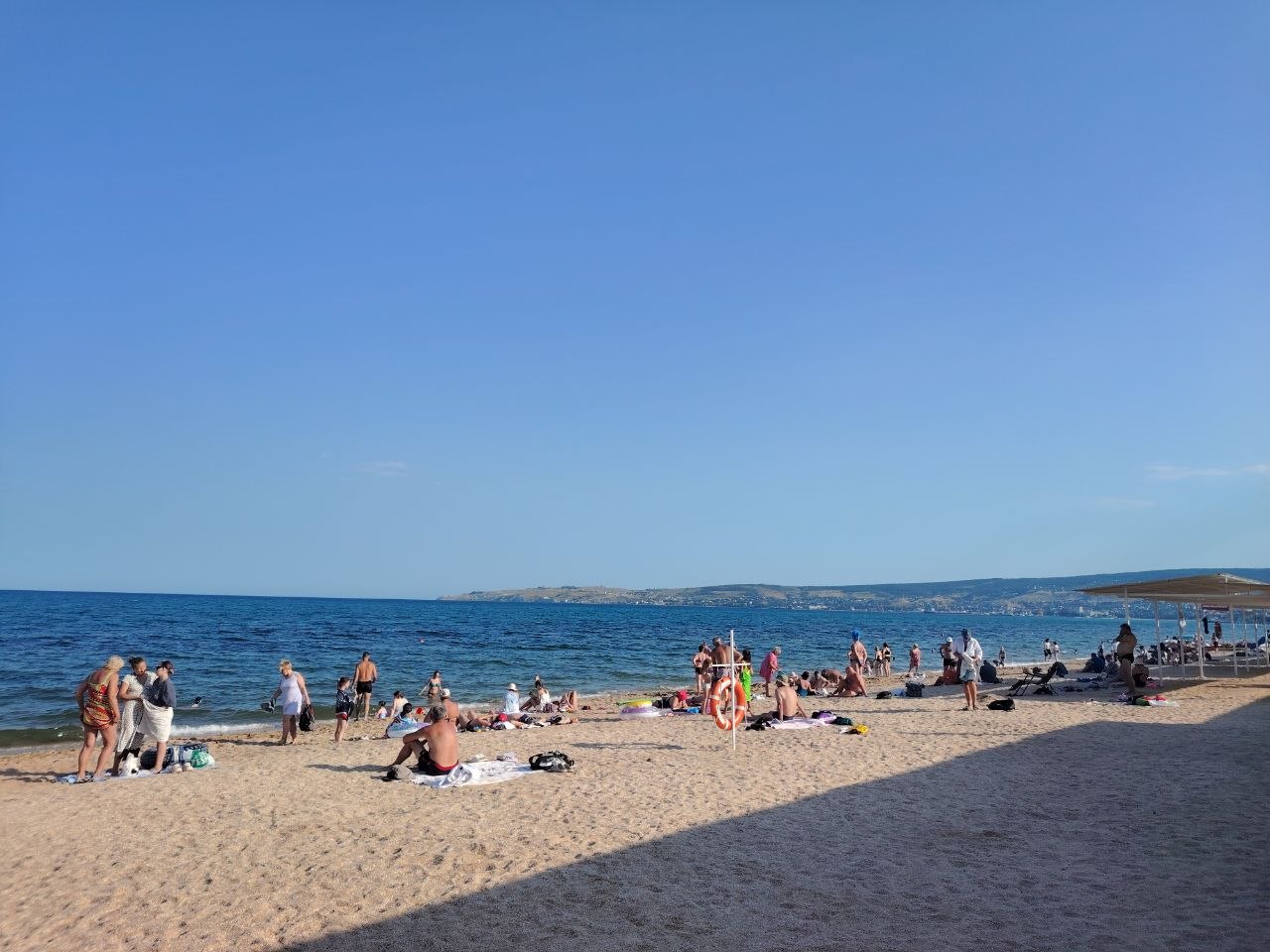
As a resident of Feodosia, I will give you some personal perspective to consider about what’s happening in Crimea.
Sorry I haven’t written much lately. I recently started driving school, which has been taking up a lot of my time, and is also a bit challenging for me language-wise.
First, I will explain the “emergency situation” that was declared in Crimea and Sevastopol last week. It is of an economic nature, rather than military or security. According to the head of Crimea Andrey Aksenov, this streamlines bureaucratic processes and gives impacted businesses an option to declare force majeure on a case by case basis.
Gasoline is being sold, though for 130 rubles a liter, which is pretty steep by Russian standards, and there is an about normal amount of traffic on the roads around town. Though it should be noted that Feodosia, like all Russian towns, is compact and built around the public transportation network, so restrictions to gasoline access are far less serious than in an American suburb, which without private cars would become uninhabitable. And note that so far, gasoline shortages have not been severe enough to impact the bus schedule.
On Tuesday night Ukrainian drones hit power infrastructure in Feodosia, which left many residents (myself included) without electricity for much of the day. In my opinion such attacks are much more serious and disruptive than gasoline shortages.
As annoying as the Ukrainian attacks are, I can’t understand the strategic point. The military gets dibs on gasoline so is always the last institution to run out, not the first. They also have their own power generation, so aren’t disrupted by outages. There is an electrichka train network, but it’s not substantial like in, say, Ukraine. Not to mention the obvious that Crimea has at most a tangential role in the war and the closest Ukrainian troops are 150 kilometers away from the border.
So I have to conclude that the pressure on Crimea is an end in of itself. Ukrainians bitterly hate Crimeans for leaving the “greater Ukrainian” project and seek to punish them at every opportunity, even if this means expending finite military resources and leaving more of their own soldiers to die without adequate drone support. As usual, harming Russians is a cause that always supersedes keeping Ukrainians alive. 10 Ukrainian soldiers is a small price to pay for one Russian grandma not being able to charge her phone for a day, apparently.
And, as I have repeatedly pointed out throughout this conflict, there is fatal scale error at play. Generations of propaganda has had the intentional effect of depriving western audiences of the ability to perceive scale in context. The western allies in WWII dropped thousands of bombs to destroy refineries, so any logical person can understand that blowing up a single storage tank might look impressive for social media purposes, but will at most annoy regional consumers. There is also the pattern of western media treating enemy infrastructure and equipment as finite. In every war the people are the most important resource. This is why the strategic bombing of World War II achieved almost nothing, and is nearly indefensible considering how much it cost in military expenditure and pilots’ lives. German industrial sites were usually repaired in days if not hours, and despite collapsing under a two-front war, never lost a battle due to insufficient fuel. Not once.
Of course there is the “smart munitions” argument, and this does seem to be the first true “smart war” in history as even the US, despite all its propaganda, mostly used dumb munitions in its wars over the past 30 years. But to what end? Does attacking energy infrastructure achieve anything? After four years of two combatants pounding their respective infrastructure, there doesn’t seem to be much to show for it. There were of course the Ukrainian attacks but even the Russian attacks, which were many times greater in volume, don’t seem to have had a large battlefield effect.
The Russian strikes were substantial enough to make NATO dirty delete their own article justifying attacks on energy infrastructure, but Ukraine is still in the fight. Though that is in no small part due to having a strategic rear in western countries that the Russian political establishment is still unwilling to touch. That hesitation becomes less and less justified over time. Iran has proven that the “collective West” is deeply divided and lacks the resolve to fight even small-scale wars when their own personnel and infrastructure is under attack.
Glad to hear you're safe. I'd seen all the news about the Crimea strikes and was a little worried for you all.
Bob, thanks!