
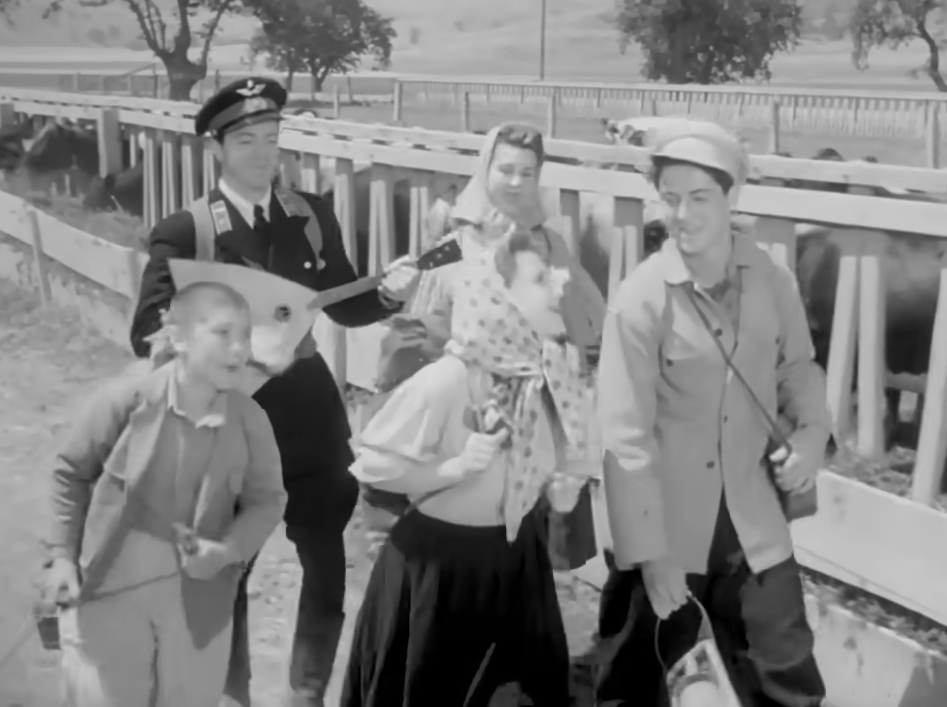
Recently I watched the 1943 pro-Soviet Hollywood movie The North Star, set in the Ukrainian SSR at the start of the German invasion. I found it to be quite entertaining and informative.
The North Star’s message, of course, is that Soviet people are America’s friends, and there’s no better way to do that than to portray them as literally Americans, with a bunch of Russian cliches. This led to one critic remarking that if Disney were to open a Russialand theme park, it would be like this movie. Interestingly, the complaints about stereotypes were mentioned on the Russian language Wikipedia page, but not the English one. Apparently, as usual, the hilarious stereotyping went over the heads of most western viewers. And to my knowledge The North Star was not screened in the Soviet Union, so their perception of it was unimportant. Incidentally, the English Wikipedia page and modern reviews always refer to the onscreen Soviet people as Ukrainians, but the word “Ukrainian” does not appear in the film itself. Everybody just says “Russians.” I think it would actually be a great torture technique to force Ukrainian patriots watch American movies made before 2022 which treat Ukraine and Russia as literally the same thing.
In this scene, the villagers play chess in a moving wagon (because the Soviets were known to really like chess, so why not?). Playing chess in a moving wagon is perhaps possible, I’m just not sure this scene was written by someone who has ever been in a moving wagon.
Anyway, set in rural Soviet Ukraine, the movie portrays the villages, private houses and peasant costumes correctly as far as I could tell, but the portrayal of people loses itself in 20th Century Americanisms. I was almost surprised the Soviet villagers didn’t play a game of baseball. Weird things kept happening that made me lose my immersion. For example, I don’t think little Soviet girls would spit in their palms for a handshake. For that matter, I don’t think even American girls did that. Boys’ preoccupation with various bodily fluids isn’t typically shared by girls, who are supposed to be made out of sugar and spice and everything nice.
I guess this village is supposed to be close to the western border with German-occupied Poland, but the geography of the movie Russialand is extremely vague. Some of the village teenagers start walking(!) to Kiev for a scholarship (did Soviet kids have scholarships?), and this is treated as an easy, casual journey. Incidentally, “Kiev” is the only Soviet city identified by name, and people say it a weirdly large number of times. I think that’s the only Ukrainian city the Americans bothered to look up before filming.
Russialand also has an abundance of manufactured consumer goods that I found a little difficult to believe at times. Consider this typical Soviet peasant family.
The Samovar tea kettle and the stove are correct, the stove is even in the correct place built into the wall near the center of the house. But I’m not convinced 1941 peasant families in western Ukraine would have had wall clocks and radios. Though in fairness, the movie needed to have radios in every room to give exposition because that’s easier than writing dialogue. And whoever designed the sets for this movie must have really loved clocks, because they’re everywhere.
Aside from the availability of such fancy items, rural people back then just did not have very much money. For comparison, there’s a scene in the 1962 Soviet movie Come Back Tomorrow, Please… when the main character gets into a Moscow taxi and panics when she sees the huge amount of money on his meter a few minutes into the trip. But the main thing is that clocks aren’t important for peasants who wake up at dawn and stop working at dusk. Even rural Russians now that I have met barely care what time it is, though everyone has a smartphone.
I have to admit that while watching this movie it’s very noticeable that the American film industry has never particularly cared about portraying the worker and farmer class people correctly. How many modern novelties could rural Americans afford back in the 1930s when they were dressing their children in flour sacks? I suppose it’s hard to say now, and movies even from that time aren’t reliable.
On one of the walls there was a picture of Alexander Pushkin, the father of Russian literature. I thought this was very on-the-nose, like an English family having a picture of William Shakespeare on the wall. But a short time later I re-watched the classic 1961 Soviet comedy The Girls, and there was a poster of Pushkin in the women’s dormitory, so I guess Hollywood was right and I was wrong, this isn’t absurd.
The clocks and radios are a bit odd, but what was also odd was what isn’t shown. There are no icons or references to religion anywhere, even in the peasants’ private spaces. This was the most vehemently anti-religion period in Soviet history, but they obviously didn’t eliminate religious ideas from people’s heads, so a western filmmaker free of Soviet censorship would surely show some religious imagery for a sense of realism, right? The North Star is actually a good example of the ongoing obstacle to accurate western depictions of Russia. The Soviet Union marketed themselves to the world as a secular post-religion country, which was uncritically believed by its western supporters. Furthermore, Anglosphere leftist academics marketing themselves as experts on the Soviet Union would have been aggressively anti-religion themselves, so wouldn’t want to tarnish the image of their precious communist paradise. Both enemies and allies of Russia uncritically believe Russian propaganda when it confirms their existing biases (and when Russian propaganda doesn’t match their biases, it’s discarded immediately, of course. It’s a very convenient mindset to have).
But it needs to be remembered that the USA, as a Protestant country, has historically had deep-rooted prejudices against Catholic and Orthodox Christianity. So even if someone at the brainstorming session did suggest throwing in some icons, the idea would have been dismissed out of fear of angering the audience. It was probably better and less upsetting for Americans to just not mention Orthodox beliefs, whether or not that’s accurate.
Visual accuracy aside, the dialogue is really, really lazy. That’s unfortunate because the first 30 minutes of screentime is committed to establishing the peacetime lives of Soviet people. The quality of this setup is comparable to the opening dialogue of a pornographic video that everybody skips. The lazy writing is made worse by the actors who muddled through their lines like they were being held at gunpoint by Stalin’s NKVD. When the action finally started, I still couldn’t tell most of the characters apart or remember why I was supposed to care about them.
Another unfortunate thing about the opening scenes is that they come off as really fashy, which is ironic to say the least. The schoolhouse scene when the adults lecture the children about sacrifice and have them sing patriotic songs felt like deleted footage from Triumph of the Will. I suppose there is such a thing as right wing and left wing filmmaking techniques, and the American school more closely resembled the German equivalent than the Soviet.
By the way, the Stalinist films from the 1930s and 40s did not have any of the collectivism in this movie and were very much focused on the power of the individual, which makes sense because emancipation starts with the individual.
Finally, roughly 30 minutes into the movie, the action started. I would like to say the movie got better, but it didn’t. But what was interesting to me is how the moviemakers just decided to do a Revolutionary War movie, but with Germans instead of British. There was even a moment with a peasant girl riding on a horse like Paul Revere shouting “The Germans are coming!”
The tempo and tone of the movie was so familiar I almost thought I was watching The Patriot with Mel Gibson. It does illustrate how there’s really nothing new in movies now, it’s all tropes that were invented and already exhausted 80 years ago.
Seeing The Patriot style propaganda pushing a pro-Soviet message was quite odd. There’s a scene when a Soviet pilot rams his damaged plane into an approaching German column, which is directly stated through monologue as an act of revenge. Such incidents did happen often, but Soviet media did not portray them as revenge. Ramming an enemy planes or vehicles prevents them from reaching their targets, which makes this an act about saving lives, not avenging lives already lost. It’s as if US media received a bunch of Soviet tropes but didn’t understand them, or cynically decided that American audiences wouldn’t understand, so rewrote them to be about revenge. Both The Patriot and this movie are extremely preoccupied with revenge, so that’s how they treat the Soviet war tropes.
The Germans, aside from being basically a stand in for the British, are categorized by a particular accessory like the stormtroopers in Star Wars. Like motorcycle trooper, grenade trooper, and my personal favorite, exposition trooper; a German who rides around in his car and gives exposition (because the radios weren’t enough).
As the Germans arrive, there’s the infamous “scorched earth” moment when the villagers destroy their own houses. This leads to a bizarre confrontation of Soviets burning their houses and German soldiers putting out the fires. If an alien who didn’t understand English watched this movie, he might think the villagers had gone insane and the Germans were a humanitarian group there to help them. If nothing else, The North Star illustrates how ridiculous scorched earth sounds when you actually see people doing it.
There is a moment when the military guy who later crashes his plane (I think the crash scene was the only reason the military guy was in the movie at all, so the writers had to invent things for him to do up to that point) confronts a group of peasants trying to unhitch their horses during a bombing raid and threatens to shoot them if they don’t seek cover. I am not sure if that’s a brutal Russian stereotype, or if American filmmakers genuinely thought that was a sensible reason to threaten to shoot someone.
The Germans’ main onscreen atrocity, draining Soviet kids’ blood to treat their wounded soldiers, did actually happen in real life, but the Americans on the movie’s IMDb page think it’s made-up propaganda. I can’t blame them really, it was very cynical for the US government to uncritically repeat Soviet talking points then turn around and say “Actually they’re the enemy.”
At the end the Germans have to be defeated by the peasants who all became expert marksmen after one second of training. I don’t think it was necessary for the Germans to be beaten in the story, especially five minutes into the war, but this is after all American propaganda, which treats its audience like idiots.
What’s almost as interesting as the movie itself is its distribution history. Shortly after Roosevelt’s death, relations with the Soviet Union soured and the movie’s production team was investigated for treason (even though they had made it on request from the US government). In particular, authorities condemned the film for humanizing Soviet people, so the first 30 minutes or so of the run time was cut, and later included an ending slide condemning Soviet brutality and praising the 1956 Hungarian uprising. It was also retitled to Armored Attack, making the film even more explicitly about war divorced from any peacetime civilizational context.
Overall, while this film made a good effort to humanize the Soviets, it didn’t quite succeed. But this is a poor reflection not on the subject of the movie, but on its creators. Hollywood Soviets are preoccupied with collectivist self-sacrificing vengeance narratives because to American writers, these sound like motivations that are plausible enough to be ascribed to an enemy, but plausible nonetheless. A textbook case of projection.
It was all a little silly, but at the end there is a fascinating exchange between the Russian doctor and the German military surgeon who is sorry for the children who died. “I have heard of men like you, civilized men who are sorry… men who have contempt for men like him (the nazis), to me you are the real villain. Men who do the work of fascists while pretending to themselves that they are better than the beasts for whom they work. Men who do murder while laughing at the men who order them to do it.”
That’s a compelling speech, but unfortunately, also projection. I think it applies much more to the US than 1940s Germany. The US establishment is divided between barely educated conservatives who bomb countries they can’t find on a map, and educated liberals who align themselves with conservatives, nazis, Islamists and every other detestable group while laughing that they’re superior.
Ian Kummer
I now have a new YouTube channel that I will use to upload videos from my travels around Russia. Expect new content there soon. Please give me a follow here.
Also feel free to connect with me on Quora (I sometimes share unique articles there).

That's interesting. Russians are more familiar with another 1943 movie: His sister's butler where Deanna Durbin sings in Russian and does it very well. As for Pushkin, I think you wouldn't find him in a 1941 rural house. Lenin would be likelier. The Girls are 1960s working class, all having a profession and some training. One was even studying for a degree.
Hey, I just referenced this blog post in a Quora comment. I am posting the link to the original Quora answer since Ian and Maria, and other readers might be interested in joining the discussion:https://qr.ae/pFoiTJIan reposting some of his content here really helps with linking to the content, even though he probably gets fewer views and content here than in his Quora answers.Anyway, I will repost my comment, which was a response to a comment saying that Hollywood was only interested in making money and therefore is not "left wing":"“Hollywood” literally is organized to distribute propaganda and is not interested in money, in the sense of getting people to pay to see movies. They have repeatedly demonstrated that they are willing to produce and distribute movies that cost more to make and market than the revenue they bring in."Ironically, dictatorships that don’t try to base their legitimacy on popular consent tend to run their entertainment industries to keep their subjects entertained, and put out much less propaganda than has been in the case of the USA. Nazi cinema under Goebbels mostly produced non-ideological movies, including many light comedies, designed to take the minds of Germans off of the fact that the Nazis had gotten them into a war with most of the rest of the world."Here is an account by a Quora writer of a Hollywood movie extolling how awesome the Soviet Union under Stalin was:The Fashy Pro-Soviet Propaganda Movie You Haven’t Heard of