
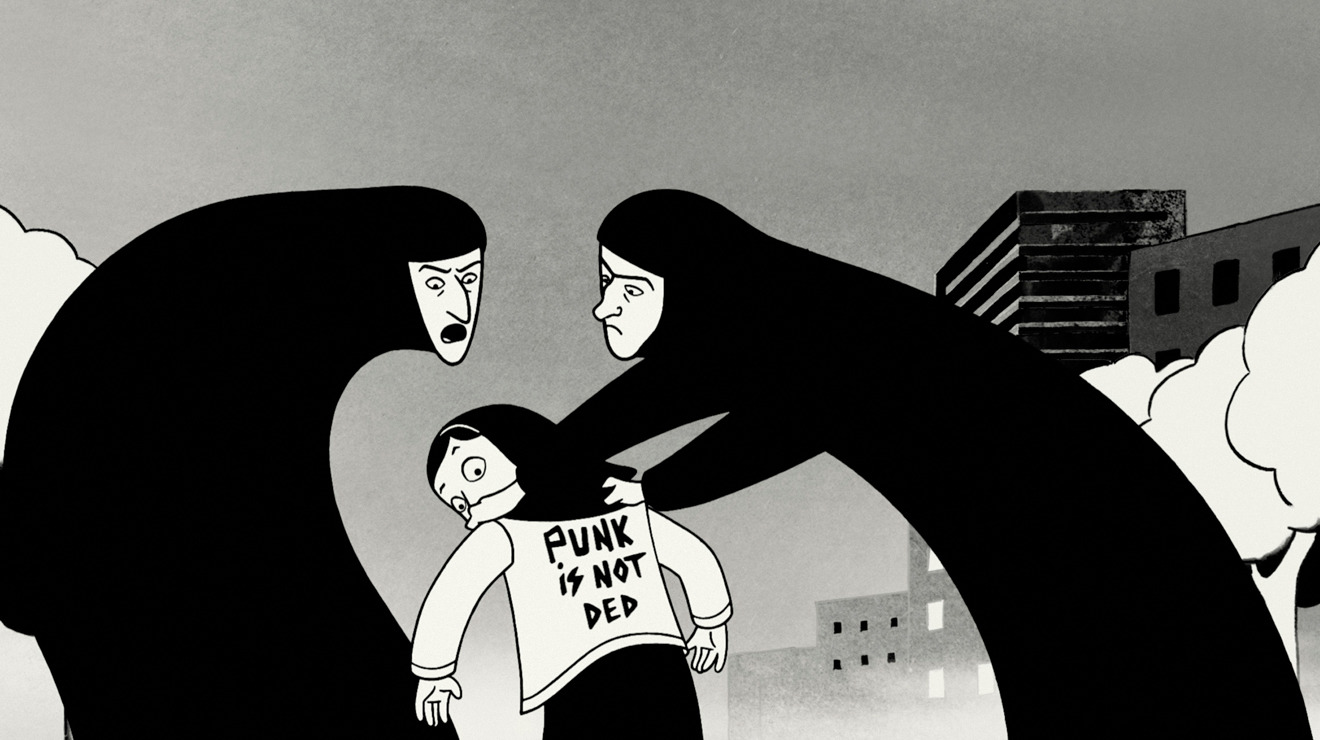
From her childhood in Iran to her death this month in Paris, Marjane Satrapi witnessed the early days of the revolution, the war with Iraq, and finally, the country’s ascendance as a world power. Her life’s work to bring about regime change in Iran ended in failure, but is a textbook example of propaganda that should be studied.
Even her choice of a fake name, Marjane Satrapi, is good SEO (search engine optimization). By using the name “Satrapi” to pen her flagship comic book Persepolis, she managed to occupy not one but two of the top words internationally associated with Iranian culture. Anyone who wants to google more information about ancient Persia’s governance system, or its capital, will be delivered her propaganda instead. There is also the brilliantly subtle purpose in such branding to shape western perceptions; the ancient pre-Islamic monarchy is the “true” Iran and the theocratic republican government is illegitimate. As you can see, Israel and the USA’s recent attempt to overthow the Iranian government and install a puppet monarch was not a new concept, it’s a consistent propaganda narrative carefully nurtured by Iran’s particularly venomous expat community.
The comic book Persepolis and 2007 animated movie of the same name was marketed in the western world as a smart and progressive alternative to the rabid Islamophobia of the Bush-era American conservatives. Persepolis is a demonstration of what I call the “out of the pot, into the fire” approach to propaganda. When part of the audience rejects propaganda and seeks the “truth,” they fall into a second (or even third or fourth) layer of propaganda. Another principle at work here is that different types of propaganda are aimed at different audiences. Frank Miller’s subtlety-of-a-brick comics like 300 and Holy Terror appeal to the working class masses who tend to think in more literal terms. Persuading these people is a matter of presenting a foreign nation as an existential enemy who wants to hurt them, simple. College educated liberals do not have quite the same value system. They feel very smart and, most importantly, want to always be superior to the working class masses. So the easiest way to persuade a liberal to hate a foreign nation is to compare them to his own working class, who he already hates. “Iran is ruled by religious bigots just like those rednecks with their guns and Bibles” is the most compelling argument for this audience.
I feel very stupid for ever liking Persepolis.
Anti-Iran propaganda is not dissimilar to anti-Russia propaganda, as it invokes the same primal prejudices in the propagandized audience. Russians are sometimes portrayed as scheming Asians who want to conquer the US, which appeals to the working class who get scared by threats of invasion, and also portrayed as backwards bigots who don’t even like gay marriage, which appeals to educated liberals. Anti-Iran and anti-Russian (and anti-China, anti-Cuba, etc.) are affirmed by authentic “survivors” of the regime who escaped to a western country, where they spin carefully curated narratives that appeal to western self-image. Marjane portrays herself and her family and friends as liberals with good taste who enjoy western music, art and culture. American-centric pop culture is the greatest soft power tool against adversaries, and also serves as affirmation that western countries are better than everywhere else. The very simple test to determine whether a country is “good” or “bad” is simply to see how accepting they are of western culture influence. Any country that rejects or pushes back against western cultural influence can be assumed to be bad.
Iran and Russia both had a revolution in the 20th century, and a major war that came to be a defining moment in their respective histories. Revolutions are very easy to paint as bad, as they involve masses of stupid, smelly peasants overthrowing their noble and educated superiorities who deserved to be in charge. A defensive war is a bit more complicated to subvert, but it can still be done by stripping the event of its heroism and victories. A war without heroes and victories is just senseless tragedy. Persepolis pushes this talking point excellently. The reader/viewer is left with no sense of the defeat of Saddam Hussein being a great accomplishment and national triumph. Which is really funny if you think about it, because the US, which was probably about a hundred times more powerful than post-revolution Iran, treats its victory over Saddam a few years later as literally the most amazing and brilliant military achievement in the history of the universe since 1945 (when the US beat Germany and Japan by itself with no help).
George Bush invaded Afghanistan and Iraq, and was correctly condemned as a war criminal by American leftists. But even while they condemned him, the liberal leftists own viewpoints were subverted by propaganda that predated Bush, and a slew of new propaganda spearheaded by people like Marjane Satrapi. By the time Bush left office at the end of his second term (note how antiwar lefties failed to even keep him out of office for a second round), they were mentally primed for Obama and his kinder, more progressive policy toward the Middle East; kill Osama bin Laden, withdraw most American troops, lean more heavily on proxy forces, and of course, endorsement of the rape of children by US-affiliated allies in Afghanistan.
I am glad Marjane lived to see the results of her life’s work; a triumphant and fully unified Iran inflicting a strategic defeat against the USA.
Watch Persepolis on Amazon Prime
Or, see the graphic novel
As an Amazon Associate I earn from qualifying purchases made through product links and web banners. Click here to navigate to the Amazon storefront.

Has she got the Noble prize? Peace and literature combined?
““Haven’t you been told that it’s strictly non-political?”“I’ve been told so many things that I don’t know whether I’m on my head or my heels,” said Mark. “But I don’t see how one’s going to start a newspaper stunt (which is about what this come to) without being political. Is it Left or Right papers that are going to print all his rot about Alcasan?”“Both, honey, both,” said Miss Hardcastle. “Don’t you understand anything? Isn’t it absolutely essential to keep a fierce Left and a fierce Right, both on their toes and each terrified of the other? That’s how we get things done. Any opposition to the N.I.C.E. is represented as a Left racket in the Right papers and a Right racket in the Left papers. If it’s properly done, you get each side outbidding the other in support of us — to refute the enemy slanders. Of course we’re non-political. The real power always is.”“I don’t believe you can do that,” said Mark. “Not with the papers that are read by educated people.”“That shows you’re still in the nursery, lovey,” said Miss Hardcastle. “Haven’t you yet realised that it’s the other way round?”“How do you mean?”“Why you fool, it’s the educated reader who can be gulled. All our difficulty comes with the others. When did you meet a workman who believes the papers? He takes it for granted that they’re all propaganda and skips the leading articles. He buys his paper for the football results and the little paragraphs about girls falling out of windows and corpses found in May-fair flats. He is our problem. We have to recondition him. But the educated public, the people who read the highbrow weeklies, don’t need reconditioning. They’re all right already. They’ll believe anything.”“As one of the class you mention,” said Mark with a smile, “I just don’t believe it.”“Good Lord!” said the Fairy, “where are your eyes? Look at what the weeklies have got away with! Look at the Weekly Question. There’s a paper for you. When Basic English came in simply as the invention of a free-thinking Cambridge don, nothing was too good for it; as soon as it was taken up by a Tory Prime Minister it became a menace to the purity of our language. And wasn’t the Monarchy an expensive absurdity for ten years? And then, when the Duke of Windsor abdicated, didn’t the Question go all monarchist and legitimist for about a fortnight? Did they drop a single reader? Don’t you see that the educated reader can’t stop reading the high-brow weeklies whatever they do? He can’t. He’s been conditioned.”("That Hideous Strength" by C.S. Lewis)