
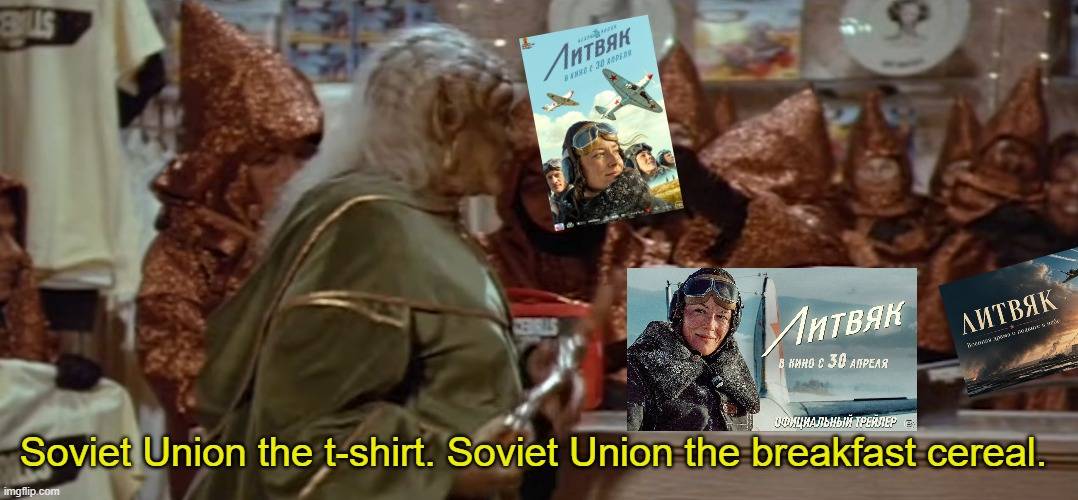
Today we went to the local theater in Feodosia to watch the new Russian war movie Litvyak, a biopic of the most famous woman combat pilot in history. And, well, it was disappointing.
Litvyak is generally an example of a Russian film that stands toe-to-toe with Disney productions in terms of special effects, but also like Disney, underdelivers in terms of plot. In fact, during this movie’s eyewatering three-hour run time, it was difficult to find a plot at all. It is not clear that the makers of this movie knew what they wanted to do before they started, which is unfortunate. Litvyak was made by the same team behind Panfilov’s 28 Men, which is perhaps described as “300 Spartans in the snow.” When I saw this marketing tie-in, I was intrigued. I thought, “Oh, this director who made a career on cheesy action flicks has gotten older and now wants to create a more mature and thoughtful story.” I was wrong. Well, maybe he tried to do a more thoughtful story but failed.
I see strong aesthetic similarities between Litvyak and the iconic Soviet war film Only Old Men Go Into Battle, but completely failing to understand what made that classic movie great. Old Men is about people with very interesting and meaningful lives playing music, writing poetry and building relationships, and they do all this despite a war, not because of it. Without the war, these people would be living equally interesting lives at home. But now that they are at war people have to live their lives to the fullest, because they could die at any moment. That’s ultimately why Old Men hits much harder than Litvyak. Each death in Old Men feels like a terrible tragedy because it was a full, interesting life snuffed out. This is the shared message of all Soviet war movies, that every soldier who stuffed himself against hte firing slit of an enemy pillbox and every pilot who rammed his plane into advancing enemy tanks was a future scientist, poet, writer or farmer who instead died at that moment. Only old men go into battle so the young men have a chance to live. But the characters in Litvyak are boring even as war heroes.
Both movies have a romantic theme, but they’re approached differently. In Old Men, the pilot “Romeo” meets the light bomber pilot Masha and starts flirting with her immediately, which she reciprocates. Before a mission Romeo gains permission from his commanding officer to marry Masha, and is killed. His comrades go to deliver the bad news to Masha, just to discover that she died the same day. Contrast this with the love affair in Litvyak, which is filled with hesitation and manufactured conflict that doesn’t seem to serve any purpose except to pad the runtime. This by the way has no resemblance to Lydia Litvyak’s own life. She fell in love and had a frontline marriage in a hurry, saw her husband die in aerial combat, then died herself not long afterward. There was no time together wasted and it is unlikely they had such pointless conversations as in the movie.
Speaking of death, the movie characters seem to have no idea how to deal with it, and their attitude is actually the opposite as in Old Men. The characters of Old Men live as they can and when there is a death, they reflect on it momentarily before moving on with the mission. There’s no prolonged paralyzation and lingering at the bedside of injured friends like in Litvyak. I found the scene when the group awkwardly informs Litvyak that her close female companion has died. It’s as if none of them have dealt with death before, and they approach it like telling a little girl that her cat got eaten by the neighborhood dogs. In real life there would be no nonsense that’s obviously going to make her feel worse, the commander would just tell her that her friend died. Or maybe, God forgive me for mentioning him, the political officer would tell her. You know, the guy who looked after the morale and personal well-being of the troops that every Red Army unit had.
Which brings me to what might be the biggest oddity of the movie. It’s set in the Soviet period but barely mentions the Soviet Union. This is admittedly an improvement over earlier Russian movies, which tended to be explicitly anti-Soviet, with the “bloody NKVD” and other stereotypical characters found in western propaganda, and more egregiously, re-write WWII history through a neo-nationalist lens. The religious and nationalist tendencies of characters hyped up and communism downplayed, or portrayed as stupid and counterproductive. That might feel good to modern filmmakers who went to American universities and hate the Soviet Union, but it’s not realistic and does nothing to understand how people felt at the time. This is no different than Hollywood movies that portray people in the Middle Ages and ancient Rome as modern woke feminists rather than try to understand how they actually felt.
Irina Rakobolskaya, chief of staff of the 46th Guards “night witches” wrote in her 2012 memoir, ‘Pilots filling out their military [party] applications wrote, “I want to go into battle as a communist.” It needs to be remembered that those who joined the party during the war years, at the front, received only two privileges; to be the first to go into battle, and to suffer a terrible death if they fell into captivity. Such a choice deserves respect, regardless of how one views the party from today’s perspectives.’
Why did Lydia Litvyak go into battle? She was a war hero who surely left behind personal correspondence and media interviews explaining why she went to war so how could it be a secret? But literally the only explanation we get from the movie is that she loved the freedom of flight. That could explain why she took flying lessons as a 12 year old, but not why she volunteered for war. Yevgenia Rudneva, a Hero of the Soviet Union who died over Crimea in 1944 who isn’t quite as famous as Litvyak but still has a street named after her in Moscow, wrote to her parents, “Courage is excellent knowledge of what you’re doing plus a good head on your shoulders, multiplied by a burning hatred of the enemy.” Did Litvyak hate fascism, did she like communism, did she like anything at all besides flying? Who knows, and the movie doesn’t tell us.
The invisible political officer, Litvyak’s Komsomol membership and ideological persuasions are examples of the moviemakers’ terror at showing anything, even accidentally, that alludes to communism. As I said, that’s an improvement over western and earlier Russian movies that were just blatant anti-Soviet historical revisionism, but it’s a disservice to audience and prevents us from gaining any understanding of people in the war generation. Litvyak strips away all political and ideological context, leaving the Soviet Union as an aesthetic, a brand that consume. The movie shows us uniforms, clothes and appliances from the war period, and I guess this is nice for the intended audiences. Older people can reminisce about their Brezhnev era Komsomol love affairs in the haystack behind the barn, and younger people can be inspired to shop for vintage Soviet products for their small studio apartments. In fact, some of the scenes were so blatant with their commercial nostalgia baiting I was half-expecting a pop-up ad explaining where these Soviet products can be purchased.
By the end of the movie we know very little about Litvyak, despite spending almost three hours with her. We don’t get to see any of her childhood, which is odd for someone who started flying early. We also, oddly, don’t get to see her martyrdom, which is of fairy tale proportions. Eight or nine German pilots saw the white lily painted on Litvyak’s fuselage and disregarded the rest of the battle to chase her down. She had a thrilling war career from beginning to end, but we get so little in the tediously long film adaptation.
Mel Brooks’ Spaceballs made fun of the shameless merchandising in Star Wars (which has only gotten worse since then) and unfortunately the same fate seems to have befallen the Soviet Union.
Ian Kummer
I now have a new YouTube channel that I will use to upload videos from my travels around Russia. Expect new content there soon. Please give me a follow here.
Also feel free to connect with me on Quora (I sometimes share unique articles there).