
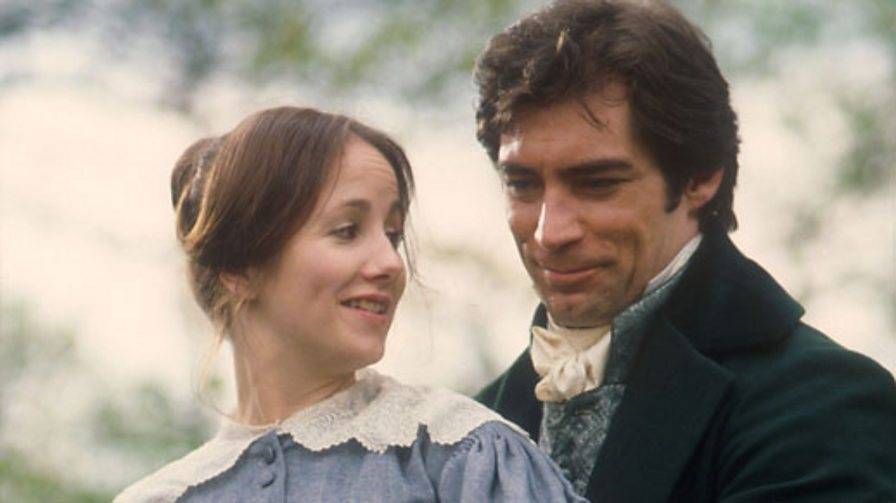
I just watched the 1983 BBC adaption of the 1847 novel Jane Eyre, by Charlotte Brontë. I honestly had not heard of this story until now, and Maria tells me I’m the only person on earth who hasn’t read it. Well anyway, here’s my review.
Jane Eyre is a lot of fun, as this was back when BBC knew how to make good content. Imagine an adaptation of this 19th century novel now. All the characters are white, nobody is gay, and only one disabled person. In a remake now, at least one of the main characters would need to be transgender. But back in 1983, being normal was still allowed.

There’s literally no action, I don’t think there is even anyone who could be construed as a bad guy in the story. There are certainly characters who are greedy, selfish, or petty, but not “bad” in the filmmaking sense, Nevertheless, suspense is maintained from start to finish of the story. The BBC episodes are a sharp 30 minutes each, and always somehow ending on a cliffhanger.
Jane Eyre herself is painfully average, not rich, not particularly brilliant, and not even pretty. “Beauty and grace are completely absent from her features,” as one of the characters put it. So she is very relatable to the average reader, who is not rich, a genius or a super model. Like all British main characters, Jane has a difficult childhood. Her parents are dead of course, and Jane’s bitterly vindictive aunt sends her to a girls’ school, just a normal school, not a magic school, unfortunately. The manager of the institution is a mean old pervert who likes hell a little too much, and steals so much of the budget for himself the girls are half-starving. The school’s terrible conditions eventually lead to a typhus outbreak, which is deadly for children who aren’t the main character.
At this point Jane has had enough character building, so grows up to a be a teacher for the same school briefly before finding a position as governess a mysterious, brooding aristocrat Mr. Rochester, played by Timothy Dalton. While watching this I actually realized why he couldn’t be James Bond for long. He’s too serious to deliver the ridiculous puns and innuendo required of James Bond. Sean Connery and Roger Moore could play the character half-seriously, understanding that the whole thing is barely not a joke, maybe that was just too much for Dalton. Regardless, he seemed more suited for roles like in Jane Eyre.
Naturally, the gazillionaire aristocrat falls in love with his simple governess. On the face of it, the relationship seems absurd. Why would such a rich bachelor, who is used to the most stylish mistresses, actresses and balerinas in Europe be interested in someone so plain and boring? Well, we find out that sometimes when something feels to good to be true, it probably is. Mr. Rochester turns out to be already married (which he had planned to conceal from Jane until it was too late) to a woman who had gone violently insane and is now locked up in a hidden room upstairs. Though as the story progressed, I became unsure if the right person was locked up. But circumstances humble him, his first wife conveniently dies, all is forgiven and he is married to Jane.
As I watched Jane Eyre, it came to me how derivative modern fiction is, and how nothing is really new anymore. And I don’t think recent authors have necessarily read Jane Eyre, they just repeat tropes that are so established now there is no intentional reference to their origins. There’s the required hard childhood with abusive family members that we’re all familiar with by now (though Jane can live in a normal bedroom, not a cupboard under the stairs), Jane and Mr. Rochester have a dom-sub dynamic that’s unfortunately similar to Fifty Shades of Gray (though without the BDSM, thank God), and there’s the mandatory third act love triangle. What circumstances could lead to this plain girl having not one but two very eligible men pining for her hand in marriage, except that she’s the main character? Though it’s equally obligatory for one of these suitors to be considerably less desirable than the other so the main character isn’t compelled to make too difficult a choice.
But the bigger trend I noticed is how British literature seems required to have a happy ending. When the big plot twist came, that Jane has a rich uncle desperate to leave her all his money upon his death, which happens soon enough to not be an inconvenience for her, I could not help but sigh. Does Britain have any poor people at all? There’s a saying that the USA has no poor people, only temporarily embarrassed billionaires. I guess Britain does not have any poor people either, only main characters who are temporarily unaware that they’ve actually been rich all along.
At the end of the day, every British character is Harry Potter; subjected to a rough character-building childhood before finding out that there’s a goblin bank account with his name on it and all of his problems are solved by magic. That would be a very nice thing to happen to anyone in real life, but it’s so tiring for me in the 21st century to see in fiction over and over again. Russian literature is often characterized as depressing, but maybe it’s just realistic. The main character isn’t always blessed with riches, and he doesn’t always get the girl. And when he does get the girl, she might be someone more realistic for a man in his position, like a prostitute. Sometimes even the prostitute doesn’t want him.
Watch Jane Eyre on Amazon Prime
As an Amazon Associate I earn from qualifying purchases made through product links and web banners. Click here to navigate to the Amazon storefront.

Ian Kummer
I now have a new YouTube channel that I will use to upload videos from my travels around Russia. Expect new content there soon. Please give me a follow here.
Also feel free to connect with me on Quora (I sometimes share unique articles there).