
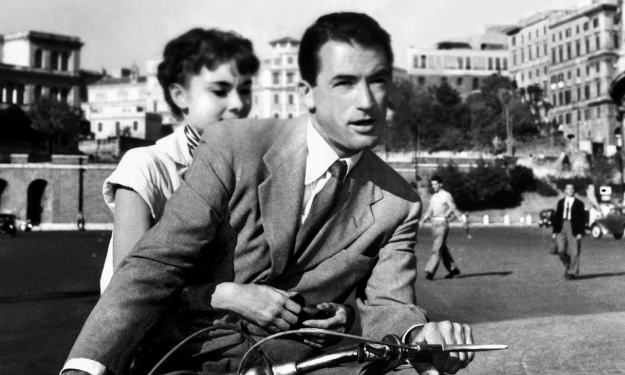
The 1953 romemantic comedy Roman Holiday was filmed on the actual streets of Rome. It’s a fun little story not trying to convey any particular lesson, but in today’s world feels like a strange, impossible fantasy.
Audrey Hepburn plays the naive Princess Ann who runs away from her handlers and ends up on a daylong adventure with American reporter Joe Bradley (played by Gregory Peck) exploring Rome before having to return to her heavily-scripted life as royalty. It’s actually a very silly and boring premise on the face of it, but there is a conflict that spices things up. Joe, and his accomplice Irving are stringing her along in an elaborate deception to get a sensational story and photos of the runaway princess that Joe’s editor has agreed to pay $5,000 for. But in the end, Joe likes Ann too much to betray her with an embarrassing media scandal.
When I watched the first part of the movie, when Ann is wandering the streets alone at night and falling asleep from the sedative her doctor had given her shortly before her escape, is rescued by Joe, then tours the city with him the next day, I was reminded of the similar sequence in the much later Disney Aladdin, when Princess Jasmine leaves the palace for the first time and almost gets her hand cut off by an angry merchant. I don’t think extrajudicial hand choppings were allowed in Baghdad, but it is probably closer to the reality of what would happen if a childlike princess wandered a western city alone in the present day.
Aside from the cultural enrichment of our modern civilization, Roman Holiday portrays a world that was totally different. 1950s Italy is portrayed as very poor, but still lacking the culture of desperation that moves the globalist world order of today. Joe is a bum who owes money to basically everyone, but it’s not a big deal. He owes his landlord two months rent, which he finds a bit annoying but isn’t terribly upset about it. Joe seems competent as a reporter but does the bare minimum, openly saying he doesn’t like the job or his boss, but the boss isn’t perplexed by being directly told this. On the contrary, he seems almost entertained by these arguments.
In the end, when Joe changes his mind about publishing the story, it’s disappointing for both him and the photographer Irving, but not a huge deal either. Honestly, even if they did get the money they probably wouldn’t have done anything smart with it. As it turns out, being poor and being desperate aren’t the same thing. It is possible to be poor but not desperate, and desperate without being poor.
Our globalist end of history economy is driven by desperation. A landlord today can’t let tenants go months without paying because he needs their money to pay the mortgage. A newsroom editor can’t let reporters oversleep and miss work because the outlet is in constant danger of going out of business. And a reporter can’t pass up a $5,000 story just because he changed his mind. I actually have to highlight the $5,000 figure, because even though there has been incredible inflation since then, $5,000 is just as huge an amount of money for an American journalist today as it was in 1953. Even the most successful workers making six figure salaries have to be scared of being replaced by migrant scab labor or AI.
Imagine asking Joe’s boss if he would like to replace him with AI, Joe is an asshole, after all. But I don’t think it would be even possible to explain why human reporters should be replaced by AI. Ultimately, the editor would understand the main problem; Joe writes stories that people actually want to read, while AI does not. In our era of desperation, everyone seems to have forgotten this. Dunkin’ Donuts replaced their fresh warm donuts baked on site with cheaper delivered donuts, and were surprised when people didn’t like them anymore and stopped buying. Wendy’s replaced their high quality ingredients with cheap ingredients, and were just as surprised to see a decline in sales.
We don’t even have to reach as far forward as 2026 to see contrast. Imagine, for example, a 1980s reporter passing up a scandalous story on Princess Diana because he ended up liking her too much and didn’t want to hurt her feelings. But of course everything is a lot worse now than in the ’80s.
Even enjoying Rome the way Ann got to is probably unattainable. Even if Italy didn’t accept a single immigrant since 1953, global tourism has gone up exponentially, so the days of strolling half-empty streets with the locals are long gone. Even the Mouth of Truth that bit off Joe’s hand for being a liar (just a prank, but maybe it should have), isn’t something you can just casually walk up to. From reviews I’ve found online, the wait time is 15 to 30 minutes on a slow day.

The world is more crowded, faster and more desperate than ever before.
I did say there’s no overt lesson or moral. But there’s a nice bit of propaganda about the US occupation when Joe flashes his American press ID to get out of trouble with the police. Though ironically, the main screenwriter of this film, Dalton Trumbo, was a blacklisted communist so not shown in the credits.
Ian Kummer
I now have a new YouTube channel that I will use to upload videos from my travels around Russia. Expect new content there soon. Please give me a follow here.
Also feel free to connect with me on Quora (I sometimes share unique articles there).

Great essay. There is in fact a word for what you are describing, "enshittification".The original causes seem to be worldwide overpopulation and resource depletion, but it also seems humans in general have experienced cognitive decline recently.Based on reading Quora posts on the subject, I consider myself lucky to have visited Italy in the 1980s. I suspect the immigrant stuff is exaggerated, but overtourism is clearly a problem.