
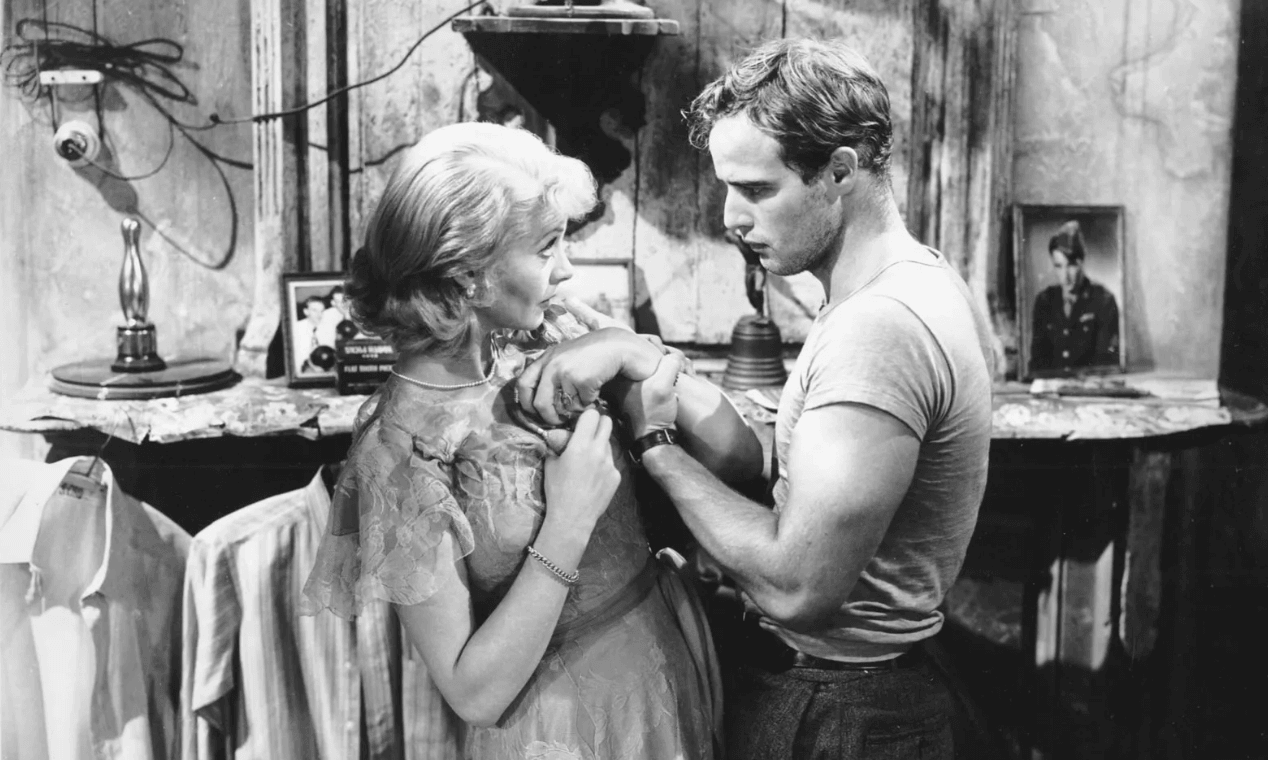
I just watched A Streetcar Named Desire, which I had heard of, but never seen before for some reason.
The movie starts with Blanche DuBois arriving in New Orleans, supposedly on a leave of absence from her teaching job, and taking a streetcar named Desire (that’s the name of the movie!) to meet her sister, Stella.
Stella hooked up with and married Stanley, an “alpha male” blue collar worker who gets into violent, stupid drunken brawls with other men at the bowling alley, which she finds irresistibly sexy. But at home he’s a violent and stupid drunken husband (who would have thought?). Stanley, played by Marlon Brando, is just as tragic a character. He’s depicted as a smart though uneducated person who does genuinely love his wife; when he’s not driven out of his senses by anger and lust, Stanley is actually a very good and gentle human being. In a different environment that provided Stanley better education and social graces he might have been a good man.
Then there’s the tragic romance between Blanche and Mitch, Stanley’s war buddy and coworker. Mitch is played by Karl Malden, who I recognized from his role as General Omar Bradley in the iconic 1970 movie Patton. Malden is a perfect character actor for Mitch, and is actually very similar in personality to General Bradley. He’s sympathetic and well-meaning, but a hopeless and insufferably obtuse dork. Having him as a lover, or a general, is like cutting diamonds with a shovel. Their romance is frustrating and ironic. Early in the movie, Blanche expressed to her sister the difficulty of not being too hard or too easy with men, and if a woman mentions marriage, the man tends to forget her address. This is pretty much how things play out with Mitch, and also illustrates how it is good to pay attention to the dialogue in old movies, because it’s usually relevant to the plot.
Blanche is a very interesting, well educated and smart but damaged person with a lot of baggage, and that should have been very obvious within the first five seconds of talking to her. But poor Mitch doesn’t have a lot of experience with women, and has a lot of ideas of what women are supposed to be like in his head. They have an emotional connection right away, but things are always awkward. Blanche has been easy in the past, but likes Mitch so doesn’t want to be easy with him out of fear of driving him away. A men’s rights activist today would probably say that this is proof that Blanche is a used-up fallen woman trying to find a gullible cuck she can con into marrying her. I am by no means saying such things never happen, but this logic only holds up if a different strategy on her part would have changed the results. In this case no, I doubt Blanche sleeping with him would have changed the disastrous outcome of their relationship.
Not to be unfair to Mitch, it’s true that Blanche should have been honest about her age and her past, but he could have been less retarded with how he approached the issue. When Mitch ghosted Blanche for their dinner date at Stanley and Stella’s house, I was sure he would barge in later demanding explanations, which is what happened. Even at this point, there still could have been a happy outcome. The question Mitch needed to answer for himself was if he wanted to marry Blanche or not. If he didn’t, then there was no sense in bullying her. The problem is that Mitch wasn’t thinking for himself. He had been influenced by his moron friend Stanley and was trying to act like an alpha male like him. That’s very clear in the last moment when he forcefully kisses her and declares that he doesn’t want to marry her. In his mind, he probably thought this is alpha male “game” which would make her swoon and have sex with him, but her reaction was, obviously, the exact opposite.
If only Mitch had thought for himself, and what Mitch wanted, not what Stanley wanted. I am reminded of a scientist family who decided to raise their baby alongside a monkey, hoping that human interaction would make the monkey smarter. They had to cancel the experiment after a few months because the baby was acting like the monkey, not the reverse. Bad company drags down, not up. This is particularly unfortunate for Mitch because he does seem to want to improve himself and rise above his assigned station in life, but he’s not ever going to achieve that by hanging out with those bums who drink and play cards at Stanley’s apartment.
Would Blanche really have been that terrible for Mitch? I guy in his late 30s with no particularly amazing skills or looks probably shouldn’t demand a blushing virginal bride. And I love how the big scandal in Blanche’s past turned out to be that she slept with a 17-year-old boy student in her English class, a horrific crime against humanity that makes her literally worse than Adolf Hitler. Just driving this home further, there’s a scene when an innocent boy wanders into the apartment selling newspapers, and Blanche takes advantage, begging for a sweet, soft kiss, a request he finds surprises but obliges. Just Blanche’s latest atrocity in a series of atrocities too numerous to list. The movie pretty directly states that these sweet, soft-spoken boys remind Blanche of her young husband who had been outed as gay and killed himself. She did actually tell Mitch about that part, making her pearl-clutching even more ridiculous.
Despite being different types of guys, both Stanley and Mitch have similar motivations in their actions against her; she threatens their masculinity. Stanley knows he’s “common,” feels very self-conscious about it, and is angered by Blanche’s aloof, overly sophisticated and sometimes outlandish behavior. So he sets out to find a way to ruin her reputation (and he is perceptive enough to figure out that she probably does have a past she doesn’t want out in the open). He does find that scandalous past and in turn poisons Mitch’s perception of her. Mitch was already frustrated by her emotional swings and games of playing hard-to-get. So when Stanley tells him that this is like a real-life Chad and Cuck meme, he immediately believes it.
At the end, having successfully ruined Blanche’s life, Stanley rapes her, while his wife is at the hospital with their baby, no less. And Blanche loses what’s left of her sanity.
But the final scene is surprising. I daresay that I even found it inspiring. Stella, consciously refusing to believe Blanche’s story of what Stanley did, has her institutionalized. This sequence is as carefully crafted as the rest of the screenplay, and starts out horrifically with medical workers chasing Blanche into the apartment. The psychiatrist is a wrinkly old man, so in appearance morally ambiguous; he could a sadist or a pervert, but he is actually a wise and kindly doctor. He offers Blanche his arm like a proper gentleman and she leaves with him willingly. He could have had her dragged out in a straight jacket, but he sought her consent, which is something that had been missing from her life for a long time. Mental hospitals could be neglectful or abusive, but right away we can tell that he will be kind to her.
If Stanley represents toxic masculinity, then the wrinkly doctor represents positive masculinity. He maintains control of the situation like the proverbial “alpha male” beloved by boomers, but without unnecessary force. His nurse pinned Blanche to the floor and advised trimming her nails, and he ignored her. That shows he relies on his own judgement, not the uninformed opinions of other people. And finally, he immediately understood Blanche just from looking at her, and what he could give in exchange for her cooperation. That’s not “empathy” beloved by liberals, but wisdom.
Seeing this play out compelled Stella to take the baby and finally leave her husband for good. Why she did this is of course open to interpretation. It’s possible that Stella was mortified by what happened to her sister and left out of anger and spite for him, but I disagree. I think seeing the psychiatrist effortlessly get calm cooperation out of Blanche proved that she wasn’t insane and was telling the truth. Actually, I think it’s very obvious that Blanche wasn’t crazy, just manic and over-stimulated. Furthermore, in the end, Blanche escaped with a kind stranger, and Stella realized that she needed to escape too before it was too late.
Blanche not actually being insane is an important enough point that I’ll repeat it. She just needed a respite, and life never gave her one. She lost the family ancestral home, then she lost her husband, then she lost her teaching job, then finally she moved to this small, dirty, noisy apartment with someone who wanted to hurt her. Literally within the first moment of them meeting, Stanley takes off his sweaty clothes in front of her. I actually missed the significance of this until I thought about it later, but Stanley repeatedly undressing in front of her is intentional aggression and domination. He invades her space and makes her uncomfortable at every opportunity, and there’s no escape.
The theme of escape is crucial here, because the possibility of escape has to exist in the first place. Today the idea of a mental hospital sending people to your doorstep to provide prolonged treatment for free sounds preposterous. Blanche might as well have said that she would take the ring to Mordor, or go through the wardrobe to fight the ice queen for control of Narnia. I almost can’t believe that in the distant, ancient past, America had these institutions for rehabilitating people free of charge just because it was a good thing. In modern America there are much more important things to spend that money on, like giving Somalis tens of millions of dollars to watch each others’ kids (or imaginary kids). Today’s Blanche DuBois would be destined to eventually run out of personal options and die in the gutter.
Funnily enough, I had a hard time guessing the social class of people in this movie from their first appearance; the men all wear suits and ties on the street, and the women wear nice dresses. Maybe teaching everyone from a young age that they should try to look presentable even if they don’t have two pennies to rub together wasn’t such a bad thing after all. I understand that this is just a movie, but it’s not far off from how Americans actually looked back then. It’s interesting how downtrodden people in the 1950s who could barely spell their own names still dressed and looked healthier than American billionaires in 2026.
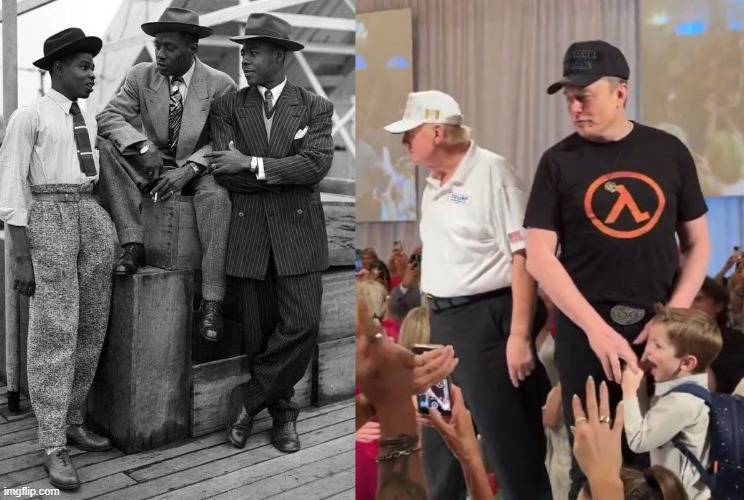
The most oppressed men in 1950s America versus the most powerful men in America now
I did find Stanley’s background as a second generation Polish immigrant interesting and, intentionally or not, this calls into question the whole idea of the American “melting pot.” The Kowalski family did not seem to be a net positive for American society, as their son is a drunken, violent loser. He could have been a drunk and violent loser back in Socialist Poland. They at least would have tried to give him a proper education and class consciousness. And if these attempts failed, there were even special education programs where he could find emancipation through labor.
Watch A Streetcar Named Desire on Amazon Prime
As an Amazon Associate I earn from qualifying purchases made through product links and web banners. Click here to navigate to the Amazon storefront.

Ian Kummer
I now have a new YouTube channel that I will use to upload videos from my travels around Russia. Expect new content there soon. Please give me a follow here.
Also feel free to connect with me on Quora (I sometimes share unique articles there).

It’s a great review, tho I’m glad that Kowalski Senior chose freedom and left for America.
Maybe you’re right about the hospital, and she gets better there. You are more optimistic than me.
It's a great review, tho I'm glad that Kowalski Senior chose freedom and left for America. Maybe you're right about the hospital, and she gets better there. You are more optimistic than me.