
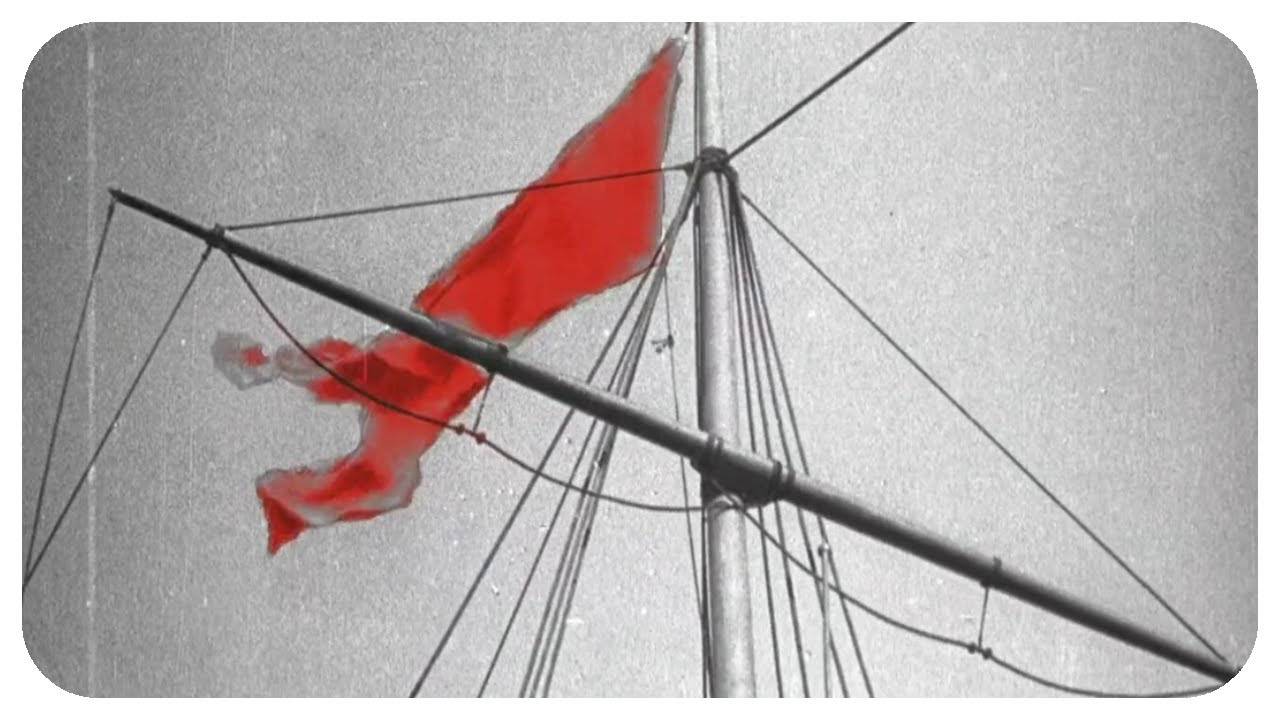
Tretyakov Gallery hosted a 100 year anniversary screening of Sergei Eisenstein’s iconic 1925 film Battleship Potemkin. It’s a masterpiece that influenced filmmaking around the world up to the present day. Aside from simply being a great movie, Battleship Potemkin has lessons that are just as relevant now as they were a century ago.
Battleship Potemkin is based on the real-life mutiny aboard a Russian battleship during the 1905 revolution. It is worth watching if you haven’t already, otherwise you can read the Wikipedia page here.
Individualism, not collectivism
Every American schoolchild knows that communism is a collectivist system in which the needs of the many outweigh the needs of the few and the individual does not matter. Yet actual real-life communist propaganda, at least in the Soviet Union, has no resemblance to its parodies in western media. Even 1940s American movies which were actively trying portray the Soviet Union positively, like The North Star, have virtually nothing in common with the Soviet movies from the same period. This disconnect calls into question how well American communists ever understood their Russian counterparts. I am of the opinion that they usually don’t understand Russia or Russian communism at all.
America’s core value is liberty, and Russia’s is justice. With the rise of Russian communism, the basis of American propaganda, both for and against the Soviet Union, accepted the assumption that they were in opposition to liberty, which simply is not correct. Liberty and justice do sometimes conflict with one another; liberty for one man might cause an injustice for another man. Like a landlord raising his tenant’s rent and then throwing him onto the street when he can’t pay, for example. But this does not by any stretch of the imagination mean that liberty and justice are ideals standing in opposition to each other.
Battleship Potemkin is not at all about collectivism, and I think part of the reason why it stands out so much to American film enthusiasts is because we don’t quite ‘get it.’ The story is a series of injustices, each one more egregious than the previous, until the injustice is impossible to tolerate. One of the ship’s officers strikes a sleeping sailor because his hammock bumped into him. The officer had the liberty to deliver punishment, but it was cruelly unjust. Vakulinchuk, a communist, is awakened by the commotion and gives a speech imploring his military comrades to join the revolution, but to no avail. Military discipline is intact.
The next and more serious injustice that starts to tear apart military discipline is the maggots. Potemkin’s meat store spoils and becomes infested with maggots. The crew are unhappy but their captain apparently doesn’t want to be bothered with such an inconvenience, so he sends the ship’s doctor, who insists that the meat is washable therefore safe to consume. But by this point everyone aboard has heard about the maggots so refuse to touch the meat. Now a minor problem has escalated to a major crisis. The captain believed he could bully everyone but failed, and their disobedience is a direct challenge to his authority.
So he assembles his crew on the deck and again orders them to eat the meat. Some refuse, and the captain has them lined up under a tarp to be executed. The ship’s priest appears and gives the execution his blessing. As the firing squad prepares to shoot, the movie breaks into a montage emphasizing the failure of every Russian authority figure and institution. The captain and his officers are cruel simpletons grinning in delight in finally resolving the insurrection they themselves had caused. The priest beats a gold cross into the palm of his hand, representing the church siding with tyranny. The two-headed Roman eagle at the ship’s bow oversees the scene silently, representing the moral failure of the empire.
At this moment Vakulinchuk decides to act, imploring the sailors of the firing squad to not commit this crime, and succeeds, triggering a riot. All the officers are thrown into the sea, though not before the captain chases down Vakulinchuk and kills him; he dies suspended in the ship’s rigging as an overt Christ figure, or a real Christ in contrast to the pseudo-Christ on the priest’s cross of gold. As for the priest himself, his fate isn’t spelled out, but he is seen pretending to be unconscious as the riot unfolds, as usual taking the most cowardly and passive route. The camera lingers on a closeup of the doctor’s spectacles in a moment of irony. As it turns out, he was right all along. The “meat” of the ship, the sailors, were healthy. It was the maggots, the officers, who needed to be “washed off.”
I have to ask the readers, what part of this story is collectivist? Vakulinchuk is an individual who acts as an individual, and finally persuades the other sailors to individually make a choice. Any one individual in this story could have changed the outcome. One man in the firing squad could have pulled the trigger, but they didn’t.
Likewise, every authority figure failed individually. The captain chose to have a cruel power trip rather than be reasonable. The doctor chose to side with the captain rather rather than refuse to approve the spoiled meat, which he absolutely had the power to do. The medical professional is one person the commander can’t punish for doing his job. And if the captain chose to ignore the medical advice, the doctor could complain and get him in trouble. The priest’s cowardly failure is even more serious. As a man of God, he could have advocated for the condemned men, and insisted on a lighter punishment. If he had done that, the captain might conceivably have been smart enough to see this as an opportunity to deescalate without looking weak. So even though Eisenstein was the archetype communist Jew, he wasn’t being unfair here. I wouldn’t even say he was being anti-religious. He was being anti-clerical, which isn’t the same as anti-religious. On the contrary, he gave the Christ role to Vakulinchuk, who deserved it.
When you have a hammer, everything looks like a nail
The final act of the movie is the most famous, with the massacre on the Odessa steps. The crew of the Potemkin hold a wake for Vakulinchuk in Odessa; the locals are angered at his unjust murder, which escalates into a second and larger insurrection. As the crowd is chanting anti-regime slogans, a finely-dressed government provocateur tries to divert their anger toward the Jews, but he is beaten and the chants continue.
Now that their provocateur failed, the regime responds the only way they know how, with violence. Lines of faceless white-uniformed soldiers appear at the top of the steps and march down while firing into the crowd. An old woman and a mother with her dead son in her arms separately try to persuade the soldiers to stop shooting, but are gunned down instead. The first time I saw this movie six or so years ago, I didn’t recognize the significance of this moment. Actually at the time I found their actions to be naive. But after watching this movie for a second time, I realize the women’s actions aren’t materially different than Vakulinchuk’s. They try to appeal to the soldiers’ humanity and fail.
A long time ago I saw a certain video on social media which I would share here but I couldn’t find again. The video showed several old women, babushkas, chasing a group of riot police and beating them with sticks. It’s funny to watch frail old women who can barely walk hitting big armored guys on the head, but this shows an important cultural trait. When a Slavic guy gets beaten by babushkas, he can’t fight back, he just has to endure it. Babushkas command respect, so he can’t hit them back, even if they’re annoying. The Tsar’s soldiers shooting a babushka in the face shows how cruel and evil they are.
Likewise, the mother is supposed to command respect from men, not just because she’s literally the future of the nation, but because she’s vulnerable and has a helpless child. Eisenstein’s choice of dialogue for her is interesting, she simply approaches the firing line with the child’s body and says “My son is very badly hurt.” The first time I saw the movie I thought this was crazy, but it’s actually very understandable. She’s directly appealing to the soldiers’ humanity and they’re supposed to stop shooting. If anybody in that line had even one shred of humanity he would have stopped shooting, but they didn’t.
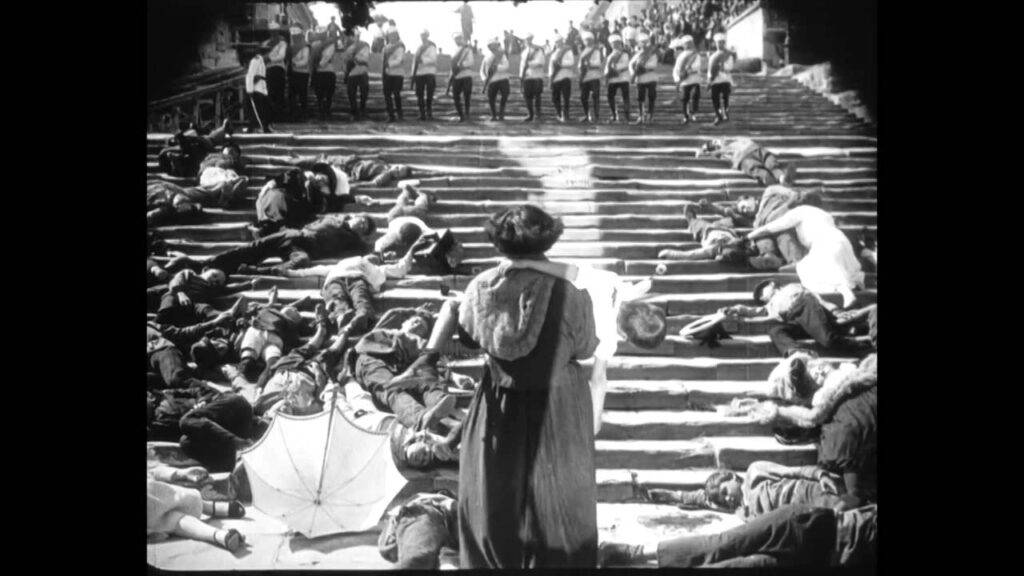
The soldiers in the movie are the only people who are dehumanized. Even the Potemkin’s officers and the priest are portrayed as human. But the soldiers’ faces are never shown, only their guns with bayonets, and marching nazi jackboots (before nazism was even cool). They are the one group that acts collectively, like robots marching in unison, just following orders, and discarding their individual sense of humanity. This scene is even more impressive when you consider that there were no robots or ChatGPT back then.
George Lucas claims that his stormtroopers in Star Wars were based on Nazi Germany. Well, why were the stormtroopers dressed in white and not black? I think he had this scene in his head whether or not he consciously realized it.
As for the iconic moment of the rolling baby carriage which was repeated in western movies a thousand times, that has the same message. A woman literally shields her baby from bullets, and the soldiers don’t care if that baby is crushed to death on the steps. The carriage rolling out of control down the steps provokes panic from the audience, which proves that we are human and the soldiers are not.
So much for collectivism.
“Into the fifth generation”
The US intelligence community saw the marxist uprisings of the 20th Century and decided that these events could be artificially recreated. They could create suffering by economically sanctioning a country, Then instigate violent riots that provoke the local government to senseless violence, provoking regime change. But this tactic pretty consistently fails, and it seems like the US political establishment doesn’t understand why. It’s a “chicken and the egg” question but it has more to do with ‘why.’ And the ‘why’ has to do with justice. Attacking a country’s security forces, like what happened in Iran recently, and being killed by security forces without just cause like in 1905 Russia, are two entirely different things. But we are so divorced from morality we cannot understand why these things are different.
Consider Prigozhin’s infamous insurrection, and why it failed. Perhaps he thought that Putin was the next Nicholas II and he was the next Lenin. Maybe he rightfully saw corruption and stupidity in how the war in Ukraine was fought and thought he could manipulate that to gain popular military support like in Battleship Potemkin. But he made a fatal error, and it had to do with justice. Putin was committing to great injustice that required overthrowing him and putting Prigozhin in his place. You can accuse Putin of being an incompetent commander-in-chief or otherwise not knowing how to properly execute a war, but I don’t think anyone can reasonably accuse him of being inhumane, and that’s the most fundamental point. Even if someone successfully argued that Putin’s Russian Federation is in every way just as incompetent as Nicholas’s Russian Empire, they’re cruel or unjust as depicted in Battleship Potemkin.
I actually find it funny when Anglos accuse Russians of being a ‘slave race’ or submissive to their government. Unlike in Britain, there is no such thing as a Russian ‘stiff upper lip.’ When there is a genuinely insufferable government, Russians are not shy about overthrowing it, but that hasn’t happened in a while. When was the last time the British overthrew an unjust government? Has it ever happened? Even the glorious revolution was elites fighting other elites, not a popular uprising.
Why the red flag?
When I was in the movie theater at Tretyakov Gallery, they showed this teaser image of the red flag which appeared in the movie:
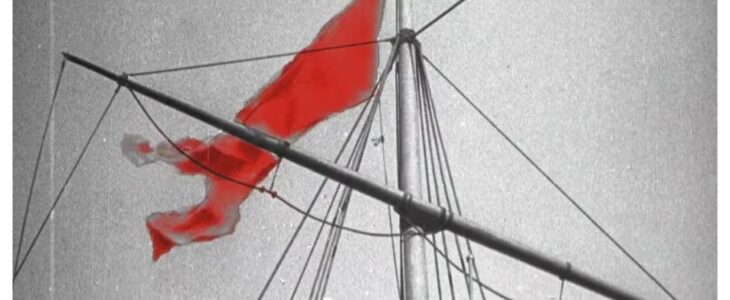
I thought that was an odd choice for the defining shot of Battleship Potemkin. Why is this the most iconic image in the movie? But at that moment when the red flag went up in the movie I was cheering for it. The red flag represents liberation from oppression, and the triumph of good over evil, and that’s why it is the most iconic shot of Battleship Potemkin.
But maybe Battleship Potemkin is not meant for westerners, because I had to live in Russia for almost four years before I thought I fully appreciated it.
As an Amazon Associate I earn from qualifying purchases made through product links and web banners. Click here to navigate to the Amazon storefront.

Ian Kummer
I now have a new YouTube channel that I will use to upload videos from my travels around Russia. Expect new content there soon. Please give me a follow here.
Also feel free to connect with me on Quora (I sometimes share unique articles there).

I thinks it’s a great review of a movie that aged better than the Matrix will, as its glory vanished with the balls of the directors.
I also think that your note on collectivism is brilliant and your point is important for the Russians just as it is for the Westerners. We don’t have inspiring or appealing propaganda now, alas. No Eisenstein.
As a side note, I also enjoy this movie as a documentary now. Imagine, every thread in it, every piece of furniture existed 100 years ago. No CGI).
I thinks it's a great review of a movie that aged better than the Matrix will, as its glory vanished with the balls of the directors. I also think that your note on collectivism is brilliant and your point is important for the Russians just as it is for the Westerners. We don't have inspiring or appealing propaganda now, alas. No Eisenstein. As a side note, I also enjoy this movie as a documentary now. Imagine, every thread in it, every piece of furniture existed 100 years ago. No CGI).
Look into Alexei Stakhanov. Individual excellence was rewarded in the USSR, at least under Stalin anyway
Look into Alexei Stakhanov. Individual excellence was rewarded in the USSR, at least under Stalin anyway