
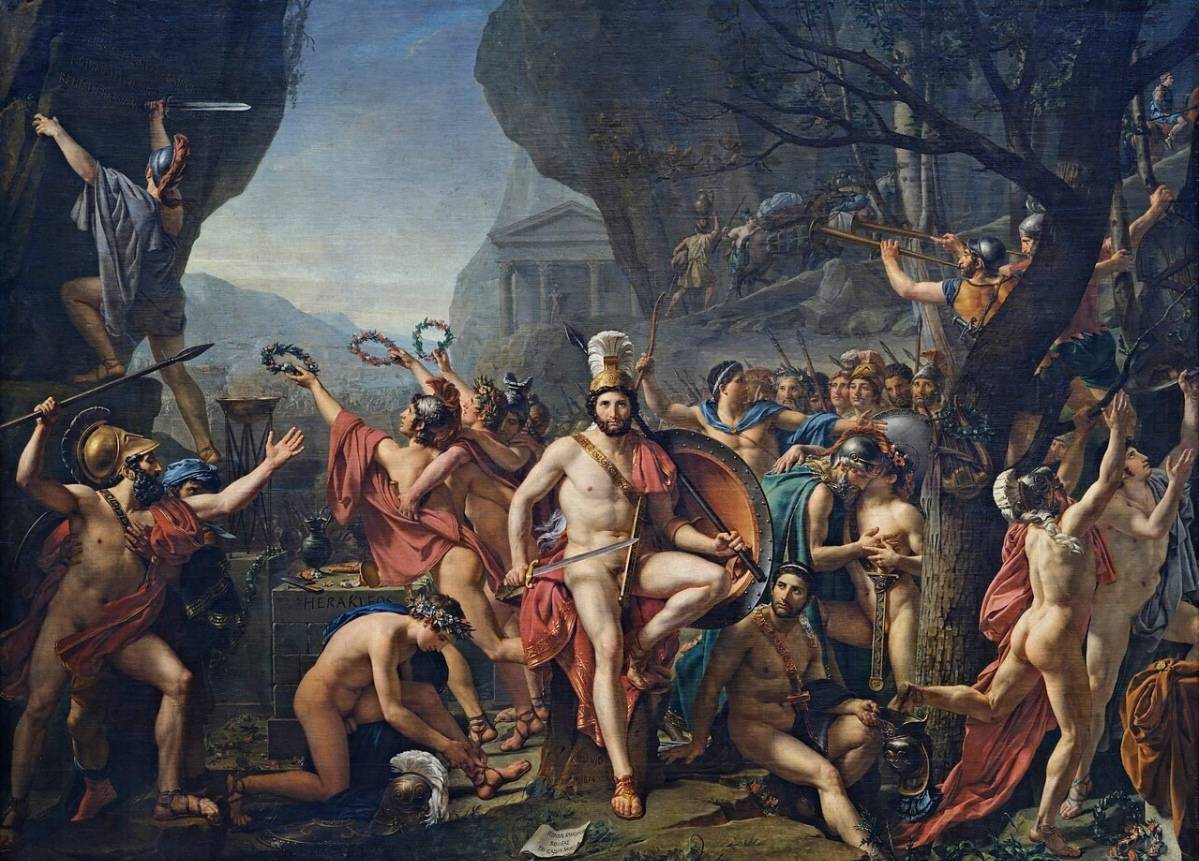
Ledtist critics widely condemned the Frank Miller movie 300 as anti-Iran war propaganda, but that was only the tip of the iceberg. It is important to understand the roots of the 300 story. The most crucial thing to understand is that virtually all of our understanding of world history was fabricated out of thin air in the 18th and 19th centuries.
Thermopylae (and before that, Marathon) was always a cool story of a small underdog army standing up to a larger army of invaders, but that was it. Hellenic Greeks did not think in terms of East vs. West, and they didn’t even think in modern terms of nations and ethnicity. They were not like the Greek nationalists of today trolling about the greatness of Greek civilization from their small Berlin apartments (and feuding with the Turkish nationalists, who are also trolling from their small Berlin apartments).
I remember one time as a kid I read a history book about Sparta and being astonished to find out that it was commonplace for a Greek guy who got into political or legal trouble in his homeland to run away to Persia, and this was a completely normal thing to do, not even weird. It was no different than aging western film actors of today invading Moscow for a “Special Tax Evasion Operation.” In fact, it could be said that Persia was the civilization, and Greeks were the primitive barbarians. Greeks would go to Persia for prestige and riches, or just to avoid getting lynched in their backwards home town. A Greek traveling to Persia to serve as a mercenary is in concept no different than a Kazakh traveling to Moscow or New York to drive cab. It is a bit silly to claim to that the cab drivers are the center of civilization while their customers leaving tips are the savages. I might also point out that the famous El Cid of Spain served as a mercenary for the Moors, but that’s a different story entirely. Anyway.
Even when Philip of Macedon unified the Greeks they did not think collectively, and certainly didn’t think in terms of being “Western.” The moment Philip died a bunch of them revolted. When his son Alexander the Great conquered the Persian Empire, they still did not think collectively. They murdered his wife and young child so they wouldn’t cause trouble, and his empire collapsed into several pieces ruled by his generals.
In the 18th Century several things happened. For one, there were large European empires and there came a need to excite the people with an identity larger than their village. There was also the Enlightenment, when it became fashionable to look beyond Christianity at the alleged pagan roots of western civilization. And that’s when historians paid special attention to the hot gates of Thermopylae. No longer was Thermopylae just an interesting footnote in ancient history, it was now a crucial point in alleged “western” history when a “western” army defeated a barbaric “eastern” horde.
During the Great Game, Persia was a crucial battleground in the British Empire’s fight to undermine and weaken the Russian Empire, so propaganda demonizing Persians was of the upmost importance. Otherwise why would anyone care about some place so far away?
Ultimately, every “East vs West” narrative engages in circular logic, not unlike the Starship Troopers movie. We have to send our armies to the other side of the galaxy to fight the evil bug race trying to steal our freedumbs. When they attack our army that we sent, this is proof that they want to steal our freedumbs (and NOT proof that we shouldn’t be sending armies to attack them).
In the 19th century, the East-West narrative was good for politicians who wanted to peddle foreign wars, and good for gay artists who wanted another justification for drawing armies of muscular naked men.
When the war against Islam (later redubbed “Global War on Terror”) started getting hot in the 1990s was easy to adapt old narratives for the new conflict. Frank Miller took the lead on this with his graphic novel 300, which depicts Spartans as Aryan super soldiers with chiseled abs, and the Persian Empire as nepharious and cowardly slave soldiers. Even 200 years later, the narrative remained the same and the men just as muscular, and just as naked, for some reason.
One of Miller’s other works, Holy Terror, is even more extreme than 300 to the point it is just blatant islamophobic war propaganda. That one has been largely forgotten, in part because Miller himself is embarrassed he ever drew it.
Stories from thousands of years ago about wars between empires that no longer exist are useful for spinning the narrative that there is an overarching civilizational conflict. Even if that narrative is completely ridiculous and no one at the time even thought in such terms doesn’t matter. Turning history into a fairy tale keeps the audience entertained and complacent. It also helps keep their feeble curiosity in check, so they won’t research these “bad” enemy civilizations.
Watch 300 on Amazon Prime
As an Amazon Associate I earn from qualifying purchases made through product links and web banners. Click here to navigate to the Amazon storefront.

Ian Kummer
I now have a new YouTube channel that I will use to upload videos from my travels around Russia. Expect new content there soon. Please give me a follow here.
Also feel free to connect with me on Quora (I sometimes share unique articles there).

“The most crucial thing to understand is that virtually all of our understanding of world history was fabricated out of thin air in the 18th and 19th centuries.”
Off topic, but this is more true than people realize.
Take William Shakespeare:
https://dennismccarthy.substack.com/p/travelling-back-in-time-to-determine
Basically, there really was a late 16th and early 17th English actor and producer named “William Shakespear”, who successfully adapted the plays of other authors, mainly Thomas North. The plays at the time were well received, and definitive editions started appearing about two decades after Shakespeare’s death, though they weren’t regarded at the time as works of genius. “William Shakespeare”, the greatest English author in the history of English, is an almost complete 19th century construct. So is what westerners think of “Christmas”, by the way.
Gore VIdal wrote a historical novel, “Creation”, which among other things tells the story of the Persian wars from the Persian point of view, and despite being fiction is probably more accurate than straight 19th century histories on the ancient world. But you can just read a translation of Herodotus directly and get a corrected view.
"The most crucial thing to understand is that virtually all of our understanding of world history was fabricated out of thin air in the 18th and 19th centuries." Off topic, but this is more true than people realize. Take William Shakespeare: https://dennismccarthy.substack.com/p/travelling-back-in-time-to-determine Basically, there really was a late 16th and early 17th English actor and producer named "William Shakespear", who successfully adapted the plays of other authors, mainly Thomas North. The plays at the time were well received, and definitive editions started appearing about two decades after Shakespeare's death, though they weren't regarded at the time as works of genius. "William Shakespeare", the greatest English author in the history of English, is an almost complete 19th century construct. So is what westerners think of "Christmas", by the way. Gore VIdal wrote a historical novel, "Creation", which among other things tells the story of the Persian wars from the Persian point of view, and despite being fiction is probably more accurate than straight 19th century histories on the ancient world. But you can just read a translation of Herodotus directly and get a corrected view.
I wonder if the Enlightenment interest in, and interpretation of, the Greco-Persian wars might not have been a reflectance of the contemporary position of Western Christendom against the Ottoman Empire. For two hundred years (c.1500 – 1700) there was a fair chance the Ottomans might have taken Vienna, driven through into Central Europe, cut off, then captured Italy etc. By the first third of the 18th century, the Ottomans had obviously passed their prime and so one could more reasonably indulge in “Hoorah for the Westerners!” narrative construction, rather than panicking about what would happen when the Devshirme collectors came to round up your daughters for the Sultan’s harem.
It was not unheard of for Christians to swap sides and join the Ottomans when they were the winning side, just like Greeks ran off to Persia when it suited them. The Albanians and to a lesser extent, Bosnians converted en-masse, people like Vlad the Impaler’s less famous brother Radu the Handsome converted to Islam and served the Sublime Porte (as a catamite as well as a military commander).
I wonder if the Enlightenment interest in, and interpretation of, the Greco-Persian wars might not have been a reflectance of the contemporary position of Western Christendom against the Ottoman Empire. For two hundred years (c.1500 – 1700) there was a fair chance the Ottomans might have taken Vienna, driven through into Central Europe, cut off, then captured Italy etc. By the first third of the 18th century, the Ottomans had obviously passed their prime and so one could more reasonably indulge in "Hoorah for the Westerners!" narrative construction, rather than panicking about what would happen when the Devshirme collectors came to round up your daughters for the Sultan's harem. It was not unheard of for Christians to swap sides and join the Ottomans when they were the winning side, just like Greeks ran off to Persia when it suited them. The Albanians and to a lesser extent, Bosnians converted en-masse, people like Vlad the Impaler's less famous brother Radu the Handsome converted to Islam and served the Sublime Porte (as a catamite as well as a military commander).