
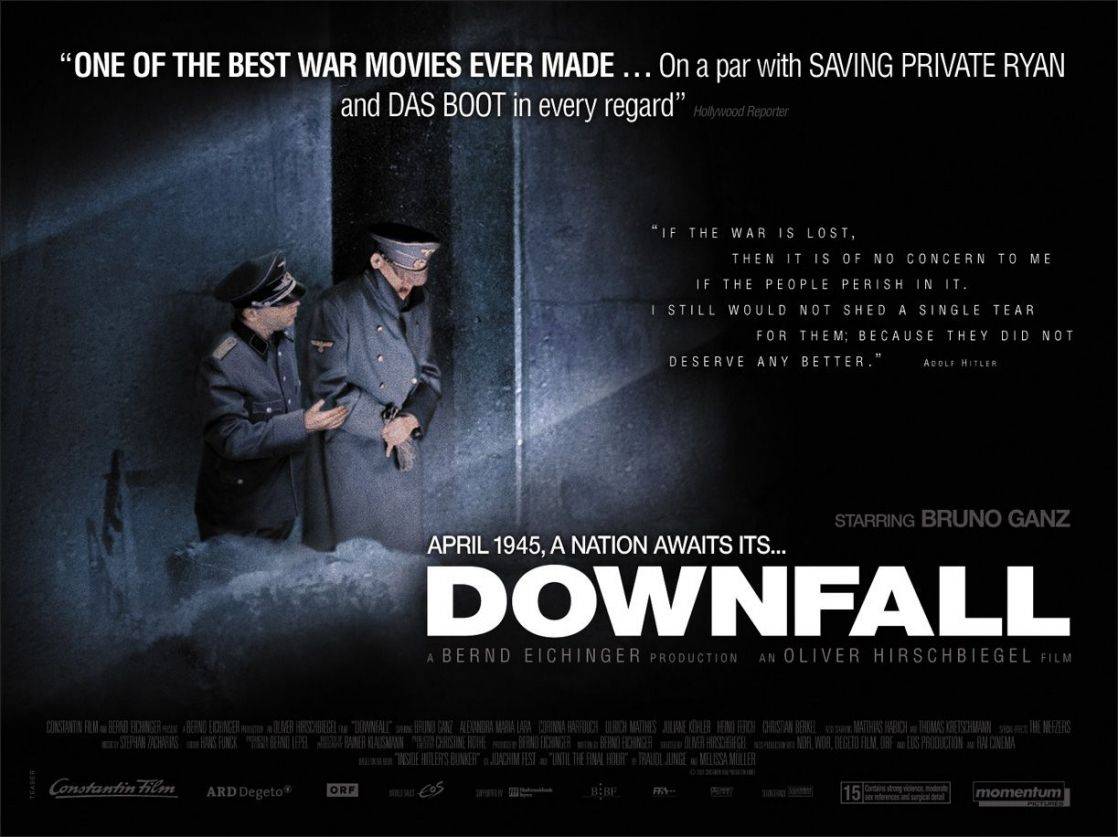
The movie depicts Nazi Germany in its final days and hours, which is fine. But I could not help but feel something bubbling beneath the surface. Angry resentment.
Downfall, as the name directly implies, is supposedly about the end of the war that destroyed Germany. But that is not quite it. Even the word “downfall” depicts not the end of something bad, but the end of something good, and the beginning of something bad. Downfall is about the beginning of Germany’s century of humiliation.
Most of the footage depicting Russians was cut from the theatrical release and that was probably for the best because it comes off as really bitter. In one deleted scene a German survivor watches Russian women rummage through Hitler’s bunker to loot the German frauleins’ underwear.
This moment conveys a pretty radical and heartfelt message. The humiliation of dirty subhuman Russians trampling around the Reich’s glorious capital was worse than anything in the war itself.
In time, Hitler could and would have been forgiven for everything. But what he could not ever be forgiven for was losing.
Watch Downfall on Amazon Prime
As an Amazon Associate I earn from qualifying purchases made through product links and web banners. Click here to navigate to the Amazon storefront.

Ian Kummer
I now have a new YouTube channel that I will use to upload videos from my travels around Russia. Expect new content there soon. Please give me a follow here.
Also feel free to connect with me on Quora (I sometimes share unique articles there).

Could you elaborate a bit? Most people know the film from the bunker memes, so I’m interested in a more serious discussion of it.
Could you elaborate a bit? Most people know the film from the bunker memes, so I'm interested in a more serious discussion of it.
Hmmm. From a German perspective, though, it is true that 1945 was the end of history, if you qualify it as being the fulfillment of a process that started in 1933 and “history” as being “the history of the Germans as an independent cultural entity.” Germany, or the German-speaking world, more or less ended as something with a self-determined cultural trajectory in the 1933-1945 period. This is when it ceased to be a (the?) world’s center of science and philosophy, arguably literature, and instead was destroyed and became, in the west for a time and then the whole thing, an extension of the American cultural sphere and a cultural backwater (sorry Germans, but I was born there, I have lots of relatives there, and that’s what it is).
This is a point that Dugin makes in Германский логос: человек апофатический, by the way, in which he more or less interprets WW2 from the German side as playing out the Ragnarok myth.
Hmmm. From a German perspective, though, it is true that 1945 was the end of history, if you qualify it as being the fulfillment of a process that started in 1933 and "history" as being "the history of the Germans as an independent cultural entity." Germany, or the German-speaking world, more or less ended as something with a self-determined cultural trajectory in the 1933-1945 period. This is when it ceased to be a (the?) world's center of science and philosophy, arguably literature, and instead was destroyed and became, in the west for a time and then the whole thing, an extension of the American cultural sphere and a cultural backwater (sorry Germans, but I was born there, I have lots of relatives there, and that's what it is). This is a point that Dugin makes in Германский логос: человек апофатический, by the way, in which he more or less interprets WW2 from the German side as playing out the Ragnarok myth.