
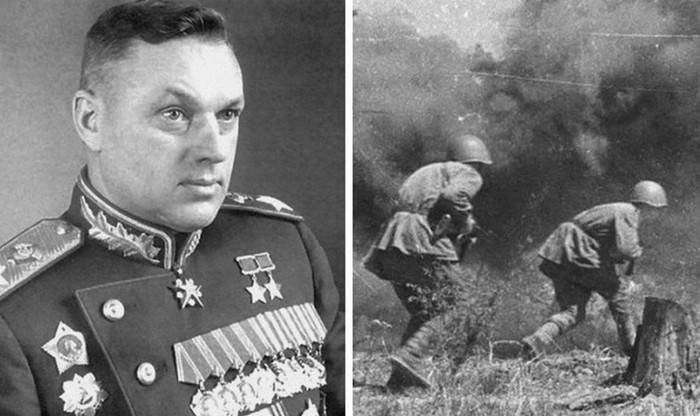
This is the second chapter in A Soldier’s Duty, the memoir of Marshal of the Soviet Union Konstantin Konstantinovich Rokossovsky (1896-1968), who commanded troops from the very beginning of the Great Patriotic War to the final days of the defeat of Nazi Germany.
Rokossovksy was an ethnic Pole who served in the Russian army in World War I, the Red Army in the Civil War, fell under the finger of suspicion and was imprisoned in 1937, released back to active duty in 1940, and was in command of a mechanized corps at the beginning of the Great Patriotic War.
A Soldier’s Duty describes the planning and implementation of huge military operations, the relationship between high command and the front, and interesting people Rokossovsky met along the way. You are now reading a translation based on the 5th edition of Soldatskii Dolg, published by Voinizdat in 1988. The 1988 edition includes text that had been considered too controversial and scandalous to print during Rokossovksy’s lifetime.
See the largest and most cataclysmic war in human history through the eyes of one of the allies’ greatest generals.
Chapters:
Tomorrow There Will Be War
The Battle Begins
On the Yartsevo Heights
An Unexpected Order
The Volokolamsk Direction (COMING SOON)
Nowhere To Retreat
Forward!
Sukhinichi
Memorable Lessons
The Bryansk Front
Battle for Stalingrad
Closing the Vise
Destruction of the Enemy
The Kursk Salient
Going for the Dnieper
For Belarussian Soil
Both Offensives Are the “Main” One
Destruction
Warsaw
In Germany
On Two Fronts
East Pomerania
From the Oder To the Elba
Happiness of a Soldier
Around 4 a.m., June 22, the duty officer came to me with a telegram from the 5th Army Headquarters: open a top secret envelope.
To receive authorization for such a thing could only have come from the Chairman of the Council of People’s Commissioners of the USSR or the People’s Commissioner of Defense. And the telegram was signed by the chief of the operations department. I ordered the duty officer to verify the authenticity of the dispatch with higher headquarters and then called my chief of staff, deputy political commander and the chiefs of the departments for a meeting to discuss how to move forward with this information.
The duty officer returned shortly and told me that communications had been disrupted. No answer from Moscow, Kiev or Lutsk.
Responsibility for opening the envelope fell on me.
The order inside instructed me to immediately prepare the corps for combat and advance in the directions of Rovno, Lutsk and Kovel. At 4 a.m. I ordered a combat alert and the division commanders Nikolai Novikov, Nikolai Kalinin and V. Chernayev reported to my command post.
While the troops were assembling, commanders received their timelines and marching orders. The Corps headquarters staff prepared an operation order.
All preparations proceeded quickly, but in a calm and planned manner. Every soldier fully understood his place and tasks.
The only difficulties were with material. We had very few trucks. Very little fuel. Almost no ammunition. There was no time to wait for instructions on where and how to get these things. Not far from us there were central warehouses with ammunition and a motor park. Objecting quartermasters had to be overcome with appropriate requests and vouchers. I had never written as many vouchers as I did on that day.
Maslov had been trying to establish contact with higher headquarters, and didn’t succeed until almost 10 a.m. He got ahold of a staff member in Lutsk for a few minutes, who said that the city was being bombed for a second time, communications were constantly disrupted, and the situation at the front was unknown.
Almost at the same time we received information that the Germans had bombed Kiev, and communications were disrupted again.
We could not make contact with the military district headquarters, who we were directly subordinate to. There were no orders from them all day.
Around 11 a.m. up to 20 German bombers flew overhead at a high altitude, and our air-defense artillery opened fire on them.
I was further convinced that we were doing the right thing and focused all of my attention on preparing the troops.
Fuel, ammunition, provisions, security details to remain behind after the corps departed, readiness inspections of units, meetings with my personal staff, all this needed to be done within a few hours. And at the same time I was already thinking about combat. With my many years of service I knew all too well what war is like, and was disturbed how first combat would greet our green soldiers.
With this detail, readers of the new generations may be able to understand the thoughts of a commander on the first day of such a sudden war. Before we departed, I forbade officers and sergeants from wearing rank insignia of a subued color. A commander must stand out in the military ranks. The soldiers must see him. And he must feel that his behavior and actions will reflect on him.
The corps departed at 2 p.m. in three directions toward Novgorod-Volynsky, Rovno and Lutsk. The 131st Mechanized Division moved in single column on the highway to our right. Their commander Nikolai Kalinin was a good military leader and former cavalryman. Kalinin was able to load all the infantry aboard trucks and tanks. And we were able to give him a few more trucks at the last minute.
At the center, one step back, advanced the 35th Tank Division under the commander of Maj. Gen. Nikolai Novikov, an experienced tanker. On the left advanced the 20th Tank Division, responsible for security and reconnaissance.
From the first moment and throughout our advance we did not see any of our aviation. Waves of German planes, mostly bombers, flew overhead at high altitude, and for some reason without fighter escort.
We soon found out why when we came across our own destroyed planes, that had imprudently been concentrated at airfields near the border.
At the start of the war, the 9th Mechanized Corps had almost all of its required personnel. We did not have all of our weapons and our people had not been fully trained. But even in this difficult condition it was possible to fight.
Unfortunately, our corps was mechanized in name only. I bitterly watched our old T-26s, BT-5s and BT-7s on the move, understanding that they could not endure prolonged combat. Infantry accompanying our tank divisions did not have trucks, and because they were designated as mechanized, they did not have horse draught either.
But despite these difficulties, we did everything to create a military fist with all our strength behind it to repel the enemy, and honorably fulfill our soldier’s duty. However, in hindsight, I can now say that the orders of the general staff did not have a variant accounting for the possibility of the corps being required to fight while still in the formation stage without mechanization. And this cannot be forgotten. The orders and objectives were written on the assumption that this was a mechanized formation with everything needed to perform as one.
From the very first day we were required to make certain changes, sujch is life. The main body of the corps, mostly on foot and deprived of horse draught, marched 50 kilometers on the first day. For me it is still an example of the endurance and selflessness of the Soviet soldier. But the people were left exhausted. I saw them at the end of the march. They had to carry their personal kit as well as machineguns and stands, 50mm and 82mm mortars and ammunition for them. And in the summer heat…
We shortened the marches to 30-35 kilometers. I met with Nokinov and Chernyaev that night to discuss lessons learned from our first day. We gave our so-called tank divisions a new order of movement. In the first echelon, tanks and infantry with an artillery unit. This echelon would advance in bounding movements, the tanks going from one position to the next, and wait for the infantry to catch up. The main body of soldiers and artillery would be in the second echelon, moving in standard infantry formations.
The mechanized division, with its trucks, moved 100 kilometers to the Rovno region and stopped to rest. At this time, there was reliable communication between the corps headquarters and all of its elements, so there was no cause for alarm in this situation.
On the morning of June 23, Kalinin reported that Commander Potapov had temporarily assigned his division a new mission; to advance to the Styr River and take up a defensive position on the eastern bank in the vicinity of Zhidichi, Lutsk and Mlynov and stop the Germans from advancing Eastward. This was done over my head.
From this report and other sources it was possible to draw a vague picture of the currention situation in the Lutsk direction. Regardless, it was clear that the eenmy had broken through the border and made deep advances into Soviet territory.
The main forces of the corps continued their movement without deviation, and with security on the flanks.
Because Kalinin was ahead, we decided to have the corps headquarters follow in the path of the 35th Tank Division. Maslov sent a sapper platoon ahead with some trucks, and we followed the units of General Novikov across the Goryn River South of Rovno.
The ferry could not transfer the division across the river in time, so the plan changed to use a bridge near Gosha. Our headquarters moved on and, I brought a battery of 85mm guns.
At the end of the day, five German tanks and three trucks with infantry emerged from a grove three kilomters East of Zdolbunova. The headquarters prepared for battle and the battery deployed their guns, ready for direct fire. The Germans saw this and declined to fight, retrograding back into the forest.
We set up the command post a little to the North.
Such a situation required information so we would know how much the troops could rest after the forced march.
The 19th and 22nd mechanized corps under the command of Generals Feklenko and Kondursev had to be ahead or to the side of us. Reconnaissance groups under the command of corps staff officers set off to search. The corps chief of staff went out with one of these groups on his motorcycle. As a result, we learned that Kondursev’s advanced units were already engaging the enemy north of Lutsk, and Feklenko’s corps was moving toward Dubno.
Maslov returned and said he had made contact with Gen. Maxim Purkaev, chief of staff of the front. He successfully found out that the corps was now under the command of the 5th Army, and needed to proceed to assembly areas near Klevan and Olyka.
Our units continued forward. On the highway toward Lutsk we met disorderly crowds of people moving East. German planes often appeared overhead to bomb soldiers and refugees alike.
The 9th Mechanized Corps reached the assembly areas on June 24 and went into battle.
Still positioned on the Styr South of Lutsk, where they had earlier repelled enemy advance units, the 131st division again repelled Germans trying to reach the Eastern embankment.
The 35th Tank Division fought elements of the German 13th German Tank Division to the south west of Klevan.
At dawn on June 24, the 20th Tank Division’s forward regiment attacked mechanized units of the 13th division in the Olyka region, inflicting heavy losses and taking many prisoners and trophies. Already Chernyaev had shown the qualities of a true commander. They entrenched and successfully repelled enemy tank units all day.
The corps headquarters set up camp in the Klevan region. The next day there were fierce defensive battles against enemy tanks and mechanized infantry from the German 13th and 14th divisions on the outskirts of Lutsk, Olyka and South of Klevan. Our units heroically endured this, and the attacks only subsided in the evening. The Germans did not attack at night back then. The sun set and the soldiers were able to rest.
On June 26 army commander Potapov ordered the corps to counterattack in the Dubno direction. To our left there was the 19th Corps, and to our right the 22nd Mechanized Corps. No one was assigned to unify the three corps’ actions. They were sent into battle separately and on the move, without taking into account the condition of the soldiers, who had already been fighting a strong enemy for 48 hours, and without considering how far they would have to march or the possibility of engaging the enemy along the way.
This was a difficult time with surprises everywhere. But let’s look at the order from the front headquarters, “Launch a powerful counterattack against the flank of the advancing enemy group, destroy it, and recover the lost positions.” Was this a realistic order in consideration of the situation in the area, not to mention the situation that had developed by June 26 in the Zhytomir, Vladimir-Volynsky and Rovno directions, where the Germans were carrying out their main offensive? No, it was not realistic. I had the feeling that the front headquarters was mindlessly relaying orders from the general staff, who did not know the details of what was happening on the ground. In this situation I think it would have been appropriate to take responsibility and adjust objectives from the general staff to be consistent with what was happening at that moment.
Our corps went into a difficult battle with the enemy, who threw everything at us. In addition to thanks and mechanized forces, they also sent infantry divisions.
Lines of communication with our neighbors were constantly disrupted. We came to find out that the 22nd Mechanized Corps was attacked by a large enemy force, suffered losses and retreated north-east of Lutsk. Gen. Kondrusev was killed right at the beginning of the battle, and his chief of staff Vladimir Tamruchi assumed command. Our neighbor to the left, the 19th Corps, was also attacked right at the beginning of the offensive and forced back toward Rovno, where they engaged in defensive battles.
That evening, a seriously upset tank division commander from the 22nd came to us. The tone of his report forced me to respond harshly, “Immediately stop ranting about the death of the corps! The 22nd is fighting! I just now spoke to Tamruchi. Go, find your units and join them…”
I and a group of staff officers went to a hilltop near the 20th Tank Division, where we saw a huge column of enemy trucks, tanks and artillery moving from Dubno toward Rovno. And from the South there were more columns of Hitlerites coming and coming.
All a corps commander with so few tanks could do was lean heavily on artillery, and so I did. I cannot deny myself the pleasure of remembering this one bright moment during such impossibly difficult battles.
I had received an order to couterattack. But our enemy was so much stronger than us, I took responsibility for the decision to not counterattack, and meet the enemy on the defensive. In these wooded, swampy areas the enemy only advanced on main roads. I ordered Novikov’s division to assume defensive positions along the Lutsk-to-Rovno highway, on the left flank of the 20th Tank Division with their artillery regiment equipped with new 85mm guns. The chief of staff organized everything, and Chernyaev carried out the maneuver with speed and energy.
The guns were entrenched along the highway, with an element on the road itself.
Germans approached in a large wedge formation with motorcycles ahead and tanks and armored vehicles following behind them.
We saw from the observation post how impressive the approaching enemy force was, and what became of them. Our gunners waited until the enemy were close and then opened fire. The highway became a monstrous traffic jam of wrecked motorcycles and vehicles and dead Hitlerites. But the intertia of the enemy advance continued, giving our guns more targets.
The enemy suffered heavy losses and retreated. Gen. Novikov took advantage of Chernyaev’s good fortune and advanced to occupy the nearby heights.
Nikolai Kalinin came to the corps headquarters with important testimony from a caputured German colonel, who had said during interrogation, “Your artillery is excellent, and the spirit of the Russian soldier is at its best…”
We had stalled the enemy for quite some time in that place. It was clear that our “insolence” would not go unpunished. And so it happened. A wave of junkers flew overhead and mercilessy bombed us but, fortunately, without any effect. The soldiers were concealed in the woods, tanks and guns placed in trenches.
As a corps commander, I was troubled by the lack of information from the front. The feeling of an elbow (when assembling in parade formation, soldiers raise their elbows to find correct spacing with their neighbors —IK) is important not just for a simple soldier, but even for the highest commanders. Without this, whether you like it or not, your mind will run wild making up scenarios.
We had to get all information ourselves. Staff members under Gen. Maslov quickly adopted to the seemingly unbearable situation and provided us with the essential information. But it came at a high cost; many staff officers were killed during their missions.
Interpreting individual reports was difficult. It was hard to know what was going on just in our direction, and what was happening to other units in the South-western Front was unknown. Gen. Potapov did not seem to be doing well. During the entire time I commanded the 9th Mechanized Corps, his staff was unable to help us with information. Besides that, communications were constantly disrupted.
Our strategic picture was disappointing. A strong German force broke through at the junction between the 5th and 6th Armies, allowing tanks and mechanized formations to break through. These troops exploited their success and rapidly advanced in the Zhitomir direction.
The enemy’s main effort appeared to the South of us. I write about the military events in the Lutsk region and am proud of the courage and brave deeds of my soldiers, but I must honestly say I don’t know how we would have looked had it been us under enemy’s main attack.
But it was not easy for us either. The commander of the 131st Mechanized Division reported that enemy infantry and tanks had pushed his regiments from their defensive positions along the Styr River, and were fording the river on a wide front. We had to conclude that the enemy was building up their forces in our direction for an even stronger tank attack.
Our divisions had thinned out. But soldiers and commanders turned from the “not shot at” to the “shot at,” and the significance of this cannot be overstated. From personal experience, they learned that, “Germans, like the Japanese, can be beaten.” I heard this expression from a tanker in the 35th Tank Division. I asked him, “What do the Japanese have to do with anything?” The tanker answered that he remembered the battle of Khakhin Gol. In short, our people got stronger.
In this period of difficult fighting we found an unusual source of reinforcements; in the forest near Klevan there was a large number of soldiers who had become lost from their units. We incorporated them into our infantry regiments, where many of these soldiers would go ont to distinguish themselves in battle.
The Germans were throwing even more forces at the 9th Mechanized Corps. Fierce fighting continued until June 29. The enemy did not succeed in cutting off the Rovno-Lutsk highway near Klevan, and did not break the defenses of the 5th Army soldiers. However, they did push back the right flank of the Army in the vicinity of Kovel and Lutsk, and forded the Styr River. These Germans did not rid themselves the threat of flanking attack from our troops against their mechanized corps as they raced toward Zhytomir. This threat greatly troubled the enemy command. So they continuously attacked us with greater and greater force to eliminate the threat.
On June 30 our soldiers encountered serious difficulties in the Zhitomir-Kiev directions, causing the 5th Army to retreat to the old defensive line (the Soviet line of fortifications established in 1928, then discontinued in 1940 with the liberation of western Belarus, Ukraine and Bessarabia, mentioned by the author in the previous chapter. Nazi generals who retired in western countries to write their war memoirs referred to the old and new lines as the Stalin Line and Molotov Line, respectively—IK). Much to our chagrin, the condition of the old defensive line had not improved. The corp’s units moved from one entrenched position to another to repel intruding enemy attacks, an example of “mobile defense.”
The Novograd-Volysnky fortified district, having beaten back the enemy, took up positions along the Sluch River, stradding the road to Zhitomir.
German tanks and mechanized formations were equipped with vehicles superior to our T-26 tanks and armored vehicles.
After forced marches and ten days of combat, we still had these old tanks (and as far as I know, the situation was not better for the 19th and 22nd Mechanized Corps). Despite these terrible material conditions and battle casualties, the corps continued to fight stubbornly.
Division commanders Col. Nikolai Kalinin, Gen. Nikolai Novikov and Col. Vasily Mikhailovich Chernyaev performed admirally in these first battles. They performed their duties in this difficult situation with honor. They demonstrated deep knowledge, creative initiative, and decisiveness, and took personal responsibility to make changes without orders as the rapidly-evolving situation required. It is easy for a corps commander to work with such excellent officers, though the word “easy” doesn’t seem appropriate for these days.
I remember while the corps was still fighting in the Klevan region, when the Germans were trying to cut off the highway, and we all managed to meet on short notice. It was the first time since the start of the war that the corps and division command teams were all togther. We embraced, kissed, lived, and went into battle. Sadly, this was the last time I met some of these glorious comrades-in-arms. Soon after in the last battle in Klevan region we lost the fine officer Col. Vasily Mikhailovich Chernyaev. He was seriously wounded. Despite evacuating him to a hospital in Kharkov, Chernyaev died of gangrene. His military friends remember him fondly.
Neither the Germans’ incredible superiority in tanks, or extensive and unhindered use of air power which bombed our fighting positions, especially in locations of enemy attacks, could break the corps’ resolve. The Hitlerites could not break us. They could only push us back, and suffered massive losses in doing so.
With the combined efforts of our infantry, artillery and inconsequential number of tanks we sought to inflict as many losses on the enemy as possible. And we succeeded in doing this during all the battles around Lutsk and Novograd-Volynsky. All the division commanders and many regimental and lower commanders and political staff received government awards. Our tireless chief of staff received an award and I received my fourth Order of the Red Banner.
Durin the fighting around Novograd-Volynsky, where the Germans were trying to push our corps to the north-east to clear themselves a path to Kiev, I received new orders. I had been appointed as an army commander on the Western Front, and was to immediately report to Moscow.
I transferred command of the corps to Gen. Maslov, and on July 14 took a car to Kiev. I arrived late in the evening, when the streets were normally full of crowds, to find it deserted, silent and bathed in darkness.
On the East bank of the Dnieper River, in Brovari, I found the front’s command post, arranged for transport to Moscow, and rested for the night.
In the morning I introduced myself to Col. Gen. Mikhail Petrovich Kirponos. He was visibly depressed, though he tried to maintain his outward composure. I considered it my duty to inform him about the situation in the 5th Army area of operations. He listened vacantly. I was interrupted several times by general giving orders by telephone. They were about “decisive counterattacks” with forces of one or two divisions, and he did not ask if these divisions could counterattack. I had the impression that the command did not want to face facts.
And the Germans were splitting Soviet forces at the center of the South-West Front, and rapidly advancnig toward Kiev. The 6th, 26th and 12th Armies were in danger of encirclement.
On July 15 I left Kiev, having already received information that things on the Western Front were also not going well; the German were advancing on Smolensk.
During my trip to Moscow I thought about the first weeks of the war over and over again. There were already great achievements of heroism among our soldiers. There were heroic defefensive efforts in Brest and Libava. Many of our units and formations fought bravely. But it was clear tha we had lost the fight for the border regions. Now the enemy could not be stopped by throwing individual units and formations at an already-shattered front. They could only be beaten by creating a strong combat group deep in our terriory, which could not only stop the advancing mechanized forces of the enemy, but deliver a crushing blow against them.
Our immediate objective now was to stop the enemy, and this was a matter of life or death for our country.
The battle for Smolensk was already raging, and the honor fell upon me to participate in its end.
What had been censored
On June 26 I took a group of staff officers to one of the heights overlooking our units in the 20th Tank Division. There was a massive column of enemy trucks, tanks and artillery approaching Rovno from Dubno. At the same time there were enemy tanks, artillery and mechanized infantry approaching our 20th and 35 Tank Divisions from the South. Then I received bad news from the commander of the 131st Mechanized Division. He reported enemy tanks and infantry had thrown back our units along the Styr River, and were now crossing on a wide front. Therefore we could expect a powerful attack in the direction of our corps.
It needs to be noted that at tis time, information sources about the situation of forces at the front was very bad. We had to get all information ourselves, and could only know about the situation in our direction; inormation about other sectors of the South-West Front was completely unkown. Apparently the 5th Army headquarters knew nothing either, because they did not tell us. Communications between our corps and 5th Army Headquarters were nonexistent, and communication with neighboring units frequently disrupted.
We came to find out that the 22nd Mechanized Corps was attacked by the enemy, suffered heavy losses and was thrown back to the north-east from Lutsk. Our neighbor to the right, the 19th Mechanized Corps, was also attacked and thrown back with heavy losses toward Rovno, where battles were continuing.
On the evening of June 25, a tank division commander from the 22nd Mechanized Corps came on foot to our corps command post inthe Klevan region. If memory serves me right, he was very upset and had a bandaged right hand. He said that his division was completely destroyed. He was able to get away, but while shooting his revolver, was overtaken by a German tank. He fell and his right hand was crushed under the tank tread.
Soon afterward, a regiment commissioner of the same corps arrived and reported the death of Gen. Kondrusev, and that his corps had been destroyed. The defeatist tone and distressed state of the division commander and the commissioner forced me to rather sternly advise them immediately stop ranting about the death of the corps, to search for their units ad join them.
The day before in the same area of Klevan, we found a large group of unfortunate soldiers, with more than a few officers among them. The majority of these people did not have weapons. To our shame, these troops, even the officers, had ripped off their ranks.
One individual in this group caught my attention; an old man sitting under a pine tree, who in my eyes did not appear to be a soldier in any way. A young nurse sat by his side. Turning to the men, there were no fewer than a hundred of them, I commanded the officers to come to me. Nobody moved. I raised my voice and ordered them a second time, then a third. Each time answered only by silence. Then I went to to the old “escapee of the encirclement” and told him to stand. Then, addressing him as commander, I asked for his rank. He muttered “colonel” with such indifference and brazen insubordination. His appearance and tone made me literally explode. I pulled out my pistol and was ready to shoot him on the spot. The colonel’s apathy and bravado disappeared instantly. Understanding that he was about to die, he fell to his knees and pleaded for mercy, swearing that he would atone for his disgrace with blood. Of course this scene was not pleasant, but that’s how it went.
I ordered the colonel to gather all of his troops and report to me personally in the morning. The order was carried out, and he brought more than 500 men. They were all used as reinforcements to replace those who had been killed in the mechanized units of the corps.
During the fightinhg around Novograd-Volynsky and to the south-east, headquarters appointed me as an army commander in the Western Front and I was to immediately report to Moscow.
On July 14 I took a car to Kiev.
I arrived in the city at night; the streets were devoid of people and an evil darkness reigned.
Kreshatik district, which would typically at this time would be full of Kievanites and humming with loud conversations, noise, laughter and shining lights, was deserted. There was not a single living soul on the streets. I stopped the car so I could learn where I might find the headquarters and lit a cigarette. And immediately a voice shouted from the darkness, “Put out the flame! What, are you tired of being alive?” There were other stronger words also said. I must confess to being very surprised. His voice was hysterical. This was not reasonable caution, but the reign of panic. I complied and quickly snuffed out the cigarette.
The command post was in Brovari, on the East bank of the Dnieper. I spent the night at the Front headquarters, and in the morning reported to Col. Gen. Mikhail Petrovich Kirponos. I was very surprised how upset he looked. Seeing my reaction, he tried to appear calm, but didn’t succeed. He absently listened to my report about the situation of the 5th Army and my corps. Then he suddenly ran to the window and shouted, “What are the air defenses doing? Planes fly by, and the guns hit nothing, it’s an outrage!” Gen. Kirponos then ordered the air defenses commander to do more. Yes, it was a dismaying situation, but at this time, but the air defenses on other fronts were not doing better.
As I reported, he decided to resolve more important questions Several times he gave orders by telephone for decisive counterattacks. But it all sounded uncertain, fussy and vague. He ordered one or two divisions to carry out counterattacks, and was not interested in hearing if this could be done, and he did not give concrete objectives. It appeared that he did not know the situation, or did not want to know.
In these moments I reached the conclusion that this man could not carry the weight of such large and difficult responsibilities on his shoulders, and this was unfortunate for the soldiers under his command. With this mood I left the South-Western Front headquarters and headed to Moscow. I had already learned that the situation at the Western Front was also very difficult; the Germans were advancing on Smolensk. I had known the commander of the Western Front, Gen. Dmitry Pavlov, a long time before the start of the war. In 1930 he was the commander of a regiment in the division I commanded. So I already knew that Pavlov would be the equal of Kirponos, if not even weaker.
During the trip to Moscow I could not help but think about how we had suffered such a serious defeat right at the start of the war.
Of course it was to be expected that the enemy would size up our units on the border and concentrate their main force to push us back some distance. But the General Staff, deep in the rear, would have to successfully deploy our main force. They had time to organize a counterattack against the enemy. Why did this not happen?
I had listened to and read many military works published after the October Revolution, which sharply criticized Russian leadership, including the General Staff, accusing them of being stupid and pediocre petty tyrants. But, remembering the start of WWI and studying the plan of the Russian General Staff from its conception, I was convinced of the opposite.
That plan took into account all real-life variables that could affect the readiness timelines, concentration and deployment of the main forces. It compared the ability of Russia and Germany to quickly mobilize and concentrate their main forces at the border, and the defensive lines and distances from the border were planned accordingly. This also determined the size and disposition of the border troops who would cover the main force as it deployed. The defensive fortifications matched the deployment line. That was the plan as I understood it.
What kind of plan did our General Staff present to the the government? Was there even a plan at all?
I really wanted to know where the designated deployment line was. Earlier, it had been on the old defensive line, located an appropriate distance from the border. This had been tested in the real world. Was that line still applicable in 1941? Yes, it could, because Fascist Germany became our neighor. They had already aggressively started wars, and had already fully mobilized their armed forces.
Additionally, new weapons, equipment and methods that were not available to armies of the past needed to be taken into account. Because this determined the nature of modern warfare. For example, the speed and, consequently, the mobility of troops in a military theater had greatly increased.
Before mobilization, we needed to preserve and strengthen our defensive line, and not destroy the fortifications on the old border. I do not agree with the construction of new fortifications right before the eyes of the Germans. Besides the fact that this was a gross violation of doctrine, the strategic situation in Spring 1941 proved that we did not have time to construct new fortifications. It was the duty of the General Staff to report evidence to the government and defend their conclusions.
I remember the district field inspection in June 1941, on the eve of war, and the conversations with many of my comrades who had sensibly evaluated the situation. We were in agreement that the Germans had freed up their hands in the West, and were prepared to use their advantage for an attack against the Soviet Union. Didn’t the district and General Staff leadership sense this too?
Let’s say for argument’s sake that the General Staff did not manage to draw up a real plan for an attack by Fascist Germany. Then how can the criminal carelessness of the district be explained? From my observations during my service in the Kiev Special Military District, and the first days of the war, I concluded that the local command had done nothing within their rights and abilities to adequately engage the enemy.
It was my honor to spend the entirety of my service in the Red Army in the border districts; in the Far East, TransBaikal, the Belarussian Military District, the Leningrad Military District. These assignments allowed me to deeply study the tasks of border troops, the needed requirements to establish and maintain combat readiness, and to activate within a a few hours. These requirements determined the deployment of troops in peacetime. Additionally, during periods of high alert were withdrawn to locations determined in advance. All of these questions were answered in war games and field inspections by the district and General Staff leadership. They also instructed how to prepare the corps and division commanders and staff… but not in the Kiev Special Military District. That’s why troops in this district in the first days of teh war werer not prepared to engage the enemy. The disposition of forces at the border did not correspond to the threat of attack. Many of the districts formations did not have ammunition, and artillery had been sent to training ranges on the border.
What happened on June 22 was not planned for, so our troops were taken by surprise in every meaning of the word. Loss of communication with the district headquarters and subordinate units made an already difficult situation worse.
Things would have gone completely differently if the district command had taken appropriate measures within their ability, and taken the initiative and personal responsibility to take appropriate measures as the situation at the border unfolded. But this did not happen. Instead, everyone waited for orders for above.
I can judge this from the contents of the operational orders in the envelope I opened on the first day of the war. These orders assumed that the mechanized corps had completed its formation phase. The General Staff and district command should have had an alternative plan for a corps in the formation phase and appropriate tasks for it. Not just the 9th Mechanized Corps was in this condition, but also the 19th and 22nd. The 4th and 8th (the district had five corps in total) were already formed and prepared to go into battle. They also had the T-34 and KV tanks.
Preserving the three mentioned corps would have played a decisive role in the following counterattack with forces from deeper in the country. These unequipped tank units made poor infantry formations because they did not have the required gear, and their tasks were based on the equipment and capabilities of a mechanized formation.
What were they thinking, those who created those directives and put them behind seven locks? They were not realistic, but orders for the “decisive actions” were given anyway. No one was bothered by sending entire mechanized corps to be exterminated. Many excellent tankers were killed while selflessly serving as infantry in unequal battles.
Even when the disposition and intent of the Germans was known, the district command refused to take personal responsibility and make drastic changes to the plan and pull their forces to the old fortifications, which would have saved them from being annhilated.
The role of the district command was reduced to blindly repeating orders from the General Staff which had no resemblance to the real and rapidly changing situation on the ground. The district command was consistently nervous and refused to take accountability. The main thing is that they threw unprepared units and formations as “bandaids” into gaps created by powerful enemy attacks. The district could have organized units for a counterattack deeper in our territory and had the units to do this. But instead they threw those units into battle piecemeal to be exterminated in detail.
I already mentioned when the commander of the front Gen. Kirponos in my presence ordered groups of one or two divisions to counterattack much stronger enemy forces. What became of them? There is only one possible answer; they were thrown completely into the hands of the enemy and annhilated.
On the road to Moscow remembering everything I had seen in the first weeks of the war, I could not understand what was going on. Because the elementary rules of tactics, operational arts and not even getting into the strategic level, called for troops who have lost a battle to leave a rearguard and break contact to avoid being completely destroyed. Then as reinforcements from deeper in friendly territory arrive, organize a new defense to defeat the enemy.
Chapters:
Tomorrow There Will Be War
The Battle Begins
On the Yartsevo Heights
An Unexpected Order
The Volokolamsk Direction (COMING SOON)
Nowhere To Retreat
Forward!
Sukhinichi
Memorable Lessons
The Bryansk Front
Battle for Stalingrad
Closing the Vise
Destruction of the Enemy
The Kursk Salient
Going for the Dnieper
For Belarussian Soil
Both Offensives Are the “Main” One
Destruction
Warsaw
In Germany
On Two Fronts
East Pomerania
From the Oder To the Elba
Happiness of a Soldier
Ian Kummer
I now have a new YouTube channel that I will use to upload videos from my travels around Russia. Expect new content there soon. Please give me a follow here.
Also feel free to connect with me on Quora (I sometimes share unique articles there).