
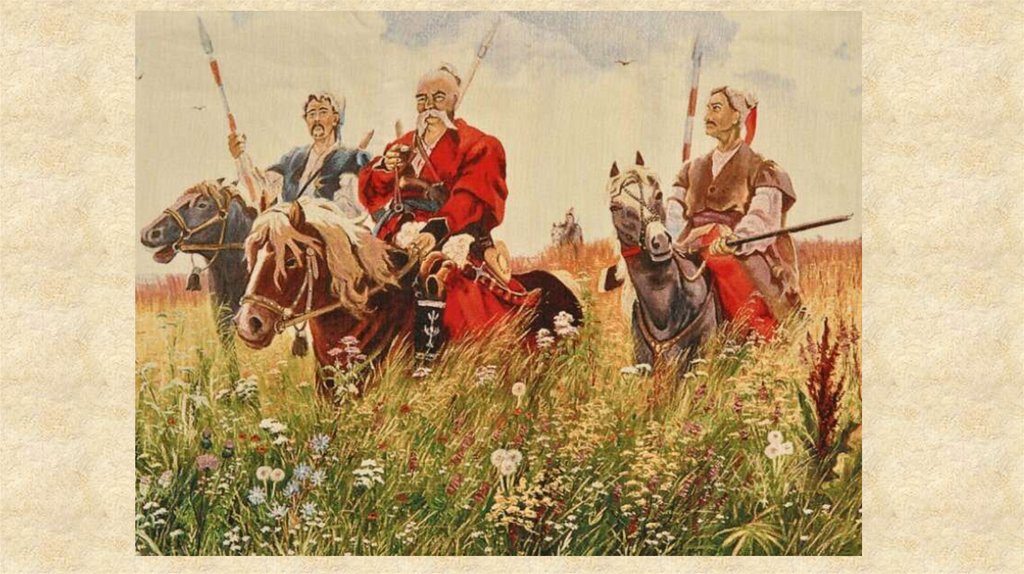
Nikolai Gogol’s novella Taras Bulba has a lot to teach us, but defies categorization.
Taras Bulba describes an intentionally anachronistic war between Poles and Zaporozhian cossacks set some time in the early 1600s. I read the book in Russian, and unfortunately it was a little beyond my current comprehension level, but I mostly managed. Speaking of language, Taras Bulba is one book that probably gets lost in translation; though Gogol wrote in Russian he used many Ukrainianisms. Cossacks are козаки rather казаки, Taras Bulba’s younger son’s name is written as Андрий (Andriy) rather than the usual Андрей (Aundrey), for a couple of examples. In general, the characters speak with a provincial informality and bluntness which contrasts sharply with Gogol’s flowery, whimsical descriptions of Novorossia and the Ukraine. Remember that before Pushkin and Gogol’s generation, Russian was not respected as a literary language, even by the Russian aristocracy themselves, who preferred French. Think of a Shakespearean history epic, but the main character is the militiaman from Much Ado About Nothing, with anger management issues.
Perhaps what makes Taras Bulba such an impressionary tale, and yet confounding to most modern literary critics is its unapologetic depiction of pre-modern characters and their savagary with attempting to interject, explain or apologize for them. The reader is put behind the eyes of the 17th century cossack and remains there to the end with no fourth wall breaking. While researching this article I found some online commentators unhappy by all the blatant xenophobia, antisemitism and religious hatred, and I can understand why. A 21st century reader consumes media with the expectation of being told what’s good and bad, and when those disclaimers are absent he assumes this to be endorsement by the author. Taras Bulba explains at length all the people he hates because they’re ruining Ukraine with their presence; Tatars, Poles, Jews, Catholics, Muslims… so pretty much everyone else. Even without the author saying so, it is clear why the “wild fields” of the Ukraine were (and sadly, still are) so violent; they were filled with groups of people who bitterly hated each other and had no geographic separation.
Even the opening chapters I could not describe Taras as a hero, and there isn’t any attempt on the author’s part to portray him as one. He’s a foolish and militantly ignorant person almost from the opening lines. His sons Ostap and Andriy return from their university education in Kiev, which Taras considered a waste of time and excitedly tells them they can now go to war. Their mother would prefer the sons to not to go to war, but Taras tells them not to listen to that stupid woman, and that a cossack doesn’t need to hide under a woman’s skirt like chicken eggs. This exchange leaves her sad because she almost never gets to see her husband, and now will not get to see her sons either. At the end of the book they’re all dead, so this was the last time she got to see any of them alive.
She is the first of several women throughout the book, and I noticed that none of them are named. This caused several western feminists to leave the book negative reviews online for being sexist (which I am sure Gogol was upset about), but I think this was an artistic choice to make women more mystical, which each of them portraying a different archetype as seen through the eyes of men.
The mother is loving and nurturing, and described as tired, pale and aged beyond what she should be. She has only gotten to see Taras a few days out of the year if that, and her youthful beauty faded away while he was off with his friends playing with their swords. So she clung to her children, and then they were taken from her too.
Later we get a detailed description of the Polish princess Andriy had been secretly meeting in Kiev and is trapped in the town under siege by the cossacks. She is as beautiful, elegant and intriguing as one would expect a Polish princess to be. Her mere presence inspires Andriy to profess his love and change allegiance. So there is the mother who gives the son love and nurturing. And then there is the lover who excites love and passion in the son.
Her Tatar servant is a bit more difficult to classify, though equals the others in importance. Andriy knew her in Kiev, and she is the first person from the besieged town he meets face to face and interacts with on a human level.
So Taras Bulba fails the Bechdel Test miserably, but it would be completely incorrect to say women aren’t important to the story. Obviously, trying to force plots to fit a certain formula or pass certain tests can actually cause a story to be worse if applied too rigidly.
Other women are mentioned in passing. One incident that stands out to me is in the opening assault against Dubno, when Polish women go to the walls and hurl stones down on the heads of the attacking cossacks. This is the specific, emphasized detail Gogol chose in his description of the town’s unyielding resistance that forced the cossacks to give up their idea of quick victory and switch to a prolonged siege. It is also one of those moments that makes me question our perception of pop history. There’s the familiar trope of men manning the ramparts while women and children seek shelter, like in Tolkien’s battle of Helm’s Deep in Lord of the Rings, but how true is it, actually? Defending the walls is definitely dangerous, but if the walls are taken there isn’t any point in trying to hide. I might daresay that the longing for “traditional values” is a search for something that didn’t properly exist to begin with. In any case, Polish women cracking open cossack skulls with rocks was very rude, and I emphasize with the indignity of the situation.
There was also a surprising moment when I had to question the value of democracy. Taras and many of the other cossacks want to go to war against the Poles, but their elected hetman doesn’t want to, and makes lame excuses, like that there’s a peace treaty. So they hold a special election to pick a different hetman who does want to fight. Of course the war is a total disaster that ends with the cossacks totally defeated and scattered. The sequence of events reminds me of Athens’ disastrous attack on Syracuse in the Peloponnesian Wars, and I wonder if that was an inspiration for Gogol when writing this.
Not allowing a leader to make unpopular decisions defeats the purpose of having a leader in the first place, so democracy is inherently and inevitably self defeating. A democratically elected leader can only do unpopular things by using coercion to stay in power. Or in other words, democracy only works when it’s not democratic. So when western media outlets declare that the only way to save democracy is to be less democratic, they’re not kidding and this is the contradictory nature of all democracies. Every democracy throughout all of history is either defeated, or survives by becoming completely authoritarian and just pretends to be democratic.
So anti-Russian propaganda about Russia being historically not democratic and preferring centralized government is actually correct. But the reason is that the Russians already tried democracy, and it is literally the worst political system. Even in monarchies it is sometimes possible to get a leader who’s not bad for the country and everyone is stuck with him until he dies. But a good democratic hetman gets voted out and replaced by a bad one. This scenario is particularly prone to happen when everyone is mad and wants to fight. But democracy(tm) enthusiasts will look you in the eye and say democracies are more peaceful than “autocrats” and don’t start wars.
Remember that one time the USA elected a hetman who was so popular in stayed in power for four whole elections and died in office? Congress instituted constitutional term limits so that mistake could not be repeated. The fact that the US has never since then had a hetman that people would even want in power for four terms is a testament to how well the system works.
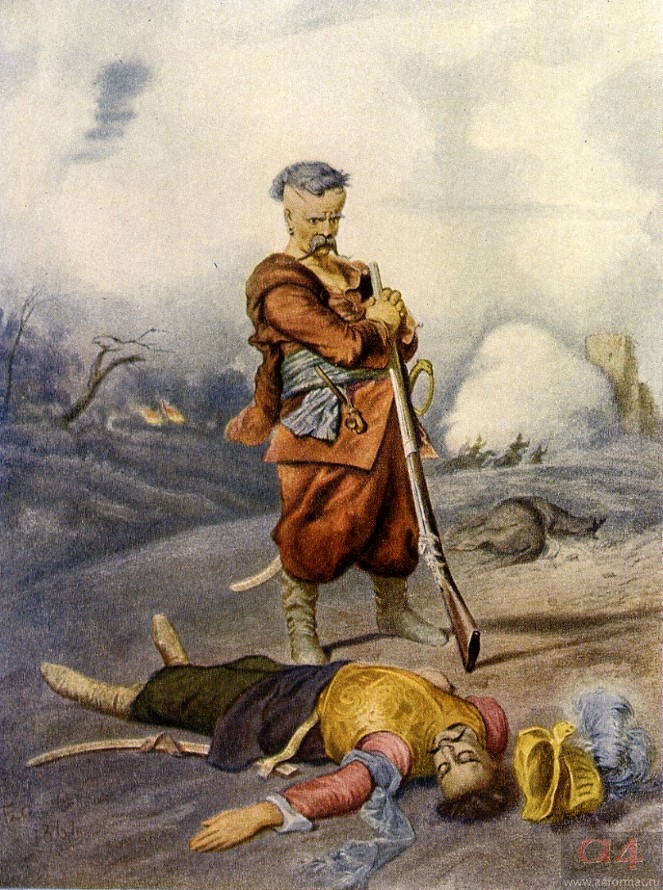
Anyway, reading this story also compelled me to contemplate the ideas of nationalism and betrayal. The scene when Taras confronts and kills his treasonous son Andriy is the most iconic and widely-quoted moment in the book, but I think it’s often misunderstood, or at least not properly thought through. Andriy is not the typical Benedict Arnold Hollywood traitor. Hollywood traitors are almost invariably motivated by greed, cowardice, insufficient loyalty to the cause, or some mix of these things. But Andriy’s journey is quite deliberately and thoughtfully depicted as human. It started with the brief flirtation with his Polish muse before her father returned to the house. But that thought only cemented during the siege, which was Andriy’s first taste of the real world away from home and university. He brings bread to the Tatar servant, who tells him of the suffering of the people, then he follows her in and sees the dead and dying for himself. As they pass through a monastery he witnesses the Catholic religious rites, which humanizes the Poles as an admirable and aesthetically pleasing culture, rather than vermin who need to be exterminated like his father claimed. Then he meets the princess herself, it all comes together and he professes his devotion to her.
Can it actually be said that Andriy did anything wrong here? The problem with accusing Andriy of betraying the cause is that there really wasn’t any cause for him to betray. There’s his father’s murderous hatred of Poles, but that’s not really a cause in of itself. It would be one thing if the Poles were some existential threat to something worth defending, but there isn’t. Taras shows little interest or love for his own family. At least, love of family doesn’t stop him from killing his own son, who doesn’t raise a hand against him in the confrontation, by the way. And he certainly doesn’t care about the great Ukrainian democratic(tm) political system. He only tolerates the getman when he does what Taras wants, after all. All he has is his nationalism, and it’s not even proper nationalism, it’s the most tribalistic and primitive nationalism possible, comparable to cavemen. He sneers at Andriy “Well, sonny, did your Poles help you?” Well excuse me, Pan Bulba, but did your cossacks, Zaporizhians or Russians or whatever you want to call them help him either?
Andriy’s older brother Ostap doesn’t serve as a particularly great alternative to his treachery either. Ostap is captured and tortured to death in the town square. Not heroic, not a noble sacrifice that clears the path to victory or anything like that, he just dies miserably and that’s it. The irony here, which I only thought of just now, is that by killing Andriy, Taras may have unknowingly killed Ostap as well. The Polish hetman might not have executed his son in law’s brother, but the main thing was that Andriy would have to be alive to argue otherwise. Why should the Poles value the lives of Taras’s sons more than Taras himself?
Then there is the question of antisemitism. The cossacks are in fairness depicted as very antisemitic, but let’s think about why and how. Taras saves the wealthy Jew, Yankel, from a pogrom and tells him “I need you to give expository dialogue for the rest of the story.” And so begins a pragmatic, brutally transactional relationship. But if you think about it, this is more of a reflection of Taras than Yankel. Notice it is Taras, not Yankel who always brings up money. If Gogol wanted to be antisemitic, he could have shown Yankel always pestering Taras for money, or comically bringing up payment in the middle of dire situations. But no, Taras treats the relationship as transactional because that’s how he treats every relationship. His wife says something he doesn’t agree with so he makes fun of her, the getman makes a decision he doesn’t like so he ousts him, and his son marries a Polish girl so he kills him. As for the idea that Jews are treacherous, are they really? I suppose Cossacks see Jews trading with both sides and suspect them of treachery, but it’s simpler than that. They suspect Jews of treachery because the Cossacks themselves are treacherous. In this cruel 17th century world they’re not less treacherous than Poles and Tatars, but I wouldn’t exactly say they have the moral high ground either. Anyway, Yankel does put his life in serious peril by helping Taras witness Ostap’s execution, a risk beyond any amount of money unless he felt genuine moral obligation due to his life debt.
Andriy and the Polish princess have a relationship that could be argued to have similar transactional qualities, and yet it isn’t because they are capable of genuine feeling for each other while Taras isn’t.
As for if Taras Bulba is propaganda, well, yes and no. There is an exciting adventure and conflict between characters without preaching about who’s right and wrong. I don’t think Poles or the other mentioned groups are portrayed as worse than the cossacks, which is generally a requirement in the modern conception of propaganda. For example, think of a movie about the wars in Vietnam or Iraq, and how they’re framed as “killing your people made our soldiers feel sad, but they forced us too and they probably deserved it anyway.” There’s definitely nothing like that going on here.
There is the unfortunate theme of filicide, the killing of ones’ own sons, that is shared by Taras Bulba and the Schevchenko’s Ukrainian nationalist poem Haidamaky. At the end of that story, the cossacks celebrate successfully murdering all the Poles but, in classic Ukrainian fashion, realize this is not going far enough. So they also murder their own children who had been raised Catholic. As Taras said, “I gave you life, and I will take it.”
Unfortunately, in his 1842 edition (which is the version I read) Gogol decided to add some patriotic stuff, particularly the final scene to make Taras’s last monologue predicting a future unbeatable Russian tsar. I found these parts the least convincing, a bit like a black bloods member in Los Angeles breaking into an I have a dream speech, or a 19th century Irish Catholic gangster in New York about “how we have to preserve the white race.” It’s not that such bigger concepts are impossible or believed by nobody, it’s just not plausible for that particular person to believe them. I’m not sure why Gogol decided to mess with a finished book that was already book, maybe he felt it would sell better, or it genuinely reflected his own changing ideas. But what made Taras Bulba good for me is how successfully it takes the reader to a different world and value system without being cluttered by obvious self-inserts by the author. I don’t think the updates even made the book a better case for Russian nationalism. Being a Saint Petersburg panslavicist dreaming of Russian brotherhood didn’t really even seem in character for someone who was otherwise a savage and petty tyrant who spent almost every waking moment thinking up ways to kill the people in the villages down the road from him. Taras Bulba as he was, a cruel barbarian from a past century, made the best self-demonstrating argument for uniting Russian lands. Even the most dimwitted reader can understand that small countries gradually merge into bigger countries, and this is usually a good, natural process. The wild fields of Ukraine don’t to be many constantly warring factions.
Ian Kummer
I now have a new YouTube channel that I will use to upload videos from my travels around Russia. Expect new content there soon. Please give me a follow here.
Also feel free to connect with me on Quora (I sometimes share unique articles there).