
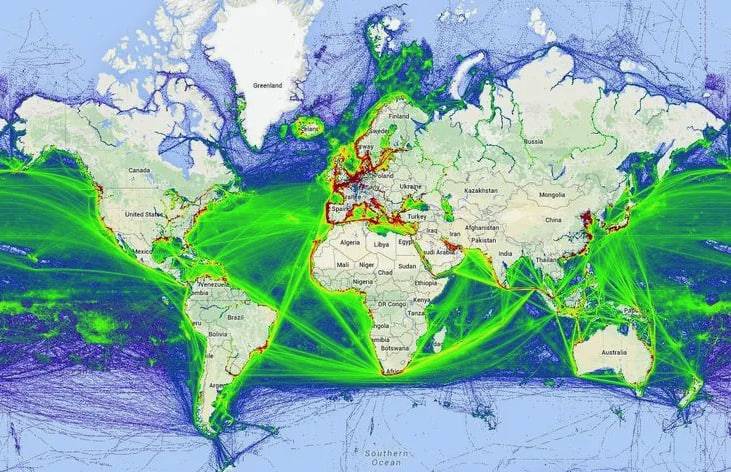
Trump’s aggression against Russian-flagged ships have started a firestorm of speculation of nuclear war. I think these ideas are hyperbole and missing the main point. The consequences of this escalation will be less severe than nukes, and economic in nature. But they will be felt by everyone.
Pretty much every human being in the developed world (which now includes practically every country not in absolute isolation) is a child of consumerism, and that’s all we’ve known our whole lives. But now it may very well come to a sudden and painful end.
The industrial revolution was accelerated by colonialism; a printing press built in 19th Century England could wind up in the far corners of the empire, like India, Australia or Canada. Trade, whether or not it is enforced through the barrel of a gun, is a force multiplier for progress. Both manufacturing and trade exploded in the 20th Century.
Soviet peoples in Eastern Europe and Central Asia achieved a level of prosperity their ancestors couldn’t have even dreamed of. A person in Armenia could buy a Latvian radio, a Russian camera, and maybe even a German car. The failings of Soviet prosperity are usually, and somewhat fairly, laid at the feet of the inadequacies of a planned economy. But the equal or even bigger glass ceiling was lack of access to global markets. More than half of the world’s GDP lay on the other side of the Iron Curtain under Washington’s control, premium markets out of Soviet and communist bloc consumers’ grasp. It is not a matter of efficiency, free market economics, or even “autocracy,” it is simply access. A man with a hundred dollars is richer than the man with a thousand Soviet rubles if dollars can buy things from anywhere in the world and rubles cannot.
Then the American dream, as it is portrayed in Norman Rockwell-style propaganda, actually somewhat came true in the 1970s and 80s, with every “middle class” family awash in cars, boats, color TVs, and plaster four-bedroom houses with detached garages and air conditioning. It was desire to attain the American dream that probably deflated loyalty to the communists’ planned economy more than anything else. I find this ironic because, as I said already, access to markets is vastly more influential to a people’s “prosperity” than what style of economy they have, and access to markets is the carrot/stick used to beat planned economies into privatizing. While I was never in the Soviet Union, or old enough to really even have an opinion on it, my interactions with Russian companies over the past five years have not left me with a feeling that they are more efficient or less lazy than Soviet shopkeepers. But anyway.
Chinese, Korean and Japanese products have all flooded into global markets to satisfy every niche of consumer demands, no matter how big or small, mainstream or obscure. Though this latest wave of industrialization came with the effect of retarding or in many cases even reversing the industrialization of countries in the “premium” marketplaces. After all, why make socks, dental floss Trump hats in the USA if they can be bought from China for 1/2 the price?
All of these things came to be because of globalism, and globalism is only possible with world peace. Not to say there are no wars or genocides, far from it, but there are no German battleships sinking British shipping, or American and Japanese submarines waging total war on each other. Most importantly, the oceans are free and anyone can travel wherever he wants unmolested by other navies. You have cheap goods in your closet and cheap exotic food on your table for the exact reason that it is cheap and safe to ship a box of mandarin oranges from Latin America to a packing plant in the Philippines, and then shipped to a grocery store in Paris or New York.
But that era seems to be coming to an end. As I wrote in today’s news media summary on Substack, Russia and China are unhappy about American piracy, but they might not respond in a meaningful way. It might simply not be worth tarnishing their national reputations to wrestle with Trump in the mud. But what about the hundreds of state and non-state entities who are ostracized by the American-led order and don’t just have much to lose in terms of prestige or credibility? It was possible to be a privateer even in the 17th Century, but the bar to meaningfully harm international trade is lower than ever. Anyone who can spend a few thousand dollars on a naval drone can do it. In the past, a group of Russian anarchists or French communists could cause mayhem for their own respective governments but they could not devastate the world economy. Now they can, and it’s not even very expensive.
I’m not saying it is necessary to interdict every ship, or even many of them. What if one in a hundred freighters was sunk? What if it was one in ten? How would insurance companies react if there was a one in ten chance of a total loss, a billion dollars of iPhones, Charlie Kirk t-shirts and dildos sent to the bottom of the ocean? Of course this would not make shipping from China to the USA impossible, just more expensive. Maybe not even much more expensive. But it would likely increase prices enough that there is no longer a cost-saving benefit to making sneakers in China rather than Nevada.
This is not the first time I’ve had this thought and I have tried to explain it to some of my American friends, but they don’t seem to get it. The difference between having freedom of navigation in the world’s oceans and not having it would be as extreme as the difference between living in Manhattan and southern Italy. It’s the difference between a comfortable consumerist lifestyle and just getting by. You have food on the table and internet access, but those luxury electronics and household items that used to be easy to fill your house with are now cost-prohibitive. I cannot overemphasize how huge of a change this would be.
Ian Kummer
I now have a new YouTube channel that I will use to upload videos from my travels around Russia. Expect new content there soon. Please give me a follow here.
Also feel free to connect with me on Quora (I sometimes share unique articles there).